
伴有代谢综合征的慢性难治性精神分裂症患者细胞因子水平、精神病理学与认知之间的关联
Association of cytokines levels, psychopathology and cognition among CR-TRS patients with metabolic syndrome.
作者信息
Dong Yeqing, Zhu Minghuan, Li Yanzhe, Liu Nannan, Wang Xinxu, Yang Bing, Li Shen, Li Zezhi
机构信息
Institute of Mental Health, Tianjin Anding Hospital, Mental Health Center of Tianjin Medical University, Tianjin, 300222, China.
Psychoneuromodulation Center, Tianjin Anding Hospital, Mental Health Center of Tianjin Medical University, Tianjin, 300222, China.
出版信息
Schizophrenia (Heidelb). 2024 Apr 16;10(1):47. doi: 10.1038/s41537-024-00469-x.
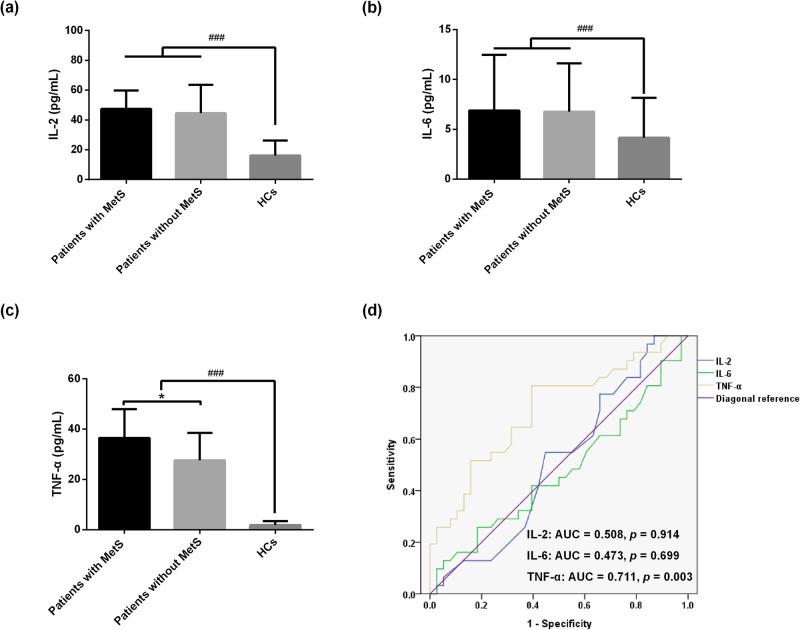
Clozapine-resistant treatment-refractory schizophrenia (CR-TRS) patients face significant clinical challenges. While links between metabolic syndrome (MetS) and inflammatory cytokines in schizophrenia have been established, the relationship between MetS and cytokine levels in CR-TRS patients remains unexplored. This study aimed to investigate the relationship between cytokines levels, clinical symptoms and cognitive impairments in CR-TRS patients, both with and without MetS. The study included 69 CR-TRS patients (31with MetS and 38 without MetS) and 84 healthy controls. The levels of IL-2, IL-6, TNF-α and routine biochemical parameters were measured. Psychopathological symptoms and cognitive function were assessed using the Positive and Negative Syndrome Scale (PANSS) and the Repeatable Battery for the Assessment of Neuropsychological Status (RBANS), respectively. We found that CR-TRS patients with MetS displayed lower cognitive function scores compared to those without MetS, even when accounting for potential confounders. TNF-α levels were significantly higher in CRTRS patients with MetS compared to those without MetS, demonstrating substantial pathophysiological potential for CR-TRS patients with MetS via receiver operating characteristic curve (ROC). In CR-TRS patients without MetS, IL-2 independently contributed to the total score and general psychopathology subscore of PANSS. Additionally, IL-6 exhibited an independent contribution to the positive subscore of PANSS. In terms of cognition function, IL-6 independently contributed to the delayed memory of RBANS in CR-TRS patients without MetS. TNF-α could potentially serve as a predictive marker for distinguishing between CR-TRS patients with/without MetS, while IL-2 and IL-6 could independently contribute to psychopathological symptoms or cognitive function in CRTRS patients without MetS. Our study provided insights into the potential interplay between cytokines, clinical symptoms and cognitive impairments in CR-TRS patients with/without MetS.
氯氮平抵抗的难治性精神分裂症(CR-TRS)患者面临重大临床挑战。虽然精神分裂症中代谢综合征(MetS)与炎性细胞因子之间的联系已被确立,但CR-TRS患者中MetS与细胞因子水平之间的关系仍未得到探索。本研究旨在调查有或无MetS的CR-TRS患者的细胞因子水平、临床症状和认知障碍之间的关系。该研究纳入了69例CR-TRS患者(31例有MetS,38例无MetS)和84名健康对照者。测量了白细胞介素-2(IL-2)、白细胞介素-6(IL-6)、肿瘤坏死因子-α(TNF-α)水平和常规生化参数。分别使用阳性和阴性症状量表(PANSS)和可重复性神经心理状态评估量表(RBANS)评估精神病理症状和认知功能。我们发现,即使考虑到潜在混杂因素,有MetS的CR-TRS患者的认知功能得分仍低于无MetS的患者。与无MetS的CR-TRS患者相比,有MetS的患者TNF-α水平显著更高,通过受试者工作特征曲线(ROC)表明有MetS的CR-TRS患者具有显著的病理生理潜能。在无MetS的CR-TRS患者中,IL-2独立影响PANSS总分和一般精神病理学子量表得分。此外,IL-6对PANSS阳性子量表有独立影响。在认知功能方面,IL-6独立影响无MetS的CR-TRS患者RBANS的延迟记忆。TNF-α可能作为区分有/无MetS的CR-TRS患者的预测标志物,而IL-2和IL-6可独立影响无MetS的CR-TRS患者的精神病理症状或认知功能。我们的研究为有或无MetS的CR-TRS患者中细胞因子、临床症状和认知障碍之间的潜在相互作用提供了见解。

 Zotero 插件