
肥胖症治疗的减肥手术前微生物群动态变化:一项全面综述。
Microbiota dynamics preceding bariatric surgery as obesity treatment: a comprehensive review.
作者信息
Zambrano Ana Karina, Paz-Cruz Elius, Ruiz-Pozo Viviana A, Cadena-Ullauri Santiago, Tamayo-Trujillo Rafael, Guevara-Ramírez Patricia, Zambrano-Villacres Raynier, Simancas-Racines Daniel
机构信息
Facultad de Ciencias de la Salud Eugenio Espejo, Centro de Investigación Genética y Genómica, Universidad UTE, Quito, Ecuador.
Universidad Espíritu Santo, Samborondón, Ecuador.
出版信息
Front Nutr. 2024 Apr 3;11:1393182. doi: 10.3389/fnut.2024.1393182. eCollection 2024.
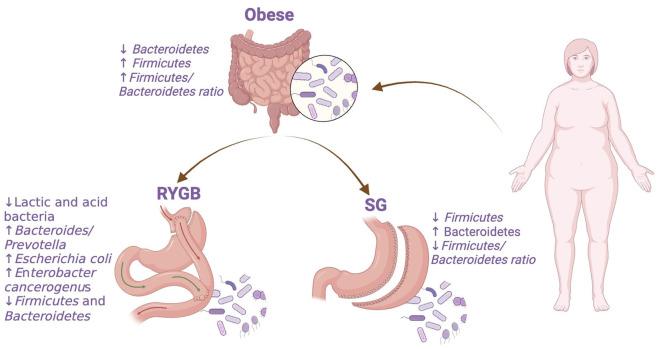
The review present data on the intricate relationship between bariatric surgery, gut microbiota, and metabolic health in obesity treatment. Bariatric surgery, is recognized as an effective intervention for managing morbid obesity, including various techniques with distinct mechanisms of action, efficacy, and safety profiles including Roux-en-Y Gastric Bypass (RYGB), Sleeve Gastrectomy (SG), Laparoscopic Adjustable Gastric Banding (LAGB), and Biliopancreatic Diversion (BPD). RYGB and SG are the most prevalent procedures globally, inducing gut microbiota changes that influence microbial diversity and abundance. Post-surgery, alterations in bacterial communities occur, such as the increased of inversely correlated with fat mass and leptin levels. During digestion, microbiota produce physiologically active compounds like bile acids (Bas) and short-chain fatty acids (SCFAs). SCFAs, derived by microbial fermentation, influence appetite, energy metabolism, and obesity-related pathways. Bas, altered by surgery, modulate glucose metabolism and insulin sensitivity. Furthermore, SG and RYGB enhance incretin secretion, particularly glucagon-like peptide 1 (GLP-1). Therefore, understanding microbiota changes after bariatric surgery could be crucial for predicting metabolic outcomes and developing targeted interventions for obesity management.
这篇综述展示了关于减肥手术、肠道微生物群和肥胖治疗中代谢健康之间复杂关系的数据。减肥手术被认为是治疗病态肥胖的有效干预措施,包括各种作用机制、疗效和安全性不同的技术,如 Roux-en-Y 胃旁路术(RYGB)、袖状胃切除术(SG)、腹腔镜可调节胃束带术(LAGB)和胆胰分流术(BPD)。RYGB 和 SG 是全球最常见的手术,会引起肠道微生物群的变化,影响微生物的多样性和丰度。手术后,细菌群落会发生改变,例如与脂肪量和瘦素水平呈负相关的细菌增加。在消化过程中,微生物群会产生生理活性化合物,如胆汁酸(Bas)和短链脂肪酸(SCFAs)。由微生物发酵产生的 SCFAs 会影响食欲、能量代谢和与肥胖相关的途径。手术改变的 Bas 会调节葡萄糖代谢和胰岛素敏感性。此外,SG 和 RYGB 会增强肠促胰岛素的分泌,尤其是胰高血糖素样肽 1(GLP-1)。因此,了解减肥手术后微生物群的变化对于预测代谢结果和制定肥胖管理的靶向干预措施可能至关重要。
 Zotero 插件