
胰岛素信号传导在昆虫行为中的多种作用。
The diverse roles of insulin signaling in insect behavior.
作者信息
Weger Anastasia A, Rittschof Clare C
机构信息
Department of Entomology, University of Kentucky, Lexington, KY, United States.
出版信息
Front Insect Sci. 2024 Apr 4;4:1360320. doi: 10.3389/finsc.2024.1360320. eCollection 2024.
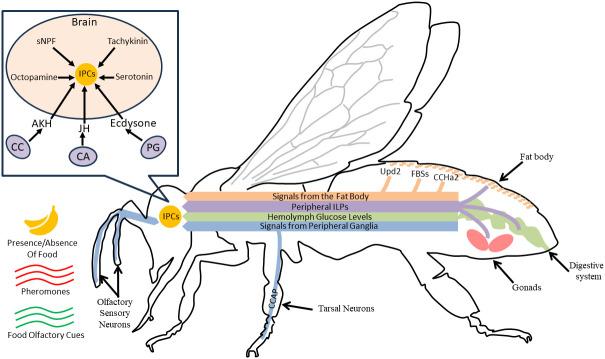
In insects and other animals, nutrition-mediated behaviors are modulated by communication between the brain and peripheral systems, a process that relies heavily on the insulin/insulin-like growth factor signaling pathway (IIS). Previous studies have focused on the mechanistic and physiological functions of insulin-like peptides (ILPs) in critical developmental and adult milestones like pupation or vitellogenesis. Less work has detailed the mechanisms connecting ILPs to adult nutrient-mediated behaviors related to survival and reproductive success. Here we briefly review the range of behaviors linked to IIS in insects, from conserved regulation of feeding behavior to evolutionarily derived polyphenisms. Where possible, we incorporate information from and other model species to describe molecular and neural mechanisms that connect nutritional status to behavioral expression via IIS. We identify knowledge gaps which include the diverse functional roles of peripheral ILPs, how ILPs modulate neural function and behavior across the lifespan, and the lack of detailed mechanistic research in a broad range of taxa. Addressing these gaps would enable a better understanding of the evolution of this conserved and widely deployed tool kit pathway.
在昆虫和其他动物中,营养介导的行为受到大脑与外周系统之间通讯的调节,这一过程严重依赖胰岛素/胰岛素样生长因子信号通路(IIS)。以往的研究主要集中在胰岛素样肽(ILP)在化蛹或卵黄生成等关键发育和成年阶段的机制及生理功能上。较少有研究详细阐述ILP与成年动物营养介导的、与生存和繁殖成功相关行为之间的联系机制。在此,我们简要回顾昆虫中与IIS相关的一系列行为,从进食行为的保守调控到进化而来的多型现象。在可能的情况下,我们整合来自果蝇及其他模式物种的信息,以描述通过IIS将营养状态与行为表达联系起来的分子和神经机制。我们找出了知识空白,包括外周ILP的多种功能作用、ILP如何在整个生命周期中调节神经功能和行为,以及在广泛的分类群中缺乏详细的机制研究。填补这些空白将有助于更好地理解这一保守且广泛应用的工具包通路的进化过程。
 Zotero 插件