
亲属关系与照料:2000 年至 2060 年美国潜在痴呆症照料中的种族差异。
Kinship and Care: Racial Disparities in Potential Dementia Caregiving in the United States From 2000 to 2060.
机构信息
Department of Sociology, Population Studies Center, University of Pennsylvania, Philadelphia, Pennsylvania, USA.
Institute for Biodiversity and Ecosystem Dynamics, University of Amsterdam, Amsterdam, The Netherlands.
出版信息
J Gerontol A Biol Sci Med Sci. 2024 Nov 7;79(Supplement_1):S32-S41. doi: 10.1093/gerona/glae106.
BACKGROUND
Although the family plays a pivotal role in older adults' care, there is limited research on how evolving demographic trends affect older adults' support networks and how the trends vary by race. To fill this gap, we examine the influence of shifting family demographics on future care needs for older adults with dementia, emphasizing the unequal health and potential caregiving burdens by race in the United States.
METHODS
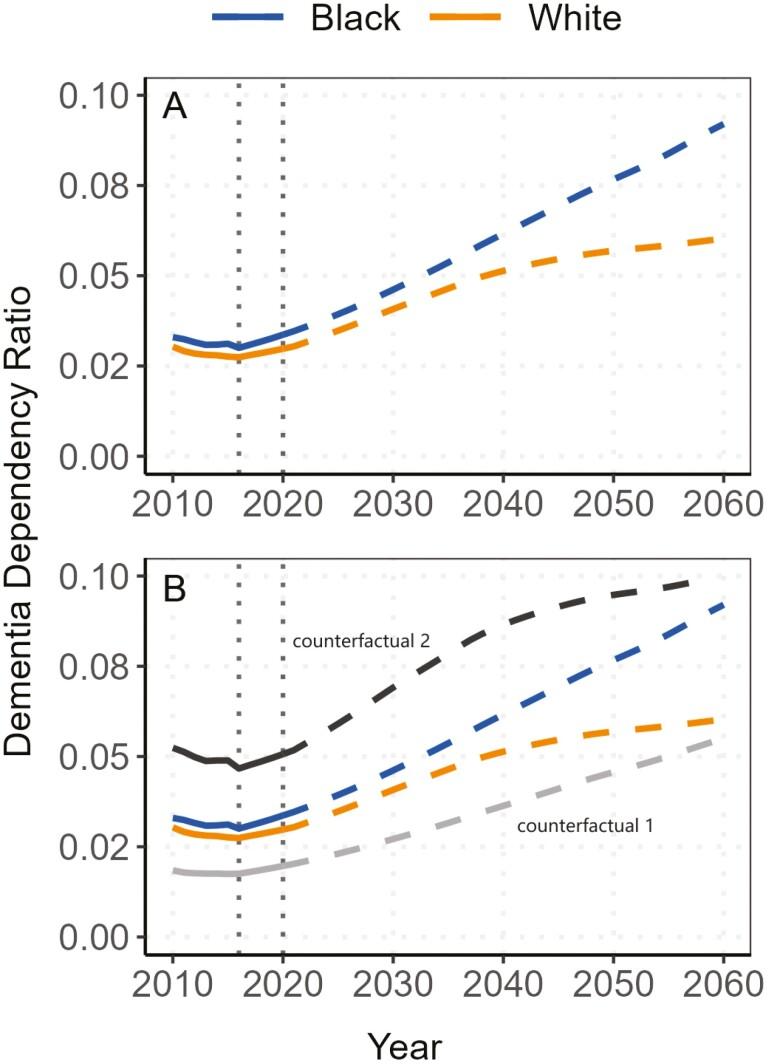
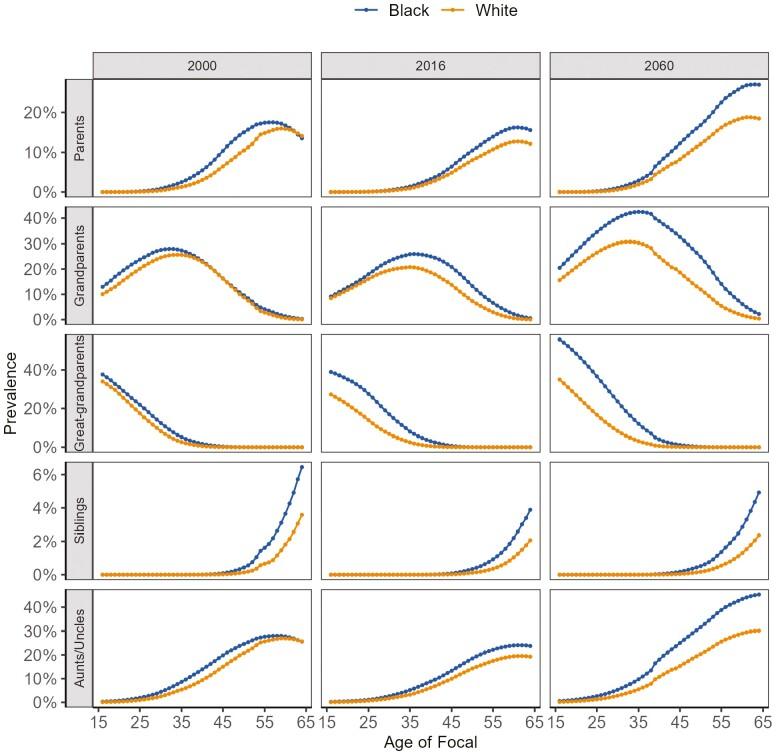
Using demographic models of kinship, we estimate the availability of potential caregivers, and dementia prevalence among one's kin by race, kin type, and the age of a focal person from 2000 to 2060. We introduce an index called the Dementia Dependency Ratio to assess dementia caregiving demands at the population level, taking into account the age and kinship structure of the population.
RESULTS
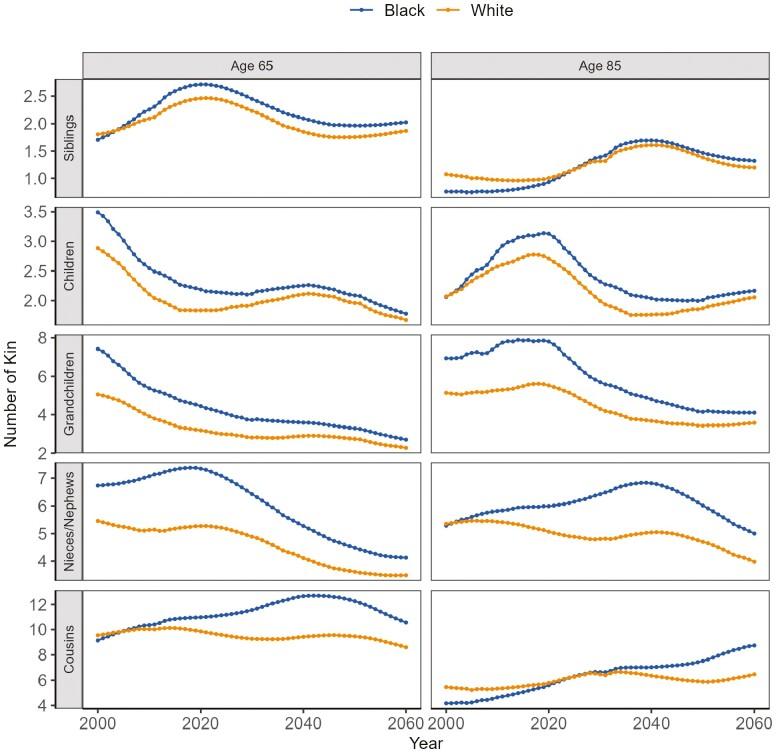
Our findings suggest that Black individuals tend to have more children, grandchildren, and nieces/nephews as they age. However, Black individuals also tend to have more kin with dementia compared to their White counterparts. This elevated prevalence of dementia among Black kinship networks counterbalances the advantage of having more kin as potential caregivers. A further projection analysis suggests that the racial gap in caregiving demand within the kinship network will widen in the next 4 decades if the racial gap in dementia prevalence remains unchanged.
CONCLUSIONS
These findings emphasize the urgency of reducing racial inequality in dementia prevalence rates and increasing public support for families with extended members affected by dementia. With the shrinkage of nuclear families and population aging in the next few decades, extended family members may undertake more caregiving responsibilities for dementia. We call for a kinship perspective in understanding dementia care in future research.
背景
尽管家庭在老年人的护理中起着关键作用,但关于不断变化的人口趋势如何影响老年人的支持网络,以及这些趋势如何因种族而异的研究有限。为了填补这一空白,我们研究了家庭人口结构的变化如何影响患有痴呆症的老年人未来的护理需求,强调了美国不同种族之间不平等的健康状况和潜在的护理负担。
方法
我们使用亲属关系的人口统计学模型,根据种族、亲属类型和焦点人物的年龄,估计潜在照顾者的可用性和一个人亲属中的痴呆症患病率,从 2000 年到 2060 年。我们引入了一个称为痴呆依赖比的指数,以评估人口水平上的痴呆症护理需求,同时考虑到人口的年龄和亲属结构。
结果
我们的研究结果表明,随着年龄的增长,黑人个体往往会有更多的子女、孙子女和侄子/侄女。然而,与白人相比,黑人亲属中也往往有更多患有痴呆症的亲属。黑人亲属网络中痴呆症的高发率抵消了作为潜在照顾者拥有更多亲属的优势。进一步的预测分析表明,如果痴呆症患病率的种族差距保持不变,那么在未来 40 年内,亲属网络中护理需求的种族差距将扩大。
结论
这些发现强调了减少痴呆症患病率种族不平等和增加对受痴呆症影响的大家庭的公共支持的紧迫性。随着未来几十年核心家庭的缩小和人口老龄化,大家庭成员可能会承担更多的痴呆症护理责任。我们呼吁在未来的研究中从亲属关系的角度理解痴呆症护理。


 Zotero 插件