
患者对罕见病遗传新生儿筛查的偏好:研究方案。
Patient preferences in genetic newborn screening for rare diseases: study protocol.
机构信息
Center for Research and Bioethics, Uppsala Universitet, Uppsala, Sweden
Research Unit of Neuromuscular and Neurodegenerative Disease, Ospedale Pediatrico Bambino Gesù IRCCS, Roma, Lazio, Italy.
出版信息
BMJ Open. 2024 Apr 19;14(4):e081835. doi: 10.1136/bmjopen-2023-081835.
INTRODUCTION
Rare diseases (RDs) collectively impact over 30 million people in Europe. Most individual conditions have a low prevalence which has resulted in a lack of research and expertise in this field, especially regarding genetic newborn screening (gNBS). There is increasing recognition of the importance of incorporating patients' needs and general public perspectives into the shared decision-making process regarding gNBS. This study is part of the Innovative Medicine Initiative project Screen4Care which aims at shortening the diagnostic journey for RDs by accelerating diagnosis for patients living with RDs through gNBS and the use of digital technologies, such as artificial intelligence and machine learning. Our objective will be to assess expecting parent's perspectives, attitudes and preferences regarding gNBS for RDs in Italy and Germany.
METHODS AND ANALYSIS
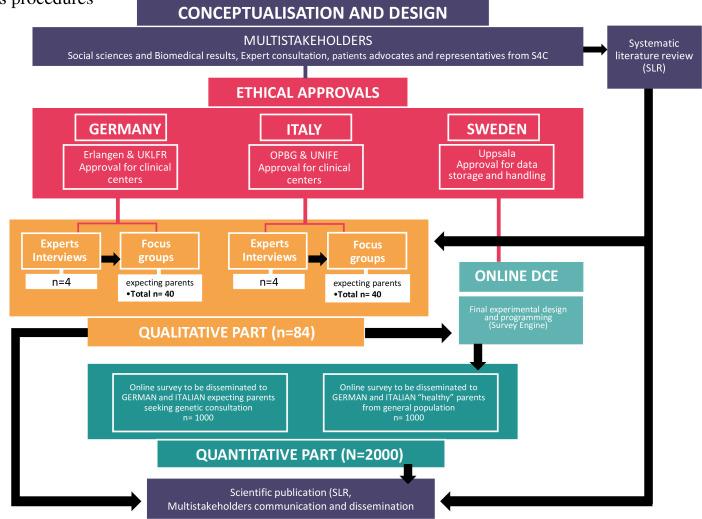
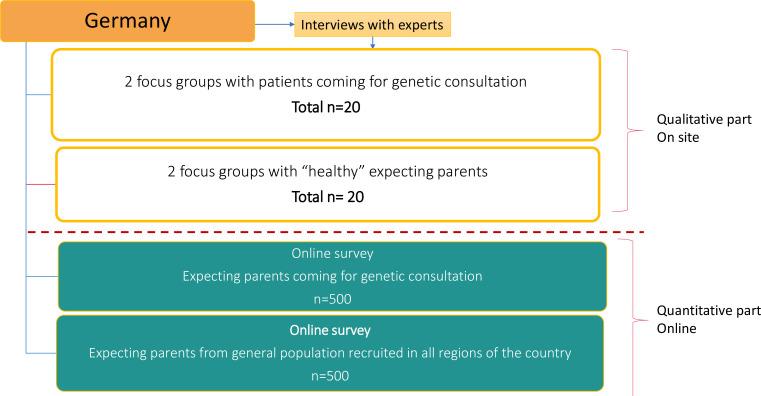
A mixed method approach will assess perspectives, attitudes and preferences of (1) expecting parents seeking genetic consultation and (2) 'healthy' expecting parents from the general population in two countries (Germany and Italy). Focus groups and interviews using the nominal group technique and ranking exercises will be performed (qualitative phase). The results will inform the treatment of attributes to be assessed via a survey and a discrete choice experiment (DCE). The total recruitment sample will be 2084 participants (approximatively 1000 participants in each country for the online survey). A combination of thematic qualitative and logit-based quantitative approaches will be used to analyse the results of the study.
ETHICS AND DISSEMINATION
This study has been approved by the Erlangen University Ethics Committee (22-246_1-B), the Freiburg University Ethics Committee (23-1005 S1-AV) and clinical centres in Italy (University of FerraraCE: 357/2023/Oss/AOUFe and Hospedale Bambino Gesu: No.2997 of 2 November 2023, Prot. No. _902) and approved for data storage and handling at the Uppsala University (2022-05806-01). The dissemination of the results will be ensured via scientific journal publication (open access).
简介
罕见病(RDs)在欧洲共影响超过 3000 万人。大多数疾病的患病率较低,这导致该领域缺乏研究和专业知识,尤其是在遗传新生儿筛查(gNBS)方面。人们越来越认识到将患者需求和公众观点纳入 gNBS 共同决策过程的重要性。本研究是创新药物倡议项目 Screen4Care 的一部分,该项目旨在通过 gNBS 和人工智能和机器学习等数字技术的使用,为患有 RD 的患者加速诊断,从而缩短 RD 的诊断过程。我们的目标将是评估意大利和德国的准父母对 RD 的 gNBS 的看法、态度和偏好。
方法和分析
混合方法将评估(1)寻求遗传咨询的准父母和(2)来自两国(德国和意大利)一般人群的“健康”准父母对 gNBS 的看法、态度和偏好。将使用名义群体技术和排名练习进行焦点小组和访谈(定性阶段)。结果将为通过调查和离散选择实验(DCE)评估属性的处理提供信息。总招募样本将为 2084 名参与者(每个国家约有 1000 名参与者参加在线调查)。将使用主题定性和基于逻辑的定量方法相结合来分析研究结果。
伦理和传播
这项研究已获得埃尔朗根大学伦理委员会(22-246_1-B)、弗莱堡大学伦理委员会(23-1005 S1-AV)和意大利临床中心(费拉拉大学 CE:357/2023/Oss/AOUFe 和 Bambino Gesu 医院:2023 年 11 月 2 日第 2997 号,第 902 号协议)的批准,并在乌普萨拉大学获得数据存储和处理的批准(2022-05806-01)。结果的传播将通过科学期刊发表(开放获取)来确保。

 Zotero 插件