
美国人群中单核细胞与淋巴细胞比值和前列腺癌之间的关联:一项基于人群的研究。
Association between monocyte-to-lymphocyte ratio and prostate cancer in the U.S. population: a population-based study.
作者信息
Wang Lanyu, Li Xiaowan, Liu Min, Zhou Hongyi, Shao Jianfeng
机构信息
Department of Urology, The Affiliated Wuxi People's Hospital of Nanjing Medical University, Wuxi People's Hospital, Wuxi Medical Center, Nanjing Medical University, Wuxi, Jiangsu, China.
Department of Critical Care Medicine, The Affiliated Wuxi People's Hospital of Nanjing Medical University, Wuxi People's Hospital, Wuxi Medical Center, Nanjing Medical University, Wuxi, Jiangsu, China.
出版信息
Front Cell Dev Biol. 2024 Apr 5;12:1372731. doi: 10.3389/fcell.2024.1372731. eCollection 2024.
INTRODUCTION
Monocyte-to-lymphocyte ratio (MLR) is a convenient and noninvasive inflammatory biomarker, and inflammation has been reported to be associated with prostate cancer (PCa). Our objective was to ascertain any possible correlation between PCa and MLR.
METHODS
We utilized data from the 1999-2020 cycles of the National Health and Nutrition Examination Survey (NHANES) regarding MLR and PCa. The independent associations of MLR and other inflammatory biomarkers (platelet-to-lymphocyte ratio (PLR), systemic immune-inflammation index (SII), neutrophil-to-lymphocyte ratio (NLR), system inflammation response index (SIRI), and aggregate index of systemic inflammation (AISI)) with PCa was investigated using weighted multivariate logistic regression and generalized additive models. Receiver operating characteristic (ROC) curves were conducted to evaluate and contrast their diagnostic capabilities.
RESULTS
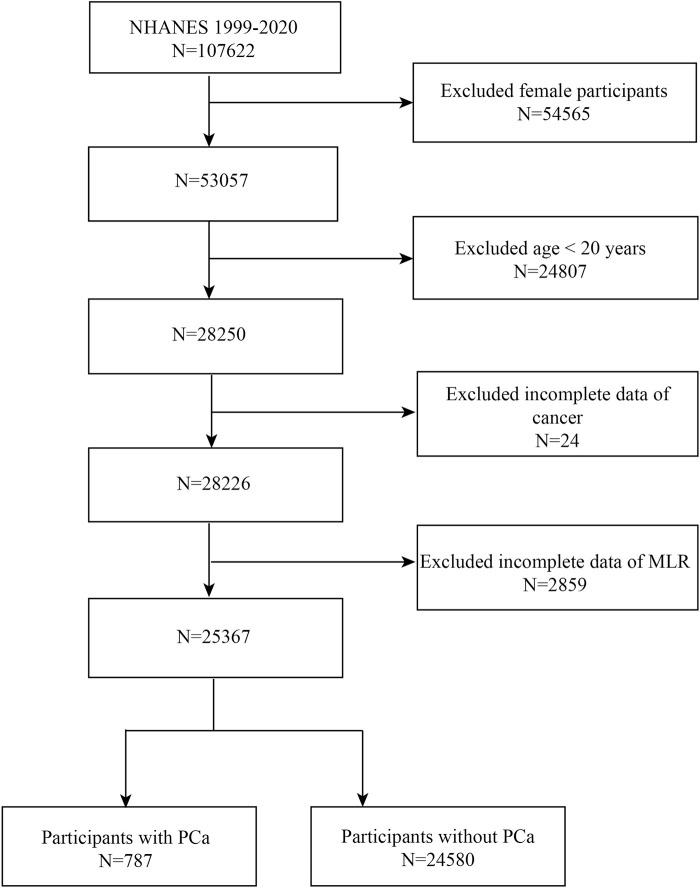
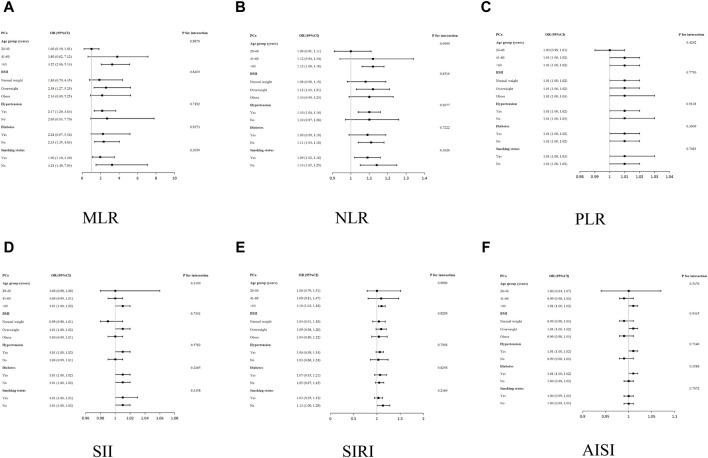
The analysis we conducted comprised 25,367 persons in total. The mean MLR was 0.31 ± 0.14. The prevalence of PCa was 3.1%. A positive association was found between MLR and PCa (OR = 2.28; 95% CI: 1.44, 3.62). According to the interaction tests, age, body mass index (BMI), hypertension, diabetes, and smoking status did not significantly impact the relationship between MLR and PCa (all for interaction >0.05). ROC analysis showed that MLR had a stronger discriminative ability and accuracy in predicting PCa than other inflammatory biomarkers (NLR, SII, AISI, PLR, and SIRI).
CONCLUSION
MLR might be better than other inflammatory biomarkers (NLR, SIRI, AISI, PLR, and SII) in predicting PCa. American adults who have elevated levels of MLR, NLR, PLR, SII, and AISI should be aware that they have a greater risk of PCa.
引言
单核细胞与淋巴细胞比值(MLR)是一种便捷且无创的炎症生物标志物,据报道炎症与前列腺癌(PCa)相关。我们的目的是确定PCa与MLR之间是否存在任何可能的关联。
方法
我们利用了1999 - 2020年国家健康与营养检查调查(NHANES)中关于MLR和PCa的数据。使用加权多变量逻辑回归和广义相加模型研究了MLR和其他炎症生物标志物(血小板与淋巴细胞比值(PLR)、全身免疫炎症指数(SII)、中性粒细胞与淋巴细胞比值(NLR)、全身炎症反应指数(SIRI)以及全身炎症聚集指数(AISI))与PCa的独立关联。绘制了受试者工作特征(ROC)曲线以评估和对比它们的诊断能力。
结果
我们进行的分析总共纳入了25367人。平均MLR为0.31±0.14。PCa的患病率为3.1%。发现MLR与PCa之间存在正相关(OR = 2.28;95%置信区间:1.44,3.62)。根据交互作用检验,年龄、体重指数(BMI)、高血压、糖尿病和吸烟状况并未显著影响MLR与PCa之间的关系(所有交互作用P>0.05)。ROC分析表明,在预测PCa方面,MLR比其他炎症生物标志物(NLR、SII、AISI、PLR和SIRI)具有更强的判别能力和准确性。
结论
在预测PCa方面,MLR可能优于其他炎症生物标志物(NLR、SIRI、AISI、PLR和SII)。MLR、NLR、PLR、SII和AISI水平升高的美国成年人应意识到他们患PCa的风险更高。


 Zotero 插件