
生物工程改造睾丸酮丛毛单胞菌CNB-1:一种用于高效降解聚对苯二甲酸乙二酯微塑料的强大全细胞生物催化剂。
Bioengineering Comamonas testosteroni CNB-1: a robust whole-cell biocatalyst for efficient PET microplastic degradation.
作者信息
Cao Zhanqing, Xia Wei, Wu Shilei, Ma Jiale, Zhou Xiaoli, Qian Xiujuan, Xu Anming, Dong Weiliang, Jiang Min
机构信息
College of Biotechnology and Pharmaceutical Engineering, Nanjing Tech University, Nanjing, 211816, China.
State Key Laboratory of Materials-Oriented Chemical Engineering, Nanjing Tech University, Nanjing, 211816, China.
出版信息
Bioresour Bioprocess. 2023 Dec 18;10(1):94. doi: 10.1186/s40643-023-00715-7.
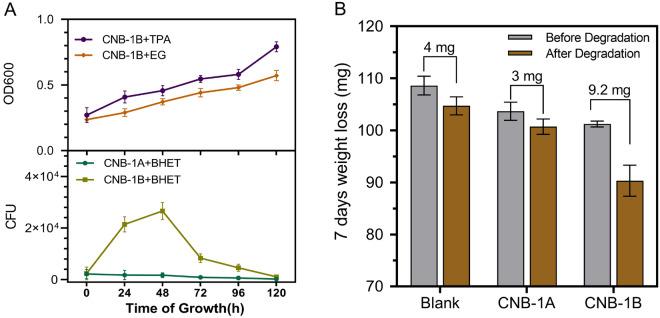
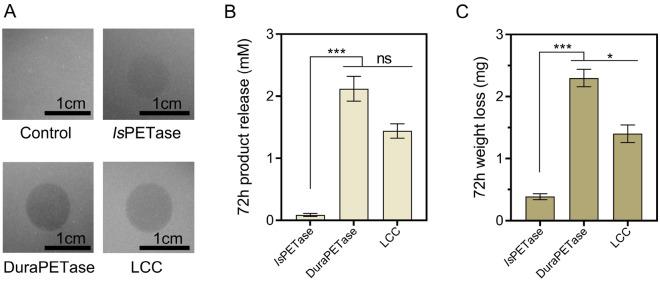
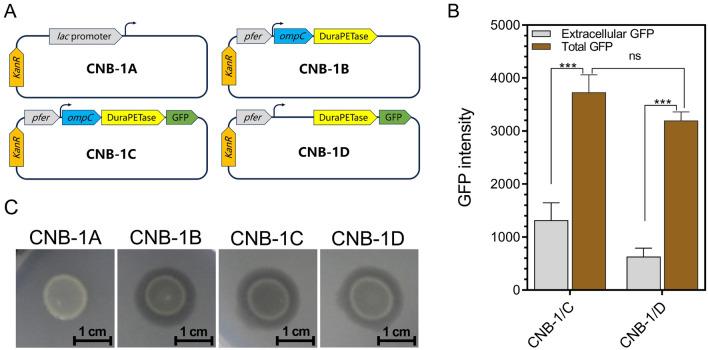
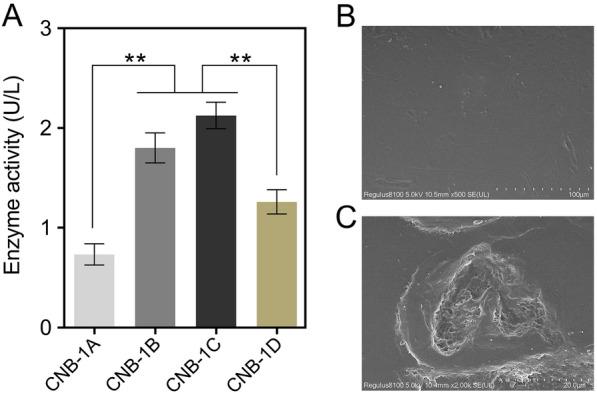
The escalating crisis of polyethylene terephthalate (PET) microplastic contamination in biological wastewater treatment systems is a pressing environmental concern. These microplastics inevitably accumulate in sewage sludge due to the absence of effective removal technologies. Addressing this urgent issue, this study introduces a novel approach using DuraPETase, a potent enzyme with enhanced PET hydrolytic activity at ambient temperatures. Remarkably, this enzyme was successfully secreted from Comamonas testosteroni CNB-1, a dominant species in the active sludge. The secreted DuraPETase showed significant hydrolytic activity toward p-NPB and PET nanoplastics. Furthermore, the CNB-1 derived whole-cell biocatalyst was able to depolymerize PET microplastics under ambient temperature, achieving a degradation efficiency of 9% within 7 days. The CNB-1-based whole biocatalysts were also capable of utilizing PET degradation intermediates, such as terephthalic acid (TPA) and ethylene glycol (EG), and bis(2-hydroxyethyl)-TPA (BHET), for growth. This indicates that it can completely mineralize PET, as opposed to merely breaking it down into smaller molecules. This research highlights the potential of activated sludge as a potent source for insitu microplastic removal.
生物废水处理系统中聚对苯二甲酸乙二酯(PET)微塑料污染危机不断升级,这是一个紧迫的环境问题。由于缺乏有效的去除技术,这些微塑料不可避免地在污水污泥中积累。为解决这一紧迫问题,本研究引入了一种新方法,即使用DuraPETase,这是一种在环境温度下具有增强PET水解活性的强效酶。值得注意的是,这种酶是从活性污泥中的优势菌种睾丸酮丛毛单胞菌CNB-1成功分泌出来的。分泌出的DuraPETase对对硝基苯磷酸酯(p-NPB)和PET纳米塑料表现出显著的水解活性。此外,源自CNB-1的全细胞生物催化剂能够在环境温度下使PET微塑料解聚,7天内降解效率达到9%。基于CNB-1的全生物催化剂还能够利用PET降解中间体,如对苯二甲酸(TPA)、乙二醇(EG)和双(2-羟乙基)-TPA(BHET)来生长。这表明它可以使PET完全矿化,而不仅仅是将其分解成更小的分子。这项研究突出了活性污泥作为原位去除微塑料的有力来源的潜力。
 Zotero 插件