
间充质干细胞疗法治疗糖尿病足溃疡:最新综合综述
Mesenchymal stem cell therapy in diabetic foot ulcer: An updated comprehensive review.
作者信息
Hetta Helal F, Elsaghir Alaa, Sijercic Victor Coll, Akhtar Mahad S, Gad Sayed A, Moses Avinash, Zeleke Mahlet S, Alanazi Fawaz E, Ahmed Abdulrahman K, Ramadan Yasmin N
机构信息
Division of Microbiology, Immunology and Biotechnology, Department of Natural Products and Alternative Medicine Faculty of Pharmacy, University of Tabuk Tabuk Saudi Arabia.
Department of Medical Microbiology and Immunology Faculty of Medicine, Assiut University Assiut Egypt.
出版信息
Health Sci Rep. 2024 Apr 21;7(4):e2036. doi: 10.1002/hsr2.2036. eCollection 2024 Apr.
BACKGROUND
Diabetes has evolved into a worldwide public health issue. One of the most serious complications of diabetes is diabetic foot ulcer (DFU), which frequently creates a significant financial strain on patients and lowers their quality of life. Up until now, there has been no curative therapy for DFU, only symptomatic relief or an interruption in the disease's progression. Recent studies have focused attention on mesenchymal stem cells (MSCs), which provide innovative and potential treatment candidates for several illnesses as they can differentiate into various cell types. They are mostly extracted from the placenta, adipose tissue, umbilical cord (UC), and bone marrow (BM). Regardless of their origin, they show comparable features and small deviations. Our goal is to investigate MSCs' therapeutic effects, application obstacles, and patient benefit strategies for DFU therapy.
METHODOLOGY
A comprehensive search was conducted using specific keywords relating to DFU, MSCs, and connected topics in the databases of Medline, Scopus, Web of Science, and PubMed. The main focus of the selection criteria was on English-language literature that explored the relationship between DFU, MSCs, and related factors.
RESULTS AND DISCUSSION
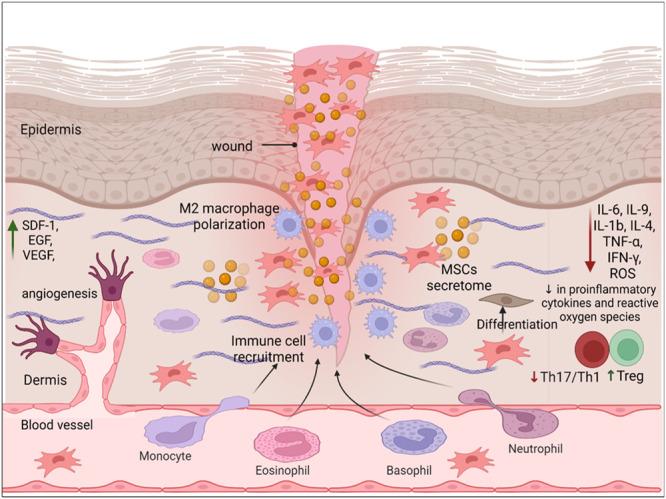
Numerous studies are being conducted and have demonstrated that MSCs can induce re-epithelialization and angiogenesis, decrease inflammation, contribute to immunological modulation, and subsequently promote DFU healing, making them a promising approach to treating DFU. This review article provides a general snapshot of DFU (including clinical presentation, risk factors and etiopathogenesis, and conventional treatment) and discusses the clinical progress of MSCs in the management of DFU, taking into consideration the side effects and challenges during the application of MSCs and how to overcome these challenges to achieve maximum benefits.
CONCLUSION
The incorporation of MSCs in the management of DFU highlights their potential as a feasible therapeutic strategy. Establishing a comprehensive understanding of the complex relationship between DFU pathophysiology, MSC therapies, and related obstacles is essential for optimizing therapy outcomes and maximizing patient benefits.
背景
糖尿病已演变成一个全球性的公共卫生问题。糖尿病最严重的并发症之一是糖尿病足溃疡(DFU),它经常给患者带来巨大的经济负担,并降低他们的生活质量。到目前为止,DFU尚无治愈性疗法,只有症状缓解或疾病进展的中断。最近的研究将注意力集中在间充质干细胞(MSCs)上,由于它们可以分化为各种细胞类型,因此为几种疾病提供了创新的潜在治疗方案。它们大多从胎盘、脂肪组织、脐带(UC)和骨髓(BM)中提取。无论其来源如何,它们都表现出可比的特征和微小的差异。我们的目标是研究MSCs对DFU治疗的疗效、应用障碍及患者受益策略。
方法
在Medline、Scopus、科学网和PubMed数据库中,使用与DFU、MSCs及相关主题相关的特定关键词进行全面检索。选择标准的主要重点是探索DFU、MSCs及相关因素之间关系的英文文献。
结果与讨论
正在进行大量研究,并且已经证明MSCs可以诱导再上皮化和血管生成,减轻炎症,有助于免疫调节,随后促进DFU愈合,使其成为治疗DFU的一种有前景的方法。这篇综述文章提供了DFU的总体概况(包括临床表现、危险因素和病因发病机制以及传统治疗),并讨论了MSCs在DFU管理中的临床进展,同时考虑了MSCs应用过程中的副作用和挑战以及如何克服这些挑战以实现最大益处。
结论
将MSCs纳入DFU管理突出了它们作为一种可行治疗策略的潜力。全面了解DFU病理生理学、MSCs疗法及相关障碍之间的复杂关系对于优化治疗结果和使患者受益最大化至关重要。

 Zotero 插件