
蔓越莓多酚与预防尿路感染:与肠道和尿路屏障完整性和功能相关的新发现。
Cranberry Polyphenols and Prevention against Urinary Tract Infections: New Findings Related to the Integrity and Functionality of Intestinal and Urinary Barriers.
机构信息
Institute of Food Science Research (CIAL), CSIC-UAM, C/Nicolás Cabrera 9, Madrid 28049, Spain.
出版信息
J Agric Food Chem. 2024 May 8;72(18):10328-10338. doi: 10.1021/acs.jafc.3c07169. Epub 2024 Apr 23.
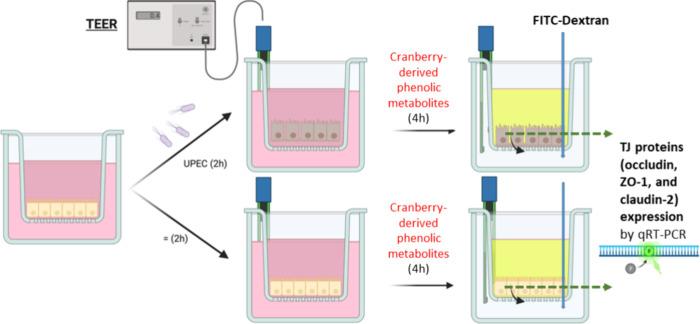
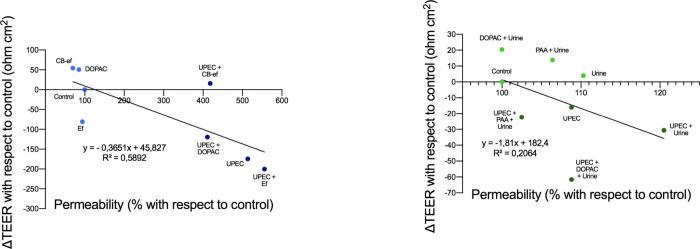
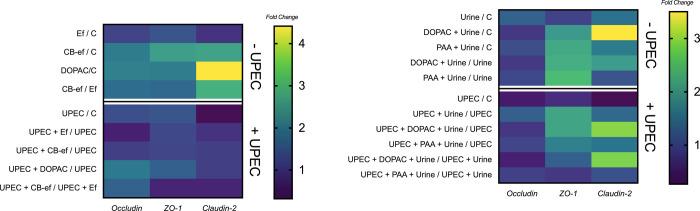
This work seeks to generate new knowledge about the mechanisms underlying the protective effects of cranberry against urinary tract infections (UTI). Using Caco-2 cells grown in Transwell inserts as an intestinal barrier model, we found that a cranberry-derived digestive fluid (containing 135 ± 5 mg of phenolic compounds/L) increased transepithelial electrical resistance with respect to control (ΔTEER = 54.5 Ω cm) and decreased FITC-dextran paracellular transport by about 30%, which was related to the upregulation of the gene expression of tight junction (TJ) proteins (i.e., occludin, zonula occludens-1 [ZO-1], and claudin-2) (∼3-4-fold change with respect to control for claudin-2 and ∼2-3-fold for occludin and ZO-1). Similar protective effects, albeit to a lesser extent, were observed when Caco-2 cells were previously infected with uropathogenic (UPEC). In a urinary barrier model comprising T24 cells grown in Transwell inserts and either noninfected or UPEC-infected, treatments with the cranberry-derived phenolic metabolites 3,4-dihydroxyphenylacetic acid (DOPAC) and phenylacetic acid (PAA) (250 μM) also promoted favorable changes in barrier integrity and permeability. In this line, incubation of noninfected T24 cells with these metabolites induced positive regulatory effects on claudin-2 and ZO-1 expression (∼3.5- and ∼2-fold change with respect to control for DOPAC and ∼1.5- and >2-fold change with respect to control for PAA, respectively). Overall, these results suggest that the protective action of cranberry polyphenols against UTI might involve molecular mechanisms related to the integrity and functionality of the urothelium and intestinal epithelium.
本研究旨在探索蔓越莓预防尿路感染(UTI)的作用机制。我们利用 Caco-2 细胞构建肠屏障模型,发现蔓越莓来源的消化液(含有 135±5mg 酚类化合物/L)可显著增加跨上皮电阻(ΔTEER=54.5Ωcm),并降低 FITC-葡聚糖的经上皮转运(约 30%),这与紧密连接(TJ)蛋白(occludin、zonula occludens-1 [ZO-1]和 claudin-2)的基因表达上调有关(claudin-2 上调约 3-4 倍,occludin 和 ZO-1 上调约 2-3 倍)。当 Caco-2 细胞预先被尿路致病性大肠埃希菌(UPEC)感染时,也观察到类似的保护作用,但程度较轻。在由 T24 细胞构建的尿路上皮屏障模型中,当用蔓越莓来源的酚类代谢物 3,4-二羟基苯乙酸(DOPAC)和苯乙酸(PAA)(250μM)处理时,也可促进屏障完整性和通透性的有利变化。此外,将这些代谢物孵育于未感染的 T24 细胞中,可诱导 claudin-2 和 ZO-1 的表达正向调控(DOPAC 分别上调约 3.5 倍和 2 倍,PAA 分别上调约 1.5 倍和>2 倍)。综上所述,这些结果表明,蔓越莓多酚预防 UTI 的作用机制可能与尿路上皮和肠上皮的完整性和功能有关。


 Zotero 插件