
单个 5eV 电子如何诱导 DNA 双链断裂:含时密度泛函理论研究。
How a Single 5 eV Electron Can Induce Double-Strand Breaks in DNA: A Time-Dependent Density Functional Theory Study.
机构信息
Department of Chemistry, Oakland University, Rochester, Michigan 48309, United States.
Department of Nuclear Medicine and Radiobiology and Clinical Research Center, Faculty of Medicine and Health Sciences, Université de Sherbrooke, Sherbrooke, QC J1H 5N4, Canada.
出版信息
J Phys Chem B. 2024 May 2;128(17):4053-4062. doi: 10.1021/acs.jpcb.3c08367. Epub 2024 Apr 23.
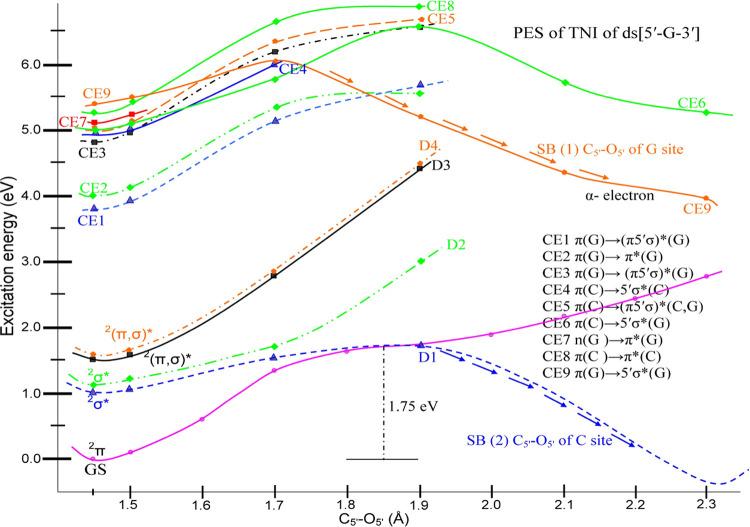
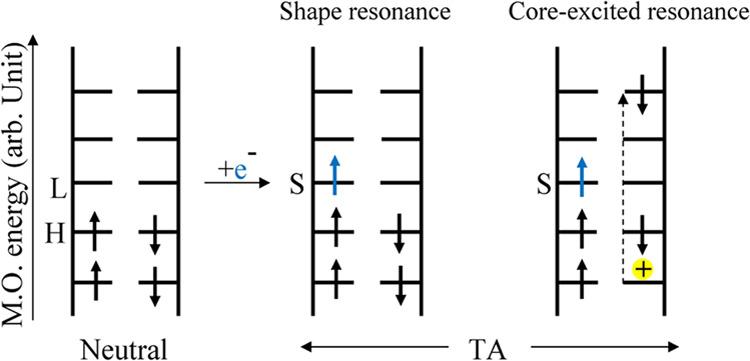
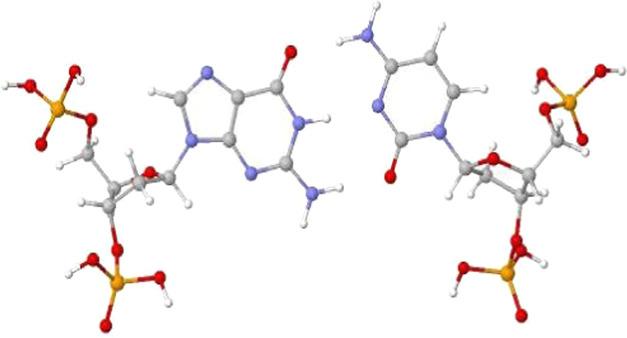
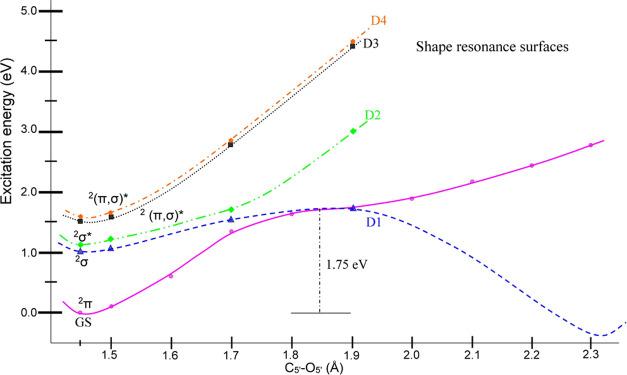
Low-energy (<20 eV) electrons (LEEs) can resonantly interact with DNA to form transient anions (TAs) of fundamental units, inducing single-strand breaks (SSBs), and cluster damage, such as double-strand breaks (DSBs). Shape resonances, which arise from electron capture in a previously unfilled orbital, can induce only a SSB, whereas a single core-excited resonance (i.e., two electrons in excited orbitals of the field of a hole) has been shown experimentally to cause cluster lesions. Herein, we show from time-dependent density functional theory (TDDFT) that a core-excited resonance can produce a DSB, i.e., a single 5 eV electron can induce two close lesions in DNA. We considered the nucleotide with the G-C base pair (ds[5'-G-3']) as a model for electron localization in the DNA double helix and calculated the potential energy surfaces (PESs) of excited states of the ground-state TA of ds[5'-G-3'], which correspond to shape and core-excited resonances. The calculations show that shape TAs start at ca. 1 eV, while core-excited TAs occur only above 4 eV. The energy profile of each excited state and the corresponding PES are obtained by simultaneously stretching both C5'-O5' bonds of ds[5'-G-3']. From the nature of the PES, we find two dissociative (σ*) states localized on the PO groups at the C5' sites of ds[5'-G-3']. The first σ* state at 1 eV is due to a shape resonance, while the second σ* state is induced by a core-excited resonance at 5.4 eV. As the bond of the latter state stretches and arrives close to the dissociation limit, the added electron on C transfers to C5' phosphate, thus demonstrating the possibility of producing a DSB with only one electron of ca. 5 eV.
低能(<20 eV)电子(LEEs)可以与 DNA 发生共振相互作用,形成基本单元的瞬态阴离子(TAs),诱导单链断裂(SSBs)和簇损伤,如双链断裂(DSBs)。电子俘获在先前未填充的轨道中产生的形状共振只能引起 SSB,而实验已经证明单个核心激发共振(即两个电子处于孔场的激发轨道中)会导致簇损伤。在此,我们通过时间依赖密度泛函理论(TDDFT)表明,核心激发共振可以产生 DSB,即单个 5 eV 电子可以在 DNA 中诱导两个相邻的损伤。我们考虑了具有 G-C 碱基对(ds[5'-G-3'])的核苷酸作为 DNA 双螺旋中电子局域的模型,并计算了基态 TA 的激发态的势能面(PES),这些激发态对应于形状和核心激发共振。计算表明,形状 TA 始于约 1 eV,而核心激发 TA 仅在 4 eV 以上发生。每个激发态的能量曲线和相应的 PES 通过同时拉伸 ds[5'-G-3']的两个 C5'-O5'键获得。从 PES 的性质来看,我们发现两个离解(σ*)态定位于 ds[5'-G-3']的 C5'位点的 PO 基团上。第一个位于 1 eV 的 σ*态归因于形状共振,而第二个位于 5.4 eV 的核心激发共振诱导。随着后者的键拉伸并接近离解极限,附加在 C 上的电子转移到 C5'磷酸上,从而证明了仅用约 5 eV 的一个电子产生 DSB 的可能性。

 Zotero 插件