
塑造致癌微环境:纤连蛋白的作用
Shaping Oncogenic Microenvironments: Contribution of Fibronectin.
作者信息
Guerrero-Barberà Gemma, Burday Natalia, Costell Mercedes
机构信息
Departament of Biochemistry and Molecular Biology, Institut Universitari de Biotecnologia i Biomedicina, Universitat de València, Valencia, Spain.
出版信息
Front Cell Dev Biol. 2024 Apr 10;12:1363004. doi: 10.3389/fcell.2024.1363004. eCollection 2024.
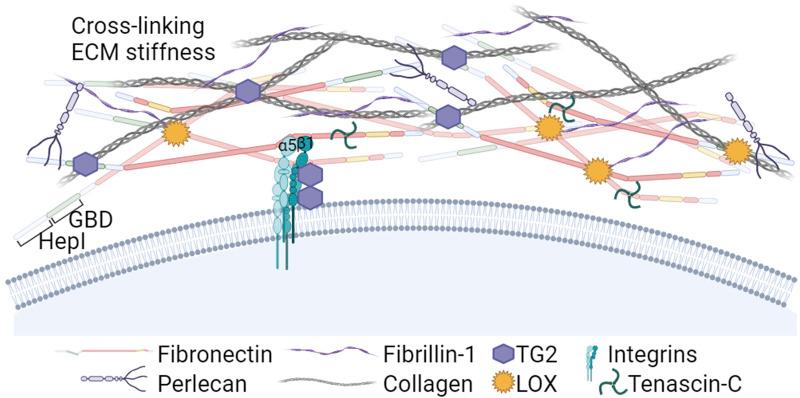
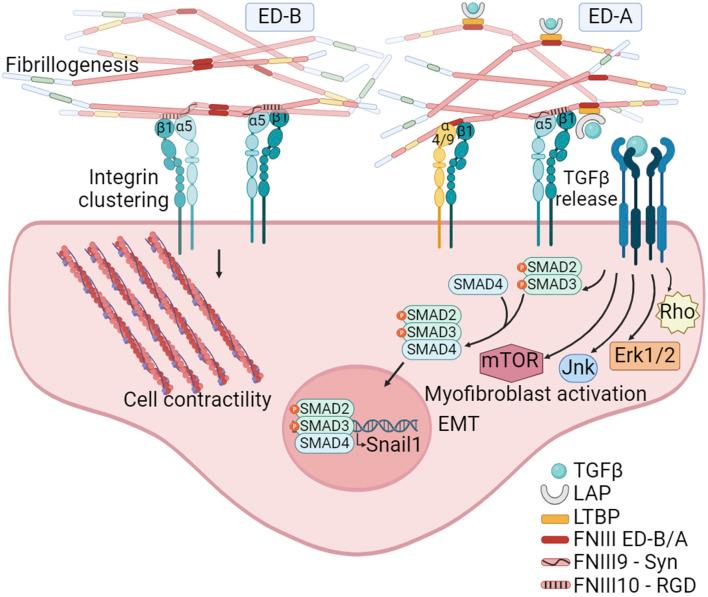
The extracellular matrix (ECM) is a complex network of proteins and glycans, dynamically remodeled and specifically tailored to the structure/function of each organ. The malignant transformation of cancer cells is determined by both cell intrinsic properties, such as mutations, and extrinsic variables, such as the mixture of surrounding cells in the tumor microenvironment and the biophysics of the ECM. During cancer progression, the ECM undergoes extensive remodeling, characterized by disruption of the basal lamina, vascular endothelial cell invasion, and development of fibrosis in and around the tumor cells resulting in increased tissue stiffness. This enhanced rigidity leads to aberrant mechanotransduction and further malignant transformation potentiating the de-differentiation, proliferation and invasion of tumor cells. Interestingly, this fibrotic microenvironment is primarily secreted and assembled by non-cancerous cells. Among them, the cancer-associated fibroblasts (CAFs) play a central role. CAFs massively produce fibronectin together with type I collagen. This review delves into the primary interactions and signaling pathways through which fibronectin can support tumorigenesis and metastasis, aiming to provide critical molecular insights for better therapy response prediction.
细胞外基质(ECM)是一个由蛋白质和聚糖组成的复杂网络,会动态重塑并专门适应每个器官的结构/功能。癌细胞的恶性转化既由细胞内在特性(如突变)决定,也由外在变量决定,如肿瘤微环境中周围细胞的混合物以及细胞外基质的生物物理学特性。在癌症进展过程中,细胞外基质会经历广泛的重塑,其特征包括基底膜破坏、血管内皮细胞侵袭以及肿瘤细胞内外纤维化的发展,导致组织硬度增加。这种增强的硬度会导致异常的机械转导,并进一步促进恶性转化,增强肿瘤细胞的去分化、增殖和侵袭。有趣的是,这种纤维化微环境主要由非癌细胞分泌和组装。其中,癌症相关成纤维细胞(CAF)起着核心作用。癌症相关成纤维细胞大量产生纤连蛋白以及I型胶原蛋白。本综述深入探讨了纤连蛋白支持肿瘤发生和转移的主要相互作用和信号通路,旨在为更好地预测治疗反应提供关键的分子见解。


 Zotero 插件