
抗 CD19 疗法在弥漫性大 B 细胞淋巴瘤治疗中的应用。
Sequencing of Anti-CD19 Therapies in the Management of Diffuse Large B-Cell Lymphoma.
机构信息
Cedars Sinai Medical Center, Samuel Oschin Cancer Center, Los Angeles, California.
UCLA, Santa Monica Cancer Care, Santa Monica, California.
出版信息
Clin Cancer Res. 2024 Jul 15;30(14):2895-2904. doi: 10.1158/1078-0432.CCR-23-1962.
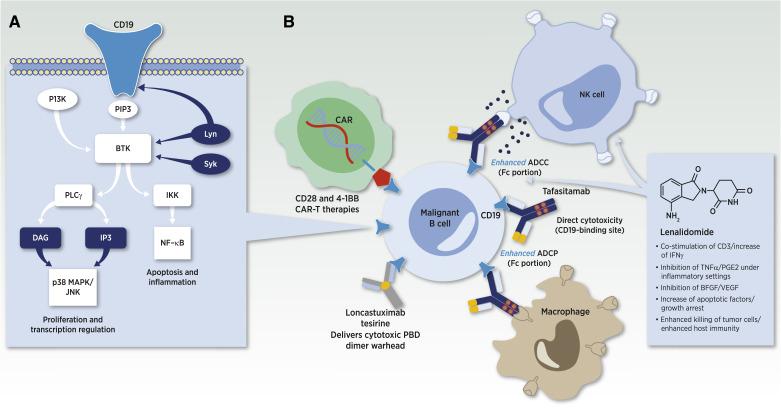
Several second- and third-line immunotherapeutic options for patients with relapsed or refractory diffuse large B-cell lymphoma ineligible for autologous stem cell transplant are directed against the B-cell antigen cluster of differentiation 19 (CD19). The anti-CD19 monoclonal antibody tafasitamab, paired with the immunomodulator lenalidomide, mediates antibody-dependent cellular toxicity and phagocytosis; the antibody-drug conjugate loncastuximab tesirine delivers the DNA cross-linking agent tesirine via CD19 binding and internalization; and CD19-directed chimeric antigen receptor T-cell therapy (CAR-T) products are engineered from autologous T cells. Although CD19 expression is assessed at diagnosis, clinically relevant thresholds of CD19 expression-which may not be detectable using current routine methodologies-have not been defined and may vary between CD19-directed treatment modalities. Determining optimal treatment sequencing strategies for CD19-directed therapy is hampered by the exclusion of patients who have received prior CD19-directed therapies from major clinical trials. Antigen escape, which is attributed to mechanisms including epitope loss and defective cell surface trafficking of CD19, is an important cause of CAR-T failure. Limited data suggest that CD19 expression may be maintained after non-CAR-T CD19-directed therapy, and retrospective analyses indicate that some patients with disease relapse after CAR-T may benefit from subsequent CD19-directed therapy. To date, clinical evidence on the effect of anti-CD19 therapy prior to CAR-T has been limited to small case series. Prospective studies and detailed analyses are needed to understand how pretreatment and posttreatment CD19 expression correlates with clinical responses to subsequent CD19-directed therapy to fully maximize treatment strategies.
有几种二线和三线免疫治疗选择可用于不符合自体干细胞移植条件的复发或难治性弥漫性大 B 细胞淋巴瘤患者,这些选择针对 B 细胞抗原分化群 19(CD19)。抗 CD19 单克隆抗体 tafasitamab 与免疫调节剂来那度胺联合使用,介导抗体依赖性细胞毒性和吞噬作用;抗体药物偶联物 loncastuximab tesirine 通过与 CD19 结合和内化来递送 DNA 交联剂 tesirine;CD19 导向嵌合抗原受体 T 细胞疗法(CAR-T)产品是从自体 T 细胞工程化而来。虽然在诊断时评估 CD19 表达,但尚未定义临床上相关的 CD19 表达阈值(当前常规方法可能无法检测到),并且可能在不同的 CD19 靶向治疗方式之间有所不同。由于主要临床试验排除了先前接受过 CD19 靶向治疗的患者,因此确定 CD19 靶向治疗的最佳治疗顺序策略受到阻碍。抗原逃逸是 CAR-T 失败的一个重要原因,其归因于包括表位丢失和 CD19 细胞表面转运缺陷在内的机制。有限的数据表明,在非 CAR-T CD19 靶向治疗后 CD19 表达可能会维持,并且回顾性分析表明,一些接受 CAR-T 治疗后疾病复发的患者可能受益于随后的 CD19 靶向治疗。迄今为止,关于 CAR-T 之前的抗 CD19 治疗效果的临床证据仅限于小型病例系列。需要前瞻性研究和详细分析来了解预处理和治疗后 CD19 表达与对随后的 CD19 靶向治疗的临床反应之间的相关性,以充分最大化治疗策略。
 Zotero 插件