
有机电合成中金属牺牲阳极故障排除指南。
A guide to troubleshooting metal sacrificial anodes for organic electrosynthesis.
作者信息
Ware Skyler D, Zhang Wendy, Guan Weiyang, Lin Song, See Kimberly A
机构信息
Division of Chemistry and Chemical Engineering, California Institute of Technology Pasadena California 91125 USA
Department of Chemistry and Chemical Biology, Cornell University Ithaca New York 14853 USA.
出版信息
Chem Sci. 2024 Mar 6;15(16):5814-5831. doi: 10.1039/d3sc06885d. eCollection 2024 Apr 24.
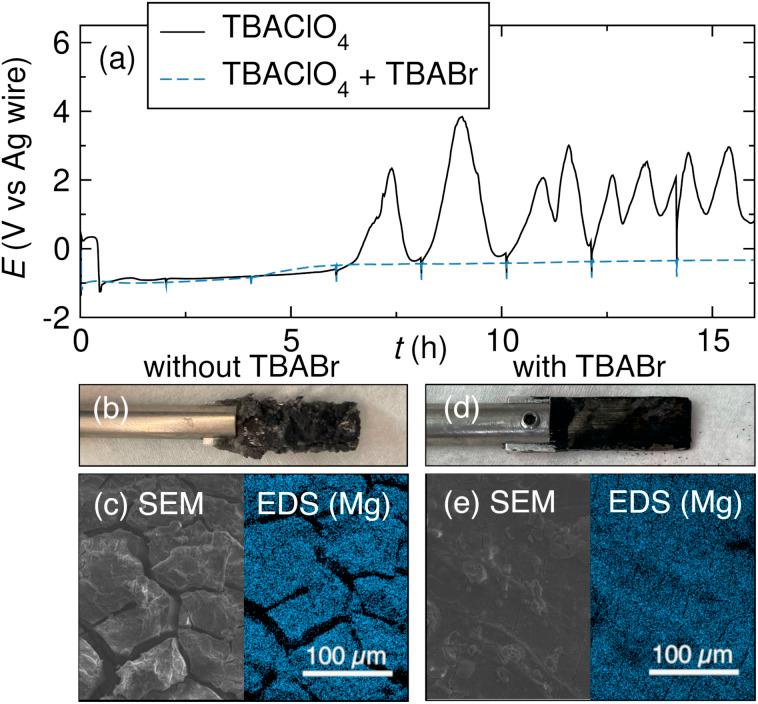
The development of reductive electrosynthetic reactions is often enabled by the oxidation of a sacrificial metal anode, which charge-balances the reductive reaction of interest occurring at the cathode. The metal oxidation is frequently assumed to be straightforward and innocent relative to the chemistry of interest, but several processes can interfere with ideal sacrificial anode behavior, thereby limiting the success of reductive electrosynthetic reactions. These issues are compounded by a lack of reported observations and characterization of the anodes themselves, even when a failure at the anode is observed. Here, we weave lessons from electrochemistry, interfacial characterization, and organic synthesis to share strategies for overcoming issues related to sacrificial anodes in electrosynthesis. We highlight common but underexplored challenges with sacrificial anodes that cause reactions to fail, including detrimental side reactions between the anode or its cations and the components of the organic reaction, passivation of the anode surface by an insulating native surface film, accumulation of insulating byproducts at the anode surface during the reaction, and competitive reduction of sacrificial metal cations at the cathode. For each case, we propose experiments to diagnose and characterize the anode and explore troubleshooting strategies to overcome the challenge. We conclude by highlighting open questions in the field of sacrificial-anode-driven electrosynthesis and by indicating alternatives to traditional sacrificial anodes that could streamline reaction optimization.
还原性电合成反应的发展通常是通过牺牲金属阳极的氧化来实现的,这种氧化作用能使电荷与在阴极发生的目标还原反应达到平衡。相对于目标化学反应而言,金属氧化作用通常被认为是直接且无害的,但有几个过程可能会干扰理想的牺牲阳极行为,从而限制还原性电合成反应的成功。即使观察到阳极出现故障,由于缺乏对阳极本身的报道观察和表征,这些问题变得更加复杂。在这里,我们结合电化学、界面表征和有机合成方面的经验,分享克服电合成中与牺牲阳极相关问题的策略。我们强调了牺牲阳极常见但未被充分探索的挑战,这些挑战会导致反应失败,包括阳极或其阳离子与有机反应成分之间的有害副反应、阳极表面被绝缘的原生表面膜钝化、反应过程中绝缘副产物在阳极表面的积累以及阴极处牺牲金属阳离子的竞争性还原。对于每种情况,我们都提出了诊断和表征阳极的实验,并探索克服挑战的故障排除策略。我们通过强调牺牲阳极驱动的电合成领域中的开放性问题,并指出可以简化反应优化的传统牺牲阳极的替代方案来结束本文。






 Zotero 插件