
不同免疫疗法联合化疗作为小细胞肺癌一线治疗的疗效和安全性的网状meta 分析。
Efficacy and safety of different immunotherapies combined with chemotherapy as first-line therapy in patients with small cell lung cancer: a network meta-analysis.
机构信息
College of Acupuncture and Massage, Chengdu University of Traditional Chinese Medicine, Chengdu, China.
出版信息
Front Immunol. 2024 Apr 17;15:1362537. doi: 10.3389/fimmu.2024.1362537. eCollection 2024.
BACKGROUND
The efficacy and safety of different immunosuppressants combined with chemotherapy in treating patients with small-cell lung cancer (extensive-disease small-cell lung cancer, limited-disease small-cell lung cancer and relapsed small-cell lung cancer) are still unknown, and there are no reports directly comparing the efficacy and safety of other immunotherapies.
OBJECTIVE
This study aimed to compare the efficacy and safety of first-line immunotherapy combined with chemotherapy in patients with small-cell lung cancer.
METHOD
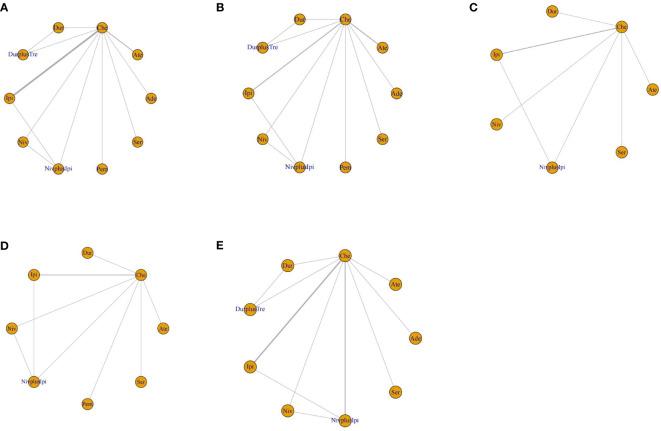
We searched Pubmed, Embase, Cochrane Library, CNKI, and Wanfang databases for relevant articles published from inception to November 11, 2020. The risk of bias of the included studies was conducted using the Cochrane risk-of-bias (RoB) tool. Multiple Bayesian network meta-analyses were performed. They conducted data analysis using R Studio and STATA version 15.1. The outcomes comprised overall survival (OS), progression-free survival (PFS), stability of response (SOR), duration of response (DOR) and adverse events of grade 3 or higher (AE grade≥3). A 95% confidence interval (CI) was provided for each estimate.
RESULTS
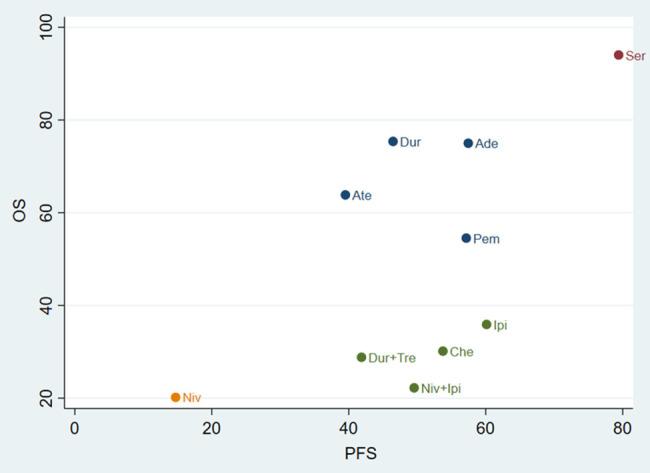
This meta-analysis included 16 RCT studies with 5898 patients. For OS, relative to chemotherapy (MD=-4.49; 95%CI [-7.97, -1.03]), durvalumab plus tremelimumab (MD=-4.62; 95%CI [-9.08, -0.11]), ipilimumab (MD=-4.26; 95%CI [-8.01, -0.3]) and nivolumab(MD=-5.66; 95%CI [-10.44, -1.11]) and nivolumab plus ipilimumab (MD=-4.56; 95%CI [-8.7, -0.1]), serplulimab can significantly increase the OS of SCLC patients. There was no significant difference between PFS, SOR and DOR. Analysis of AE showed that different immunotherapy combined chemotherapy regimens were similar to single chemotherapy regarding the overall incidence of AE grade≥3. However, after the cumulative ranking of the common symptoms of different adverse reactions, it was found that nivolumab ranked first in the occurrence probability of anemia (99.08%), fatigue (84.78%), and decreased appetite (89.66%). durvalumab was the most likely in nausea (75.4%). Pembrolizumab (76.24%) was most likely to cause pruritus. Chemotherapy combined with immunotherapy caused less diarrhea than chemotherapy alone (80.16%).
CONCLUSIONS
According to our analysis, serplulimab combined with chemotherapy is more likely to show better efficacy with a manageable safety profile for small-cell lung cancer. However, the evidence for this comparison shows some limitations due to the number of literature.
SYSTEMATIC REVIEW REGISTRATION
https://www.crd.york.ac.uk/PROSPERO/, identifier CRD42023486053.
背景
不同免疫抑制剂联合化疗治疗小细胞肺癌(广泛期小细胞肺癌、局限期小细胞肺癌和复发性小细胞肺癌)的疗效和安全性尚不清楚,也没有直接比较其他免疫疗法疗效和安全性的报道。
目的
本研究旨在比较小细胞肺癌一线免疫治疗联合化疗的疗效和安全性。
方法
我们检索了 Pubmed、Embase、Cochrane 图书馆、中国知网和万方数据库,检索时间从建库至 2020 年 11 月 11 日,纳入研究的偏倚风险采用 Cochrane 偏倚风险(RoB)工具进行评估。采用贝叶斯网状meta 分析进行多组分析。使用 R Studio 和 STATA 版本 15.1 进行数据分析。结果包括总生存期(OS)、无进展生存期(PFS)、缓解稳定性(SOR)、缓解持续时间(DOR)和 3 级及以上不良事件(AE 等级≥3)。每个估计值都提供了 95%置信区间(CI)。
结果
本 meta 分析纳入了 16 项 RCT 研究,共 5898 例患者。对于 OS,与化疗相比(MD=-4.49;95%CI [-7.97, -1.03]),durvalumab 联合 tremelimumab(MD=-4.62;95%CI [-9.08, -0.11])、ipilimumab(MD=-4.26;95%CI [-8.01, -0.3])和 nivolumab(MD=-5.66;95%CI [-10.44, -1.11])以及 nivolumab 联合 ipilimumab(MD=-4.56;95%CI [-8.7, -0.1]),serplulimab 能显著提高 SCLC 患者的 OS。PFS、SOR 和 DOR 无显著差异。AE 分析显示,不同免疫联合化疗方案与单药化疗相比,3 级及以上 AE 的总发生率相似。然而,在不同不良反应常见症状的累积排序后发现,nivolumab 在贫血(99.08%)、乏力(84.78%)和食欲下降(89.66%)的发生概率方面排名第一。durvalumab 在恶心(75.4%)方面最有可能。Pembrolizumab(76.24%)最易引起瘙痒。与单独化疗相比,化疗联合免疫治疗引起的腹泻更少(80.16%)。
结论
根据我们的分析,serplulimab 联合化疗在小细胞肺癌中可能表现出更好的疗效,且安全性可管理。然而,由于文献数量有限,这一比较的证据存在一些局限性。
系统综述注册
https://www.crd.york.ac.uk/PROSPERO/,标识符 CRD42023486053。



 Zotero 插件