
嵌合抗原受体(CAR)修饰的T细胞在急性髓系白血病中的应用:局限性与展望
Chimeric antigen receptor (CAR) modified T Cells in acute myeloid leukemia: limitations and expectations.
作者信息
Guijarro-Albaladejo Beatriz, Marrero-Cepeda Cristina, Rodríguez-Arbolí Eduardo, Sierro-Martínez Belén, Pérez-Simón José Antonio, García-Guerrero Estefanía
机构信息
Instituto de Biomedicina de Sevilla, IBiS/Hospital Universitario Virgen del Rocío/CSIC/Universidad de Sevilla, Servicio de Hematología, Hospital Universitario Virgen del Rocío, Seville, Spain.
Unidad de Gestión Clínica de Hematología, Instituto de Biomedicina de Sevilla, IBiS/Hospital Universitario Virgen del Rocío/CSIC/Universidad de Sevilla, Seville, Spain.
出版信息
Front Cell Dev Biol. 2024 Apr 17;12:1376554. doi: 10.3389/fcell.2024.1376554. eCollection 2024.
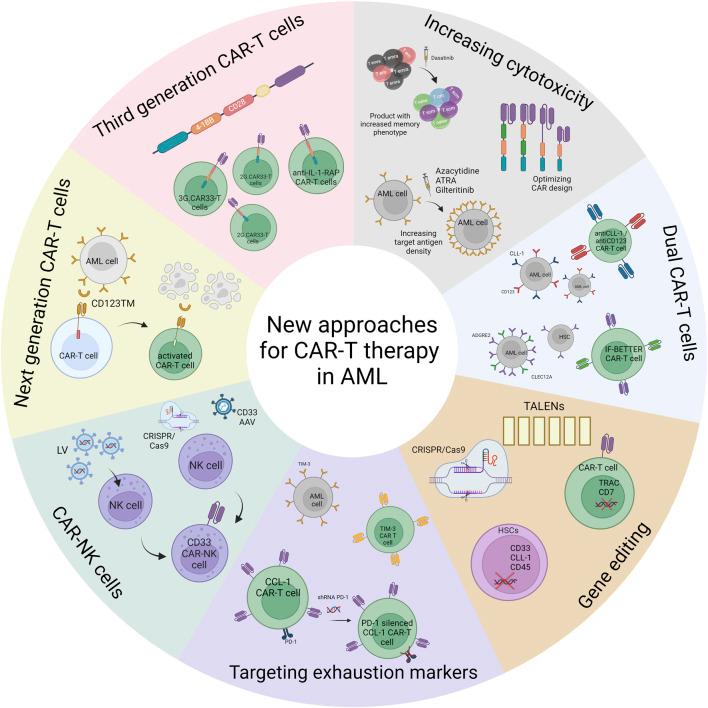
Acute myeloid leukemia (AML) is an aggressive hematologic malignancy with a poor prognosis despite the advent of novel therapies. Consequently, a major need exists for new therapeutic options, particularly for patients with relapsed/refractory (R/R) AML. In recent years, it has been possible to individualize the treatment of a subgroup of patients, particularly with the emergence of multiple targeted therapies. Nonetheless, a considerable number of patients remain without therapeutic options, and overall prognosis remains poor because of a high rate of disease relapse. In this sense, cellular therapies, especially chimeric antigen receptor (CAR)-T cell therapy, have dramatically shifted the therapeutic options for other hematologic malignancies, such as diffuse large B cell lymphoma and acute lymphoblastic leukemia. In contrast, effectively treating AML with CAR-based immunotherapy poses major biological and clinical challenges, most of them derived from the unmet need to identify target antigens with expression restricted to the AML blast without compromising the viability of the normal hematopoietic stem cell counterpart. Although those limitations have hampered CAR-T cell therapy translation to the clinic, there are several clinical trials where target antigens, such as CD123, CLL-1 or CD33 are being used to treat AML patients showing promising results. Moreover, there are continuing efforts to enhance the specificity and efficacy of CAR-T cell therapy in AML. These endeavors encompass the exploration of novel avenues, including the development of dual CAR-T cells and next-generation CAR-T cells, as well as the utilization of gene editing tools to mitigate off-tumor toxicities. In this review, we will summarize the ongoing clinical studies and the early clinical results reported with CAR-T cells in AML, as well as highlight CAR-T cell limitations and the most recent approaches to overcome these barriers. We will also discuss how and when CAR-T cells should be used in the context of AML.
急性髓系白血病(AML)是一种侵袭性血液系统恶性肿瘤,尽管有了新的治疗方法,但其预后仍然很差。因此,迫切需要新的治疗选择,特别是对于复发/难治性(R/R)AML患者。近年来,已经能够对一部分患者进行个体化治疗,特别是随着多种靶向治疗的出现。尽管如此,仍有相当数量的患者没有治疗选择,而且由于疾病复发率高,总体预后仍然很差。从这个意义上说,细胞疗法,特别是嵌合抗原受体(CAR)-T细胞疗法,已经极大地改变了其他血液系统恶性肿瘤的治疗选择,如弥漫性大B细胞淋巴瘤和急性淋巴细胞白血病。相比之下,用基于CAR的免疫疗法有效治疗AML带来了重大的生物学和临床挑战,其中大多数挑战源于尚未满足的需求,即识别仅在AML原始细胞上表达的靶抗原,同时又不损害正常造血干细胞的活力。尽管这些限制阻碍了CAR-T细胞疗法向临床的转化,但有几项临床试验正在使用CD123、CLL-1或CD33等靶抗原治疗AML患者,显示出有希望的结果。此外,人们一直在努力提高CAR-T细胞疗法在AML中的特异性和疗效。这些努力包括探索新的途径,包括开发双特异性CAR-T细胞和下一代CAR-T细胞,以及利用基因编辑工具来减轻肿瘤外毒性。在这篇综述中,我们将总结正在进行的临床研究以及用CAR-T细胞治疗AML所报告的早期临床结果,同时强调CAR-T细胞的局限性以及克服这些障碍的最新方法。我们还将讨论在AML的背景下应如何以及何时使用CAR-T细胞。
 Zotero 插件