
加纳家养动物和野生动物体内的肠道寄生虫卡耶塔环孢子球虫和人隐孢子虫
Enteric parasites Cyclospora cayetanensis and Cryptosporidium hominis in domestic and wildlife animals in Ghana.
作者信息
Oduro Daniel, Baafi Esther, Opoku-Agyeman Philip, Adams Tryphena, Okai Akweley Abena, Bruku Selassie, Kyei Sandra, Banahene Phillip, Danso-Coffie Caleb, Boafo Emmanuel, Yeboah Rhoda, Futagbi Godfred, Duah-Quashie Nancy Odurowah
机构信息
Department of Animal Biology and Conservation Science, School of Biological Sciences, College of Basic and Applied Sciences, University of Ghana, Accra, Ghana.
Department of Epidemiology, Noguchi Memorial Institute for Medical Research, College of Health Sciences, University of Ghana, Accra, Ghana.
出版信息
Parasit Vectors. 2024 May 2;17(1):199. doi: 10.1186/s13071-024-06225-5.
BACKGROUND
Enteric parasitic infections remain a major public health problem globally. Cryptosporidium spp., Cyclospora spp. and Giardia spp. are parasites that cause diarrhea in the general populations of both developed and developing countries. Information from molecular genetic studies on the speciation of these parasites and on the role of animals as vectors in disease transmission is lacking in Ghana. This study therefore investigated these diarrhea-causing parasites in humans, domestic rats and wildlife animals in Ghana using molecular tools.
METHODS
Fecal samples were collected from asymptomatic school children aged 9-12 years living around the Shai Hills Resource Reserve (tourist site), from wildlife (zebras, kobs, baboons, ostriches, bush rats and bush bucks) at the same site, from warthogs at the Mole National Park (tourist site) and from rats at the Madina Market (a popular vegetable market in Accra, Ghana. The 18S rRNA gene (18S rRNA) and 60-kDa glycoprotein gene (gp60) for Cryptosporidium spp., the glutamate dehydrogenase gene (gdh) for Giardia spp. and the 18S rDNA for Cyclospora spp. were analyzed in all samples by PCR and Sanger sequencing as markers of speciation and genetic diversity.
RESULTS
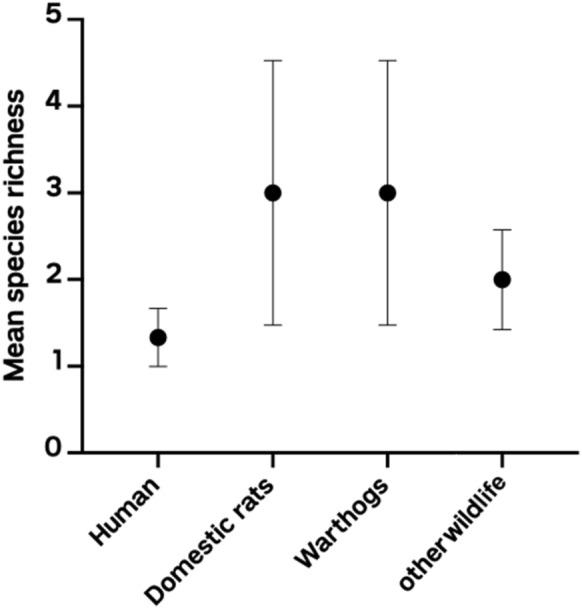
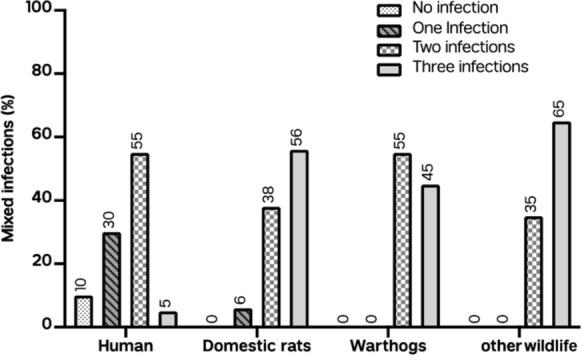
The parasite species identified in the fecal samples collected from humans and animals included the Cryptosporidium species C. hominis, C. muris, C. parvum, C. tyzzeri, C. meleagridis and C. andersoni; the Cyclopora species C. cayetanensis; and the Gardia species, G. lamblia and G. muris. For Cryptosporidium, the presence of the gp60 gene confirmed the finding of C. parvum (41%, 35/85 samples) and C. hominis (29%, 27/85 samples) in animal samples. Cyclospora cayetanensis was found in animal samples for the first time in Ghana. Only one human sample (5%, 1/20) but the majority of animal samples (58%, 51/88) had all three parasite species in the samples tested.
CONCLUSIONS
Based on these results of fecal sample testing for parasites, we conclude that animals and human share species of the three genera (Cryptosporidium, Cyclospora, Giardia), with the parasitic species mostly found in animals also found in human samples, and vice-versa. The presence of enteric parasites as mixed infections in asymptomatic humans and animal species indicates that they are reservoirs of infections. This is the first study to report the presence of C. cayetanensis and C. hominis in animals from Ghana. Our findings highlight the need for a detailed description of these parasites using high-throughput genetic tools to further understand these parasites and the neglected tropical diseases they cause in Ghana where such information is scanty.
背景
肠道寄生虫感染在全球范围内仍然是一个主要的公共卫生问题。隐孢子虫属、环孢子虫属和贾第虫属是在发达国家和发展中国家的普通人群中引起腹泻的寄生虫。加纳缺乏关于这些寄生虫物种形成以及动物作为疾病传播媒介作用的分子遗传学研究信息。因此,本研究使用分子工具对加纳的人类、家鼠和野生动物中的这些致腹泻寄生虫进行了调查。
方法
从居住在沙伊山资源保护区(旅游景点)周边的9至12岁无症状学童、同一地点的野生动物(斑马、水羚、狒狒、鸵鸟、林鼠和薮羚)、莫尔国家公园(旅游景点)的疣猪以及马迪纳市场(加纳阿克拉一个受欢迎的蔬菜市场)的大鼠中采集粪便样本。通过聚合酶链反应(PCR)和桑格测序分析所有样本中的隐孢子虫属18S核糖体RNA基因(18S rRNA)和60 kDa糖蛋白基因(gp60)、贾第虫属谷氨酸脱氢酶基因(gdh)以及环孢子虫属18S核糖体DNA(18S rDNA),作为物种形成和遗传多样性的标记。
结果
在从人类和动物采集的粪便样本中鉴定出的寄生虫物种包括隐孢子虫属的人隐孢子虫、鼠隐孢子虫、微小隐孢子虫、泰勒氏隐孢子虫、火鸡隐孢子虫和安氏隐孢子虫;环孢子虫属的卡耶坦环孢子虫;以及贾第虫属的蓝氏贾第鞭毛虫和鼠贾第虫。对于隐孢子虫,gp60基因的存在证实了在动物样本中发现微小隐孢子虫(41%,35/85个样本)和人隐孢子虫(29%,27/85个样本)。卡耶坦环孢子虫首次在加纳的动物样本中被发现。在检测的样本中,只有一个人类样本(5%,1/20)含有所有三种寄生虫物种,但大多数动物样本(58%,51/88)含有这三种寄生虫物种。
结论
基于这些粪便样本寄生虫检测结果,我们得出结论,动物和人类共享这三个属(隐孢子虫属、环孢子虫属、贾第虫属)的物种,在动物中发现的寄生物种大多也存在于人类样本中,反之亦然。无症状人类和动物物种中存在肠道寄生虫混合感染表明它们是感染源。这是首次报道在加纳动物中存在卡耶坦环孢子虫和人隐孢子虫的研究。我们的研究结果强调需要使用高通量基因工具对这些寄生虫进行详细描述,以进一步了解这些寄生虫以及它们在加纳引起的被忽视的热带疾病,因为那里此类信息匮乏。
 Zotero 插件