
BNT162b2 或 mRNA-1273 异源加强接种后 SARS-CoV-2 IgA、IgG、中和和总抗体反应的随访和比较评估。
Follow-Up and Comparative Assessment of SARS-CoV-2 IgA, IgG, Neutralizing, and Total Antibody Responses After BNT162b2 or mRNA-1273 Heterologous Booster Vaccination.
机构信息
Biomedical Sciences Department, College of Health Sciences, Qatar University, Doha, Qatar.
Biomedical Research Center, Qatar University, Doha, Qatar.
出版信息
Influenza Other Respir Viruses. 2024 May;18(5):e13290. doi: 10.1111/irv.13290.
BACKGROUND
Priming with ChAdOx1 followed by heterologous boosting is considered in several countries. Nevertheless, analyses comparing the immunogenicity of heterologous booster to homologous primary vaccination regimens and natural infection are lacking. In this study, we aimed to conduct a comparative assessment of the immunogenicity between homologous primary vaccination regimens and heterologous prime-boost vaccination using BNT162b2 or mRNA-1273.
METHODS
We matched vaccinated naïve (VN) individuals (n = 673) with partial vaccination (n = 64), primary vaccination (n = 590), and primary series plus mRNA vaccine heterologous booster (n = 19) with unvaccinated naturally infected (NI) individuals with a documented primary SARS-CoV-2 infection (n = 206). We measured the levels of neutralizing total antibodies (NTAbs), total antibodies (TAbs), anti-S-RBD IgG, and anti-S1 IgA titers.
RESULTS
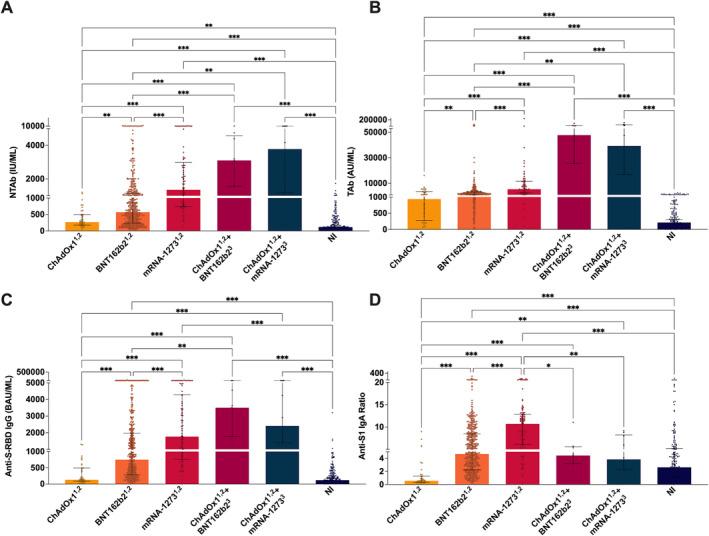
Homologous primary vaccination with ChAdOx1 not only showed less potent NTAb, TAb, anti-S-RBD IgG, and anti-S1 IgA immune responses compared to primary BNT162b2 or mRNA-1273 vaccination regimens (p < 0.05) but also showed ~3-fold less anti-S1 IgA response compared to infection-induced immunity (p < 0.001). Nevertheless, a heterologous booster led to an increase of ~12 times in the immune response when compared to two consecutive homologous ChAdOx1 immunizations. Furthermore, correlation analyses revealed that both anti-S-RBD IgG and anti-S1 IgA significantly contributed to virus neutralization among NI individuals, particularly in symptomatic and pauci-symptomatic individuals, whereas among VN individuals, anti-S-RBD IgG was the main contributor to virus neutralization.
CONCLUSION
The results emphasize the potential benefit of using heterologous mRNA boosters to increase antibody levels and neutralizing capacity particularly in patients who received primary vaccination with ChAdOx1.
背景
在多个国家,人们考虑使用 ChAdOx1 进行基础免疫,然后进行异源加强免疫。然而,缺乏比较异源加强免疫与同源基础免疫方案和自然感染的免疫原性的分析。在这项研究中,我们旨在使用 BNT162b2 或 mRNA-1273 对同源基础免疫方案和异源 priming-boost 免疫接种的免疫原性进行比较评估。
方法
我们将接种过疫苗的未感染(VN)个体(n=673)与部分接种(n=64)、基础接种(n=590)和基础接种系列外加 mRNA 疫苗异源加强(n=19)与有记录的原发性 SARS-CoV-2 感染的未接种自然感染(NI)个体(n=206)相匹配。我们测量了中和总抗体(NTAbs)、总抗体(TAbs)、抗-S-RBD IgG 和抗-S1 IgA 滴度。
结果
与基础 BNT162b2 或 mRNA-1273 疫苗接种方案相比,ChAdOx1 同源基础接种不仅显示出较弱的 NTAb、TAbs、抗-S-RBD IgG 和抗-S1 IgA 免疫反应(p<0.05),而且与感染诱导的免疫反应相比,抗-S1 IgA 反应也低了约 3 倍(p<0.001)。然而,与两次连续的 ChAdOx1 免疫接种相比,异源加强免疫导致免疫反应增加了约 12 倍。此外,相关性分析显示,在 NI 个体中,抗-S-RBD IgG 和抗-S1 IgA 均显著有助于病毒中和,尤其是在有症状和轻症个体中,而在 VN 个体中,抗-S-RBD IgG 是病毒中和的主要贡献者。
结论
这些结果强调了使用异源 mRNA 加强剂来提高抗体水平和中和能力的潜在益处,特别是在那些接受 ChAdOx1 基础免疫的患者中。




 Zotero 插件