
基于机器学习的法国 5 年出生队列中 RSV 严重感染风险分层
RSV Severe Infection Risk Stratification in a French 5-Year Birth Cohort Using Machine-learning.
机构信息
From the Hospices Civils de Lyon, Hôpital Femme Mère Enfant, Service de Réanimation Pédiatrique et d'Accueil des Urgences, Bron, France.
Center of Excellence in Respiratory Pathogens (CERP), Hospices Civils de Lyon and Centre International de Recherche en Infectiologie (CIRI), Équipe Santé publique, épidémiologie et écologie évolutive des maladies infectieuses (PHE3ID), Inserm U1111, CNRS UMR5308, ENS de Lyon, Université Claude Bernard - Lyon 1, Lyon, France.
出版信息
Pediatr Infect Dis J. 2024 Sep 1;43(9):819-824. doi: 10.1097/INF.0000000000004375. Epub 2024 May 7.
BACKGROUND
Respiratory syncytial virus (RSV) poses a substantial threat to infants, often leading to challenges in hospital capacity. With recent pharmaceutical developments to be used during the prenatal and perinatal periods aimed at decreasing the RSV burden, there is a pressing need to identify infants at risk of severe disease. We aimed to stratify the risk of developing a clinically severe RSV infection in infants under 1 year of age.
METHODS
This retrospective observational study was conducted at the Hospices Civils de Lyon, France, involving infants born between 2014 and 2018. This study focused on infants hospitalized with severe and very severe acute lower respiratory tract infections associated with RSV (SARI-WI group). Data collection included perinatal information and clinical data, with machine-learning algorithms used to discriminate SARI-WI cases from nonhospitalized infants.
RESULTS
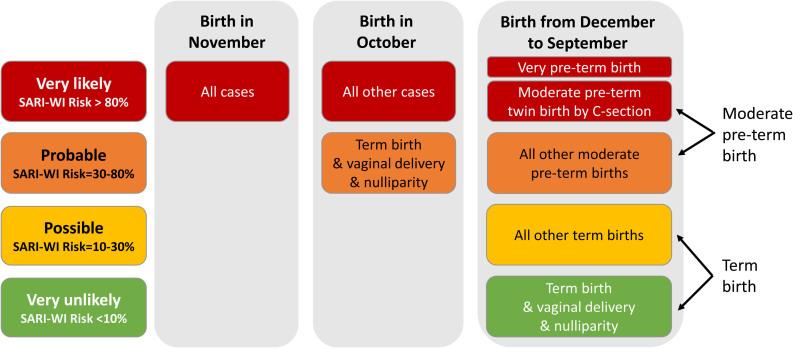
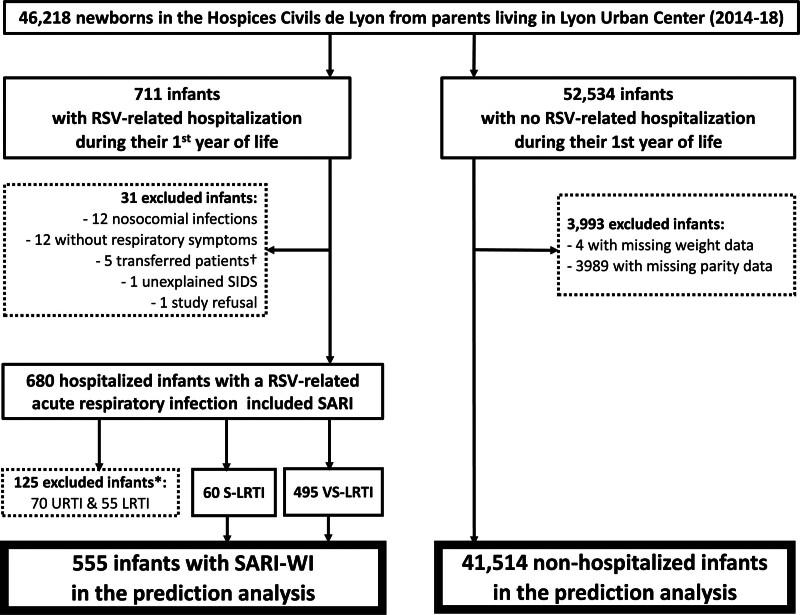
Of 42,069 infants, 555 developed SARI-WI. Infants born in November were very likely (>80%) predicted SARI-WI. Infants born in October were very likely predicted SARI-WI except for births at term by vaginal delivery and without siblings. Infants were very unlikely (<10%) predicted SARI-WI when all the following conditions were met: born in other months, at term, by vaginal delivery and without siblings. Other infants were possibly (10-30%) or probably (30-80%) predicted SARI-WI.
CONCLUSIONS
Although RSV preventive measures are vital for all infants, and specific recommendations exist for patients with high-risk comorbidities, in situations where prioritization becomes necessary, infants born just before or within the early weeks of the epidemic should be considered as a risk group.
背景
呼吸道合胞病毒(RSV)对婴儿构成重大威胁,经常导致医院容量不足。随着最近在产前和围产期使用的药物开发旨在降低 RSV 负担,迫切需要确定患有严重疾病风险的婴儿。我们旨在对 1 岁以下婴儿发生临床严重 RSV 感染的风险进行分层。
方法
这是一项在法国里昂民事医院进行的回顾性观察研究,涉及 2014 年至 2018 年期间出生的婴儿。本研究重点关注因 RSV 导致严重和非常严重急性下呼吸道感染而住院的婴儿(SARI-WI 组)。数据收集包括围产期信息和临床数据,使用机器学习算法将 SARI-WI 病例与未住院的婴儿区分开来。
结果
在 42069 名婴儿中,有 555 名发生 SARI-WI。11 月出生的婴儿很可能(>80%)预测会发生 SARI-WI。10 月出生的婴儿很可能预测会发生 SARI-WI,但足月通过阴道分娩且没有兄弟姐妹的情况除外。如果满足以下所有条件,婴儿不太可能(<10%)预测会发生 SARI-WI:在其他月份出生、足月、通过阴道分娩且没有兄弟姐妹。其他婴儿可能(10-30%)或可能(30-80%)预测会发生 SARI-WI。
结论
虽然 RSV 预防措施对所有婴儿都很重要,并且针对高风险合并症的患者有具体建议,但在需要优先考虑的情况下,应将在流行前或早期几周内出生的婴儿视为风险群体。
 Zotero 插件