
Luc7 剪接因子锌指模块的功能分析。
Functional analysis of the zinc finger modules of the splicing factor Luc7.
机构信息
Department of Biochemistry, University of Wisconsin-Madison, Madison, Wisconsin 53706, USA.
Department of Chemistry and Biochemistry, University of California, Los Angeles, Los Angeles, California 90095, USA.
出版信息
RNA. 2024 Jul 16;30(8):1058-1069. doi: 10.1261/rna.079956.124.
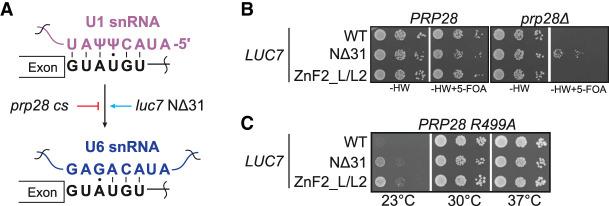
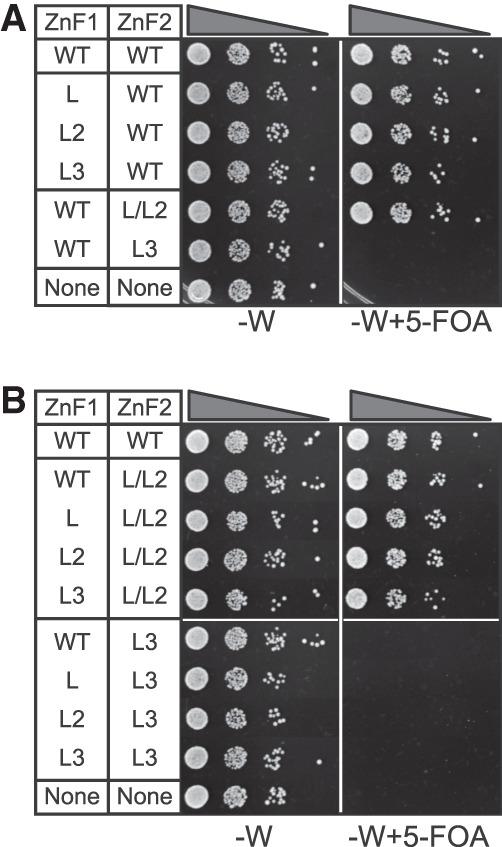
Identification of splice sites is a critical step in pre-messenger RNA (pre-mRNA) splicing because the definition of the exon/intron boundaries controls what nucleotides are incorporated into mature mRNAs. The intron boundary with the upstream exon is initially identified through interactions with the U1 small nuclear ribonucleoprotein (snRNP). This involves both base-pairing between the U1 snRNA and the pre-mRNA as well as snRNP proteins interacting with the 5' splice site (5'ss)/snRNA duplex. In yeast, this duplex is buttressed by two conserved protein factors, Yhc1 and Luc7. Luc7 has three human paralogs (LUC7L, LUC7L2, and LUC7L3), which play roles in alternative splicing. What domains of these paralogs promote splicing at particular sites is not yet clear. Here, we humanized the zinc finger (ZnF) domains of the yeast Luc7 protein in order to understand their roles in splice site selection using reporter assays, transcriptome analysis, and genetic interactions. Although we were unable to determine a function for the first ZnF domain, humanization of the second ZnF domain to mirror that found in LUC7L or LUC7L2 resulted in altered usage of nonconsensus 5'ss. In contrast, the corresponding ZnF domain of LUC7L3 could not support yeast viability. Further, humanization of Luc7 can suppress mutation of the ATPase Prp28, which is involved in U1 release and exchange for U6 at the 5'ss. Our work reveals a role for the second ZnF of Luc7 in splice site selection and suggests that different ZnF domains may have different ATPase requirements for release by Prp28.
剪接位点的鉴定是前信使 RNA(pre-mRNA)剪接的关键步骤,因为外显子/内含子边界的定义控制着哪些核苷酸被纳入成熟的 mRNAs。与上游外显子的内含子边界最初是通过与 U1 小核核糖核蛋白(snRNP)的相互作用来识别的。这涉及到 U1 snRNA 与 pre-mRNA 之间的碱基配对,以及 snRNP 蛋白与 5'剪接位点(5'ss)/snRNA 双链的相互作用。在酵母中,这个双链体由两个保守的蛋白质因子 Yhc1 和 Luc7 支撑。Luc7 有三个人类同源物(LUC7L、LUC7L2 和 LUC7L3),它们在可变剪接中发挥作用。这些同源物的哪些结构域促进特定位点的剪接尚不清楚。在这里,我们对酵母 Luc7 蛋白的锌指(ZnF)结构域进行了人源化,以便通过报告基因检测、转录组分析和遗传相互作用来了解它们在剪接位点选择中的作用。尽管我们无法确定第一个 ZnF 结构域的功能,但将第二个 ZnF 结构域人源化以反映在 LUC7L 或 LUC7L2 中发现的结构域,导致非保守 5'ss 的使用发生改变。相比之下,LUC7L3 的相应 ZnF 结构域不能支持酵母的生存能力。此外,Luc7 的人源化可以抑制涉及 U1 释放和在 5'ss 处交换 U6 的 ATP 酶 Prp28 的突变。我们的工作揭示了 Luc7 的第二个 ZnF 在剪接位点选择中的作用,并表明不同的 ZnF 结构域可能对 Prp28 的释放有不同的 ATP 酶要求。



 Zotero 插件