
美国乳腺癌患者的治疗拒绝、种族和民族差异与总生存。
Declination of Treatment, Racial and Ethnic Disparity, and Overall Survival in US Patients With Breast Cancer.
机构信息
Department of Public Health Sciences, University of Chicago, Chicago, Illinois.
Center for Health and the Social Sciences, University of Chicago, Chicago, Illinois.
出版信息
JAMA Netw Open. 2024 May 1;7(5):e249449. doi: 10.1001/jamanetworkopen.2024.9449.
IMPORTANCE
Declining treatment negatively affects health outcomes among patients with cancer. Limited research has investigated national trends of and factors associated with treatment declination or its association with overall survival (OS) among patients with breast cancer.
OBJECTIVES
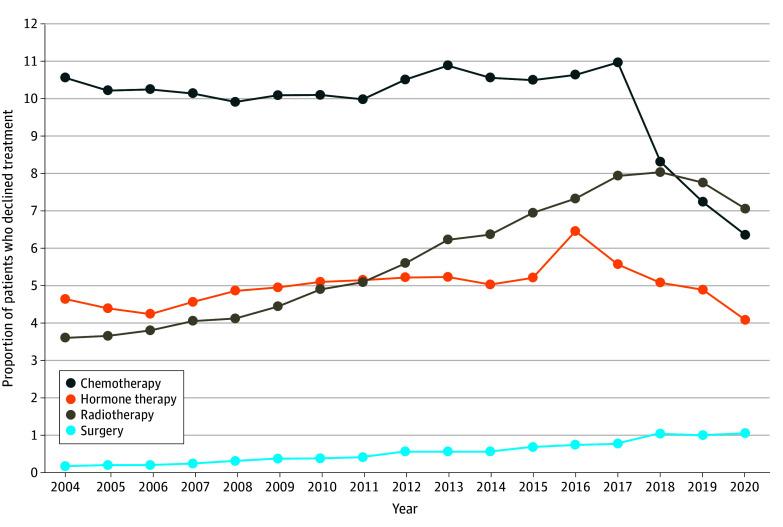
To examine trends and racial and ethnic disparities in treatment declination and racial and ethnic OS differences stratified by treatment decision in US patients with breast cancer.
DESIGN, SETTING, AND PARTICIPANTS: This retrospective cross-sectional study used data for patients with breast cancer from the 2004 to 2020 National Cancer Database. Four treatment modalities were assessed: chemotherapy, hormone therapy (HT), radiotherapy, and surgery. The chemotherapy cohort included patients with stage I to IV disease. The HT cohort included patients with stage I to IV hormone receptor-positive disease. The radiotherapy and surgery cohorts included patients with stage I to III disease. Data were analyzed from March to November 2023.
EXPOSURE
Race and ethnicity and other sociodemographic and clinicopathologic characteristics.
MAIN OUTCOMES AND MEASURES
Treatment decision, categorized as received or declined, was modeled using logistic regression. OS was modeled using Cox regression. Models were controlled for year of initial diagnosis, age, sex, health insurance, median household income, facility type, Charlson-Deyo comorbidity score, histology, American Joint Committee on Cancer stage, molecular subtype, and tumor grade.
RESULTS
The study included 2 837 446 patients (mean [SD] age, 61.6 [13.4] years; 99.1% female), with 1.7% American Indian, Alaska Native, or other patients; 3.5% Asian or Pacific Islander patients; 11.2% Black patients; 5.6% Hispanic patients; and 78.0% White patients. Of 1 296 488 patients who were offered chemotherapy, 124 721 (9.6%) declined; 99 276 of 1 635 916 patients (6.1%) declined radiotherapy; 94 363 of 1 893 339 patients (5.0%) declined HT; and 15 846 of 2 590 963 patients (0.6%) declined surgery. Compared with White patients, American Indian, Alaska Native, or other patients (adjusted odds ratio [AOR], 1.47; 95% CI, 1.26-1.72), Asian or Pacific Islander patients (AOR, 1.29; 95% CI, 1.15-1.44), and Black patients (AOR, 2.01; 95% CI, 1.89-2.14) were more likely to decline surgery; American Indian, Alaska Native, or other patients (AOR, 1.13; 95% CI, 1.05-1.21) and Asian or Pacific Islander patients (AOR, 1.21; 95% CI, 1.16-1.27) were more likely to decline chemotherapy; and Black patients were more likely to decline radiotherapy (AOR, 1.05; 95% CI, 1.02-1.08). Asian or Pacific Islander patients (AOR, 0.81; 95% CI, 0.77-0.85), Black patients (AOR, 0.86; 95% CI, 0.83-0.89), and Hispanic patients (AOR, 0.66; 95% CI, 0.63-0.69) were less likely to decline HT. Furthermore, Black patients who declined chemotherapy had a higher mortality risk than White patients (adjusted hazard ratio [AHR], 1.07; 95% CI, 1.02-1.13), while there were no OS differences between Black and White patients who declined HT (AHR, 1.05; 95% CI, 0.97-1.13) or radiotherapy (AHR, 0.98; 95% CI, 0.92-1.04).
CONCLUSIONS AND RELEVANCE
This cross-sectional study highlights racial and ethnic disparities in treatment declination and OS, suggesting the need for equity-focused interventions, such as patient education on treatment benefits and improved patient-clinician communication and shared decision-making, to reduce disparities and improve patient survival.
重要性
治疗的减少会对癌症患者的健康结果产生负面影响。有限的研究调查了美国乳腺癌患者治疗减少的全国趋势和相关因素,以及其与总生存(OS)的关联。
目的
研究美国乳腺癌患者治疗决定中治疗减少的趋势和种族和民族差异,以及按治疗决策分层的种族和民族 OS 差异。
设计、设置和参与者:这项回顾性的横断面研究使用了来自 2004 年至 2020 年国家癌症数据库的乳腺癌患者数据。评估了四种治疗方式:化疗、激素治疗(HT)、放疗和手术。化疗队列包括 I 期至 IV 期疾病患者。HT 队列包括 I 期至 IV 期激素受体阳性疾病患者。放疗和手术队列包括 I 期至 III 期疾病患者。数据分析于 2023 年 3 月至 11 月进行。
暴露
种族和民族以及其他社会人口统计学和临床病理特征。
主要结果和措施
使用逻辑回归模型对治疗决定(分为接受或拒绝)进行建模。使用 Cox 回归模型对 OS 进行建模。模型控制了初始诊断年份、年龄、性别、健康保险、中位数家庭收入、医疗机构类型、Charlson-Deyo 合并症评分、组织学、美国癌症联合委员会分期、分子亚型和肿瘤分级。
结果
研究纳入了 2837446 名患者(平均[SD]年龄,61.6[13.4]岁;99.1%为女性),其中 1.7%为美洲印第安人、阿拉斯加原住民或其他人群;3.5%为亚洲或太平洋岛民患者;11.2%为黑人患者;5.6%为西班牙裔患者;78.0%为白人患者。在 1296488 名接受化疗的患者中,有 124721 名(9.6%)拒绝化疗;在 1635916 名接受放疗的患者中,有 99276 名(6.1%)拒绝放疗;在 1893339 名接受 HT 的患者中,有 94363 名(5.0%)拒绝 HT;在 2590963 名接受手术的患者中,有 15846 名(0.6%)拒绝手术。与白人患者相比,美洲印第安人、阿拉斯加原住民或其他人群(调整后的优势比[OR],1.47;95%CI,1.26-1.72)、亚洲或太平洋岛民患者(OR,1.29;95%CI,1.15-1.44)和黑人患者(OR,2.01;95%CI,1.89-2.14)更有可能拒绝手术;美洲印第安人、阿拉斯加原住民或其他人群(OR,1.13;95%CI,1.05-1.21)和亚洲或太平洋岛民患者(OR,1.21;95%CI,1.16-1.27)更有可能拒绝化疗;黑人患者更有可能拒绝放疗(OR,1.05;95%CI,1.02-1.08)。亚洲或太平洋岛民患者(OR,0.81;95%CI,0.77-0.85)、黑人患者(OR,0.86;95%CI,0.83-0.89)和西班牙裔患者(OR,0.66;95%CI,0.63-0.69)更不可能拒绝 HT。此外,拒绝化疗的黑人患者的死亡率高于白人患者(调整后的危害比[AHR],1.07;95%CI,1.02-1.13),而拒绝 HT 的黑人患者和白人患者的 OS 没有差异(AHR,1.05;95%CI,0.97-1.13)或放疗(AHR,0.98;95%CI,0.92-1.04)。
结论和相关性
这项横断面研究强调了治疗减少和 OS 方面的种族和民族差异,表明需要采取以公平为重点的干预措施,如对治疗益处的患者教育,以及改善患者-临床医生沟通和共同决策,以减少差异并提高患者生存。

 Zotero 插件