
中国高钠摄入导致的心血管疾病负担:1990 年至 2019 年的纵向研究。
Cardiovascular Disease Burden Attributable to High Sodium Intake in China: A Longitudinal Study from 1990 to 2019.
机构信息
Jiading Central Hospital, Shanghai University of Medicine & Health Sciences, Shanghai 201899, China.
Department of Prevention Medicine, College of Public Health, Shanghai University of Medicine & Health Sciences, Shanghai 201318, China.
出版信息
Nutrients. 2024 Apr 26;16(9):1307. doi: 10.3390/nu16091307.
BACKGROUND
Overconsumption of sodium has been identified as a key driving factor for diet-related cardiovascular diseases (CVDs). China, being a country bearing a hefty burden of CVD, has a large population with diverse cultural traditions and ethnic beliefs, which complicates the patterns of dietary sodium intake, necessitating a systematic investigation into the profile of the high sodium intake (HSI)-related burden of CVD within its subregions. This study aims to estimate the evolving patterns of HSI-induced CVD burden across China from 1990 to 2019.
METHODS
The methodology used in the Global Burden of Disease Study was followed to assess deaths and disability-adjusted life years (DALYs) by age, sex, region, and socio-demographic index (SDI). The estimated annual percentage change (EAPC) was calculated to quantify the secular changes in the age-standardized mortality rate (ASMR) and age-standardized DALY rate (ASDR).
RESULTS
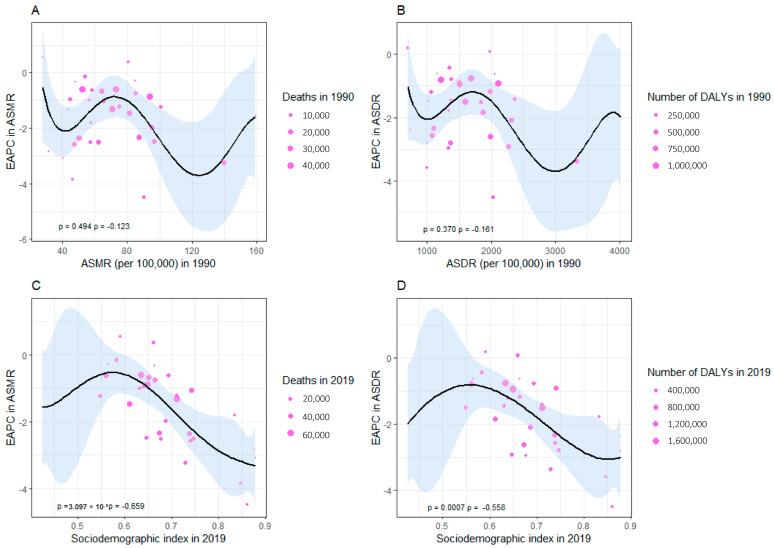
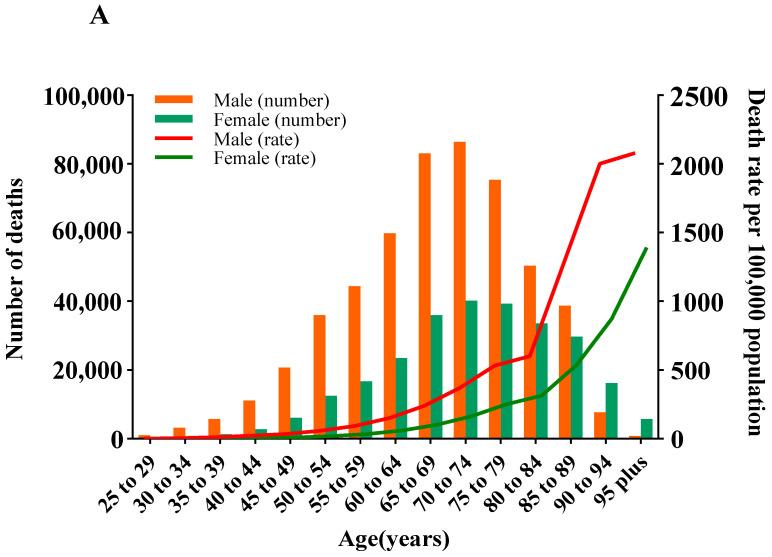
In 2019, 0.79 million deaths and 1.93 million DALYs of CVD were attributed to HSI, an increase of 53.91% and 39.39% since 1990, respectively. Nevertheless, a downward trend in ASMR (EAPC: -1.45, 95% CI: -1.55, -1.35) and ASDR (EAPC: -1.61, 95% CI: -1.68, -1.53) was detected over time. ASMR and ASDR were higher for males, individuals aged ≥60 years, and regions with low-middle SDI. A markedly negative association between the EAPC in both ASMR and ASDR and the SDI was found in 2019 (ρ = -0.659, < 0.001 and ρ = -0.558, < 0.001, respectively).
CONCLUSIONS
The HSI-induced CVD burden is gender-, age-, and socioeconomic-dependent. Integrated and targeted strategies for CVD prevention are anticipated in the future throughout China.
背景
摄入过多的钠已被确定为与饮食相关的心血管疾病(CVD)的一个关键驱动因素。中国是一个 CVD 负担沉重的国家,拥有庞大的人口,具有多样化的文化传统和民族信仰,这使得饮食中钠的摄入量模式变得复杂,需要对其各地区的高钠摄入(HSI)相关 CVD 负担情况进行系统调查。本研究旨在估计 1990 年至 2019 年期间中国 HSI 导致 CVD 负担的演变模式。
方法
本研究采用全球疾病负担研究方法,根据年龄、性别、地区和社会人口指数(SDI)评估死亡人数和伤残调整生命年(DALYs)。计算了估计的年变化百分比(EAPC),以量化年龄标准化死亡率(ASMR)和年龄标准化 DALY 率(ASDR)的长期变化。
结果
2019 年,HSI 导致 0.79 百万人死亡和 1.93 百万人 DALYs 的 CVD,分别比 1990 年增加了 53.91%和 39.39%。然而,随着时间的推移,ASMR(EAPC:-1.45,95%CI:-1.55,-1.35)和 ASDR(EAPC:-1.61,95%CI:-1.68,-1.53)呈下降趋势。男性、年龄≥60 岁和中低 SDI 地区的 ASMR 和 ASDR 更高。2019 年发现,ASMR 和 ASDR 的 EAPC 与 SDI 之间存在显著的负相关关系(ρ=-0.659,<0.001 和 ρ=-0.558,<0.001)。
结论
HSI 导致的 CVD 负担与性别、年龄和社会经济状况有关。预计未来中国将实施综合和有针对性的 CVD 预防策略。



 Zotero 插件