
基于双能CT小肠造影建立机器学习模型以评估克罗恩病的活动度。
Establishing a machine learning model based on dual-energy CT enterography to evaluate Crohn's disease activity.
作者信息
Li Junlin, Xie Gang, Tang Wuli, Zhang Lingqin, Zhang Yue, Zhang Lingfeng, Wang Danni, Li Kang
机构信息
North Sichuan Medical College, Nanchong, 637100, China.
Department of Radiology, Chongqing General Hospital, Chongqing, 401121, China.
出版信息
Insights Imaging. 2024 May 12;15(1):115. doi: 10.1186/s13244-024-01703-x.
OBJECTIVES
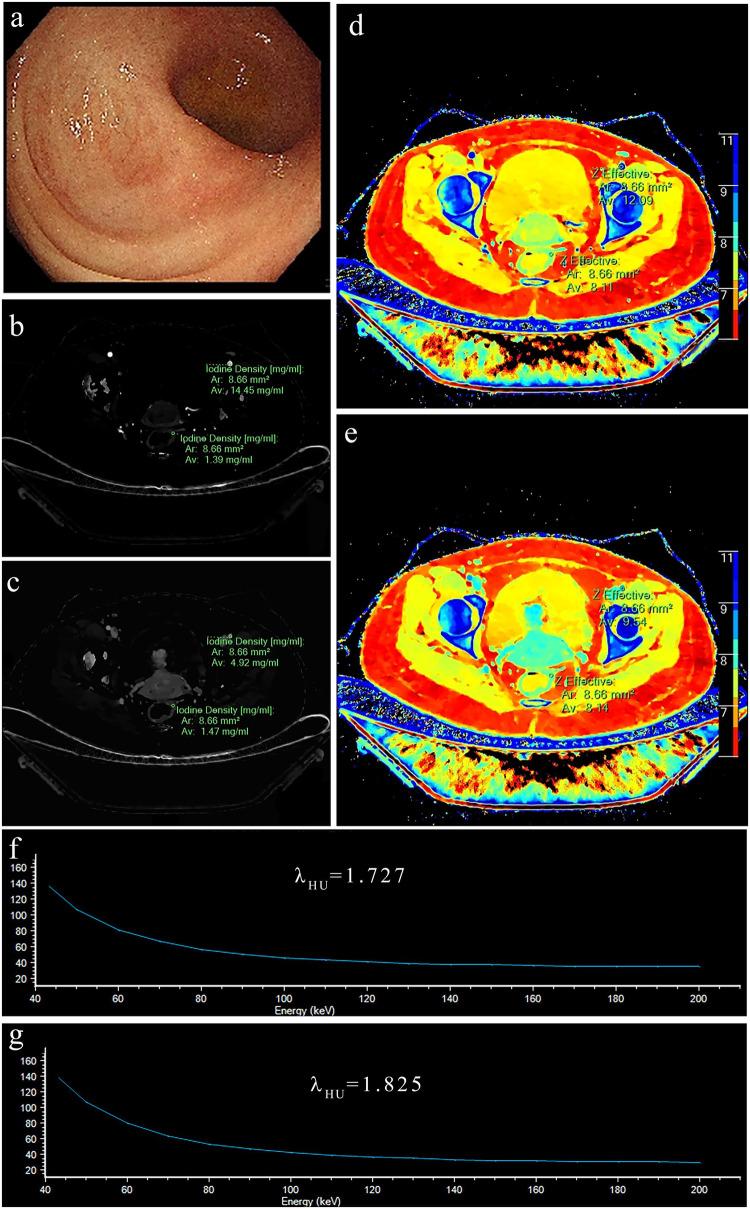
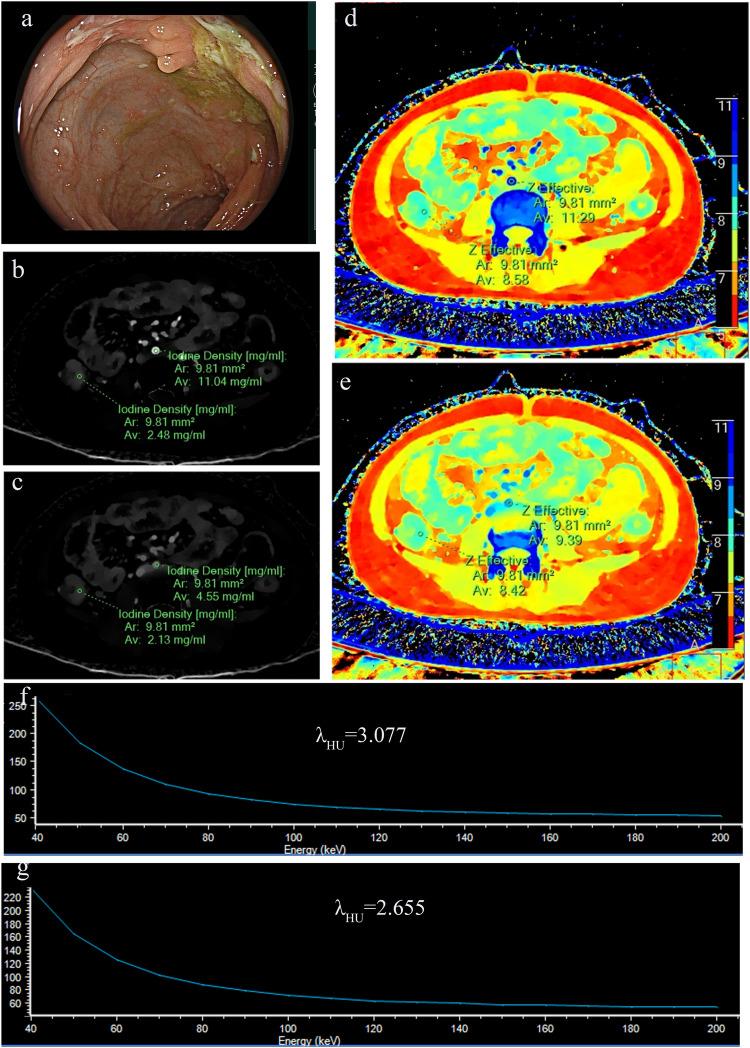
The simplified endoscopic score of Crohn's disease (SES-CD) is the gold standard for quantitatively evaluating Crohn's disease (CD) activity but is invasive. This study aimed to develop and validate a machine learning (ML) model based on dual-energy CT enterography (DECTE) to noninvasively evaluate CD activity.
METHODS
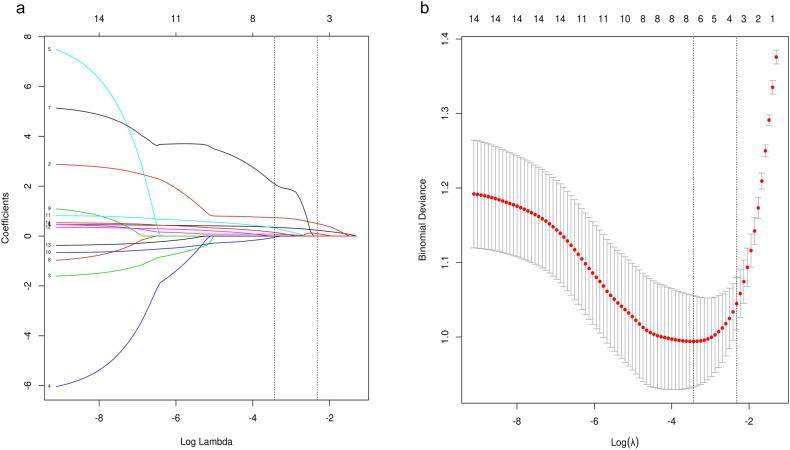
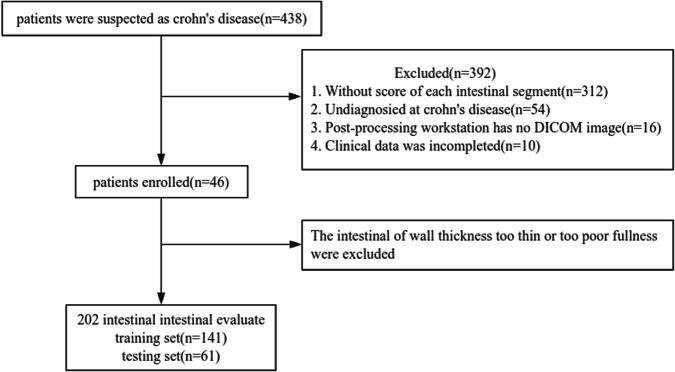
We evaluated the activity in 202 bowel segments of 46 CD patients according to the SES-CD score and divided the segments randomly into training set and testing set at a ratio of 7:3. Least absolute shrinkage and selection operator (LASSO) was used for feature selection, and three models based on significant parameters were established based on logistic regression. Model performance was evaluated using receiver operating characteristic (ROC), calibration, and clinical decision curves.
RESULTS
There were 110 active and 92 inactive bowel segments. In univariate analysis, the slope of spectral curve in the venous phases (λ-V) has the best diagnostic performance, with an area under the ROC curve (AUC) of 0.81 and an optimal threshold of 1.975. In the testing set, the AUC of the three models established by the 7 variables to differentiate CD activity was 0.81-0.87 (DeLong test p value was 0.071-0.766, p > 0.05), and the combined model had the highest AUC of 0.87 (95% confidence interval (CI): 0.779-0.959).
CONCLUSIONS
The ML model based the DECTE can feasibly evaluate CD activity, and DECTE parameters provide a quantitative analysis basis for evaluating specific bowel activities in CD patients.
CRITICAL RELEVANCE STATEMENT
The machine learning model based on dual-energy computed tomography enterography can be used for evaluating Crohn's disease activity noninvasively and quantitatively.
KEY POINTS
Dual-energy CT parameters are related to Crohn's disease activity. Three machine learning models effectively evaluated Crohn's disease activity. Combined models based on conventional and dual-energy CT have the best performance.
目的
克罗恩病简化内镜评分(SES-CD)是定量评估克罗恩病(CD)活动度的金标准,但具有侵入性。本研究旨在开发并验证一种基于双能量CT小肠造影(DECTE)的机器学习(ML)模型,以无创评估CD活动度。
方法
我们根据SES-CD评分评估了46例CD患者202个肠段的活动度,并将这些肠段以7:3的比例随机分为训练集和测试集。采用最小绝对收缩和选择算子(LASSO)进行特征选择,并基于逻辑回归建立了3个基于显著参数的模型。使用受试者工作特征(ROC)、校准和临床决策曲线评估模型性能。
结果
有110个活动肠段和92个非活动肠段。单因素分析中,静脉期光谱曲线斜率(λ-V)具有最佳诊断性能,ROC曲线下面积(AUC)为0.81,最佳阈值为1.975。在测试集中,由7个变量建立的用于区分CD活动度的3个模型的AUC为0.81-0.87(德龙检验p值为0.071-0.766,p>0.05),联合模型的AUC最高,为0.87(95%置信区间(CI):0.779-0.959)。
结论
基于DECTE的ML模型可有效评估CD活动度,且DECTE参数为评估CD患者特定肠段活动度提供了定量分析依据。
关键相关性声明
基于双能量计算机断层扫描小肠造影的机器学习模型可用于无创定量评估克罗恩病活动度。
要点
双能量CT参数与克罗恩病活动度相关。3个机器学习模型有效评估了克罗恩病活动度。基于传统和双能量CT的联合模型性能最佳。

 Zotero 插件