
与不宁腿综合征共存时满足人类需求的促进因素和障碍的体验:一项定性研究。
Experiences of facilitators and barriers for fulfilment of human needs when living with restless legs syndrome: a qualitative study.
机构信息
School of Health and Welfare, Jönköping University, Jönköping, Sweden.
Centre for Interprofessional Collaboration within Emergency Care (CICE), Linnaeus University, Växjö, Sweden.
出版信息
Int J Qual Stud Health Well-being. 2024 Dec;19(1):2348884. doi: 10.1080/17482631.2024.2348884. Epub 2024 May 12.
PURPOSE
Restless Legs Syndrome (RLS) is a widespread condition that affects sleep leading to daytime sleepiness, depression, and reduced quality of life. This study aims to determine and describe how patients with RLS experience their everyday life, with a focus on facilitators and barriers related to Maslow's hierarchical theory of human needs.
METHOD
Semi-structured interviews were analysed with qualitative content analysis resulting in facilitators and barriers affecting the fulfilment of the five human needs.
RESULTS
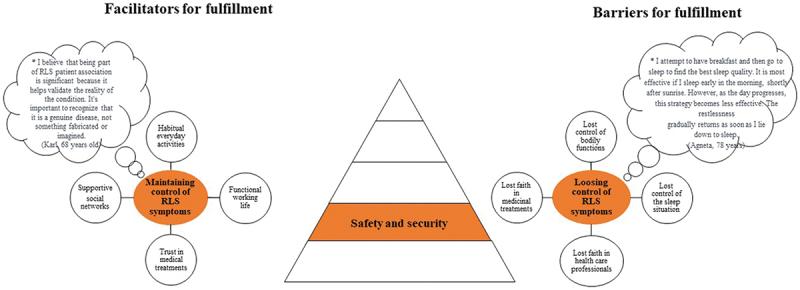
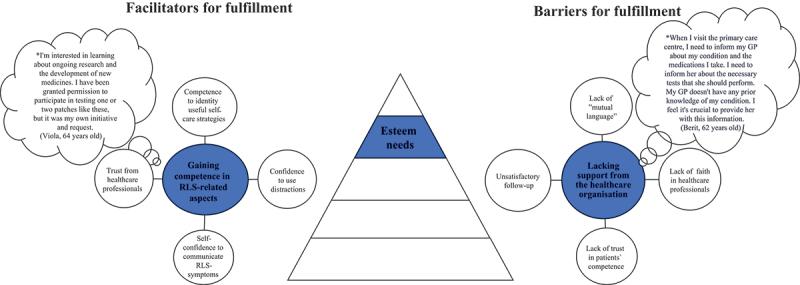
Addressing RLS symptoms through medications and a quiet sleep environment fulfils psychological needs. Control over RLS symptoms, engagement in activities, trust in treatments, and social support meet safety and security needs. Social inclusion, close relationships, and meaningful interactions fulfil a sense of belongingness and love needs despite RLS. Competence in managing RLS, effective self-care strategies, confident communication, and trust-building support esteem needs. Finally, comprehensive understanding through person-centred interventions and coping fulfils the self-actualization needs in managing RLS.
CONCLUSION
Holistic and person-centred interventions, including facilitators for the fulfilment of physiological, psychological, and social needs could help healthcare professionals to provide holistic care.
目的
不宁腿综合征(RLS)是一种广泛存在的病症,会影响睡眠质量,导致白天嗜睡、抑郁和生活质量下降。本研究旨在确定并描述 RLS 患者的日常生活体验,重点关注与马斯洛人类需求层次理论相关的促进因素和障碍。
方法
采用半结构式访谈,对其进行定性内容分析,得出影响满足人类五项需求的促进因素和障碍。
结果
通过药物治疗和安静的睡眠环境来缓解 RLS 症状,可以满足心理需求。对 RLS 症状的控制、参与活动、对治疗的信任以及社会支持可以满足安全和保障需求。尽管患有 RLS,但社会包容、亲密关系和有意义的互动可以满足归属感和爱的需求。管理 RLS 的能力、有效的自我护理策略、自信的沟通和建立信任可以支持尊重需求。最后,通过以患者为中心的干预措施和应对方式来全面理解,可以满足管理 RLS 时的自我实现需求。
结论
全面的、以患者为中心的干预措施,包括满足生理、心理和社会需求的促进因素,可以帮助医疗保健专业人员提供全面的护理。



 Zotero 插件