
利用自动化机器学习预测寻常型银屑病和银屑病关节炎患者即将进行的必要治疗变化并揭示对疾病进展的新影响:一项回顾性研究。
Using Automated Machine Learning to Predict Necessary Upcoming Therapy Changes in Patients With Psoriasis Vulgaris and Psoriatic Arthritis and Uncover New Influences on Disease Progression: Retrospective Study.
作者信息
Schaffert Daniel, Bibi Igor, Blauth Mara, Lull Christian, von Ahnen Jan Alwin, Gross Georg, Schulze-Hagen Theresa, Knitza Johannes, Kuhn Sebastian, Benecke Johannes, Schmieder Astrid, Leipe Jan, Olsavszky Victor
机构信息
Department of Dermatology, Venereology and Allergology, University Medical Center and Medical Faculty Mannheim, University of Heidelberg, and Center of Excellence in Dermatology, Mannheim, Germany.
Department of Medicine V, Division of Rheumatology, University Medical Center and Medical Faculty Mannheim, Mannheim, Germany.
出版信息
JMIR Form Res. 2024 Jun 27;8:e55855. doi: 10.2196/55855.
BACKGROUND
Psoriasis vulgaris (PsV) and psoriatic arthritis (PsA) are complex, multifactorial diseases significantly impacting health and quality of life. Predicting treatment response and disease progression is crucial for optimizing therapeutic interventions, yet challenging. Automated machine learning (AutoML) technology shows promise for rapidly creating accurate predictive models based on patient features and treatment data.
OBJECTIVE
This study aims to develop highly accurate machine learning (ML) models using AutoML to address key clinical questions for PsV and PsA patients, including predicting therapy changes, identifying reasons for therapy changes, and factors influencing skin lesion progression or an abnormal Bath Ankylosing Spondylitis Disease Activity Index (BASDAI) score.
METHODS
Clinical study data from 309 PsV and PsA patients were extensively prepared and analyzed using AutoML to build and select the most accurate predictive models for each variable of interest.
RESULTS
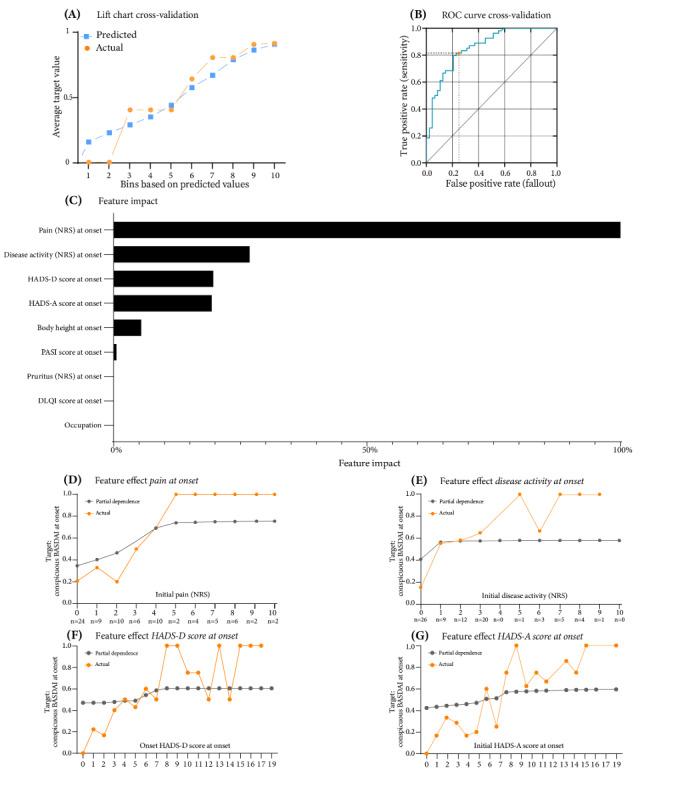
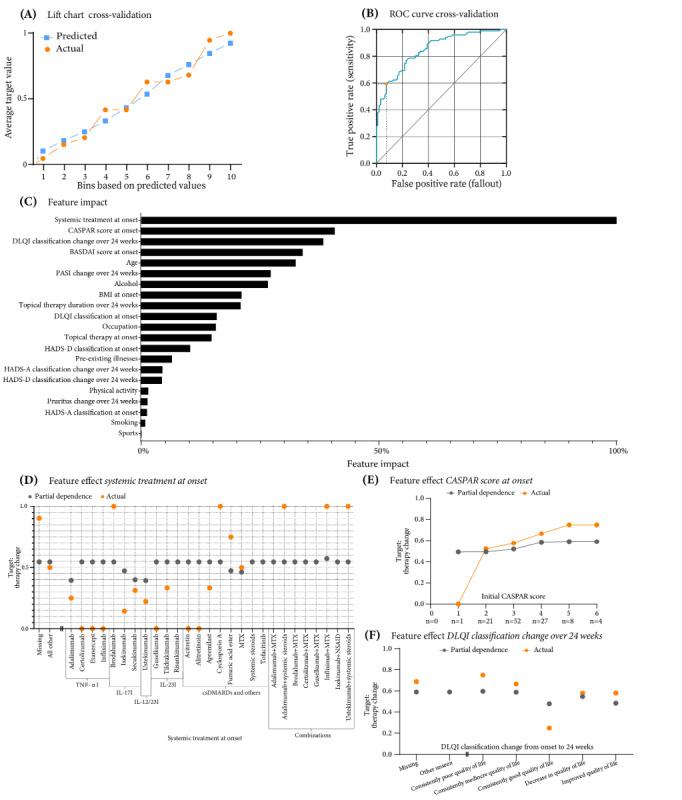
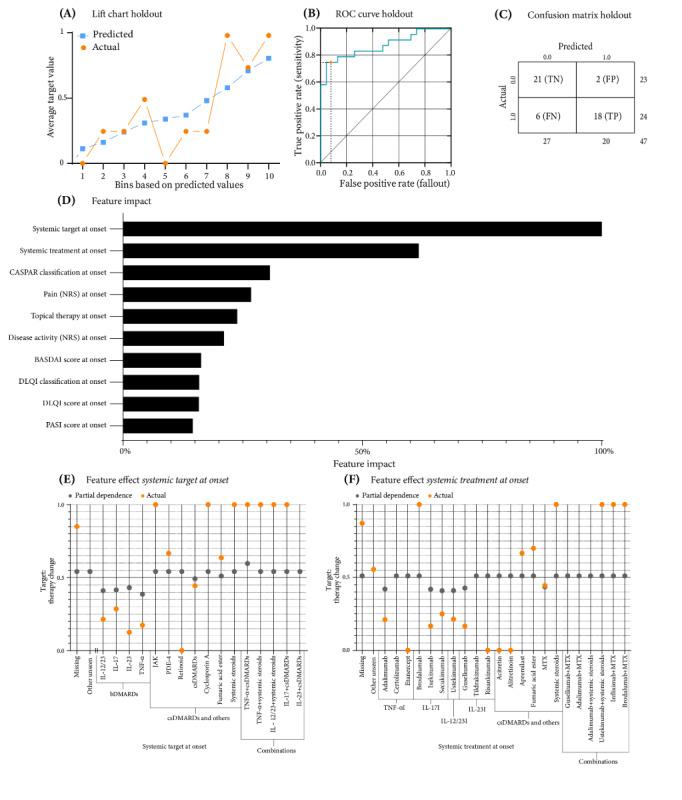
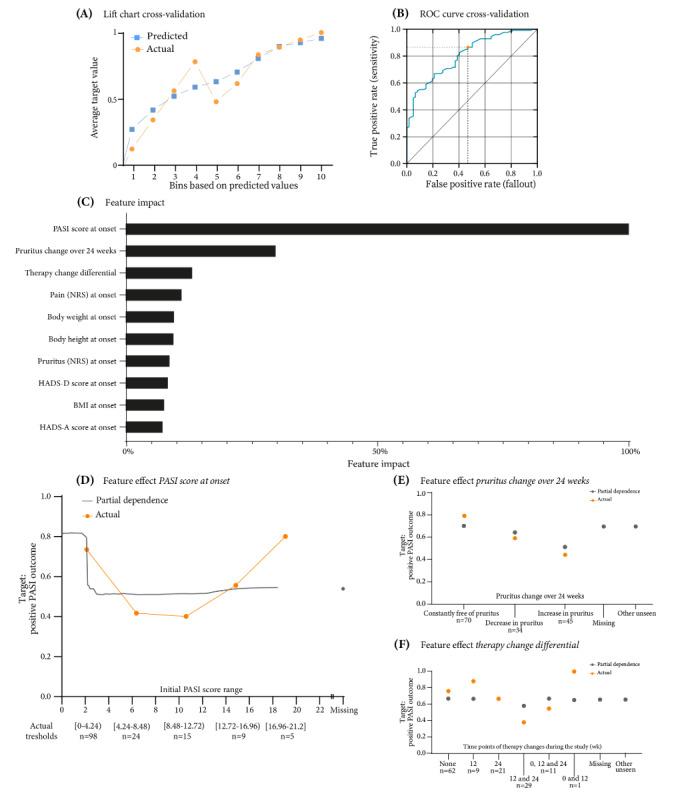
Therapy change at 24 weeks follow-up was modeled using the extreme gradient boosted trees classifier with early stopping (area under the receiver operating characteristic curve [AUC] of 0.9078 and logarithmic loss [LogLoss] of 0.3955 for the holdout partition). Key influencing factors included the initial systemic therapeutic agent, the Classification Criteria for Psoriatic Arthritis score at baseline, and changes in quality of life. An average blender incorporating three models (gradient boosted trees classifier, ExtraTrees classifier, and Eureqa generalized additive model classifier) with an AUC of 0.8750 and LogLoss of 0.4603 was used to predict therapy changes for 2 hypothetical patients, highlighting the significance of these factors. Treatments such as methotrexate or specific biologicals showed a lower propensity for change. An average blender of a random forest classifier, an extreme gradient boosted trees classifier, and a Eureqa classifier (AUC of 0.9241 and LogLoss of 0.4498) was used to estimate PASI (Psoriasis Area and Severity Index) change after 24 weeks. Primary predictors included the initial PASI score, change in pruritus levels, and change in therapy. A lower initial PASI score and consistently low pruritus were associated with better outcomes. BASDAI classification at onset was analyzed using an average blender of a Eureqa generalized additive model classifier, an extreme gradient boosted trees classifier with early stopping, and a dropout additive regression trees classifier with an AUC of 0.8274 and LogLoss of 0.5037. Influential factors included initial pain, disease activity, and Hospital Anxiety and Depression Scale scores for depression and anxiety. Increased pain, disease activity, and psychological distress generally led to higher BASDAI scores.
CONCLUSIONS
The practical implications of these models for clinical decision-making in PsV and PsA can guide early investigation and treatment, contributing to improved patient outcomes.
背景
寻常型银屑病(PsV)和银屑病关节炎(PsA)是复杂的多因素疾病,对健康和生活质量有重大影响。预测治疗反应和疾病进展对于优化治疗干预至关重要,但具有挑战性。自动化机器学习(AutoML)技术有望基于患者特征和治疗数据快速创建准确的预测模型。
目的
本研究旨在使用AutoML开发高度准确的机器学习(ML)模型,以解决PsV和PsA患者的关键临床问题,包括预测治疗变化、确定治疗变化的原因以及影响皮肤病变进展或异常的巴斯强直性脊柱炎疾病活动指数(BASDAI)评分的因素。
方法
对309例PsV和PsA患者的临床研究数据进行了广泛准备,并使用AutoML进行分析,以构建和选择针对每个感兴趣变量的最准确预测模型。
结果
使用带早期停止的极端梯度提升树分类器对24周随访时的治疗变化进行建模(验证集的受试者工作特征曲线下面积[AUC]为0.9078,对数损失[LogLoss]为0.3955)。关键影响因素包括初始全身治疗药物、基线时银屑病关节炎分类标准评分以及生活质量变化。一个包含三个模型(梯度提升树分类器、ExtraTrees分类器和Eureqa广义相加模型分类器)的平均混合器(AUC为0.8750,LogLoss为0.4603)用于预测2例假设患者的治疗变化,突出了这些因素的重要性。甲氨蝶呤或特定生物制剂等治疗的变化倾向较低。一个由随机森林分类器、极端梯度提升树分类器和Eureqa分类器组成的平均混合器(AUC为0.9241,LogLoss为0.4498)用于估计24周后的银屑病面积和严重程度指数(PASI)变化。主要预测因素包括初始PASI评分、瘙痒水平变化和治疗变化。较低的初始PASI评分和持续低瘙痒与更好的结果相关。使用Eureqa广义相加模型分类器、带早期停止的极端梯度提升树分类器和随机失活相加回归树分类器组成的平均混合器(AUC为0.8274,LogLoss为0.5037)分析发病时BASDAI分类。影响因素包括初始疼痛、疾病活动以及医院焦虑抑郁量表的抑郁和焦虑评分。疼痛、疾病活动和心理困扰增加通常导致更高的BASDAI评分。
结论
这些模型对PsV和PsA临床决策的实际意义可指导早期调查和治疗,有助于改善患者预后。
 Zotero 插件