
GITR 通过对 NLRP3 的翻译后调控加剧脂多糖诱导的巨噬细胞焦亡。
GITR exacerbates lysophosphatidylcholine-induced macrophage pyroptosis in sepsis via posttranslational regulation of NLRP3.
机构信息
Zhongshan School of Medicine, Sun Yat-sen University, Guangzhou, China.
Key Laboratory of Tropical Disease Control (Sun Yat-sen University), Ministry of Education, Guangzhou, China.
出版信息
Cell Mol Immunol. 2024 Jul;21(7):674-688. doi: 10.1038/s41423-024-01170-w. Epub 2024 May 13.
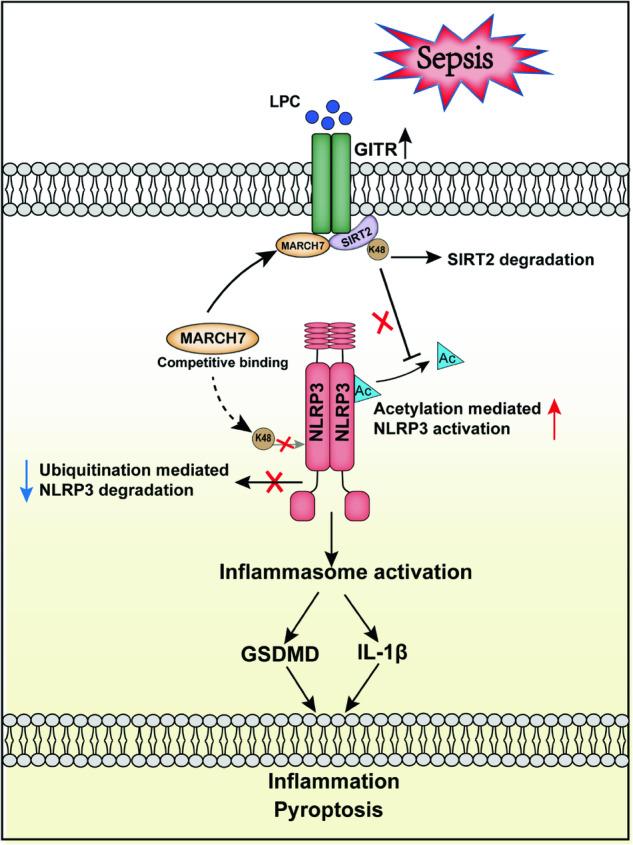
The NLRP3 inflammasome functions as an inflammatory driver, but its relationship with lipid metabolic changes in early sepsis remains unclear. Here, we found that GITR expression in monocytes/macrophages was induced by lysophosphatidylcholine (LPC) and was positively correlated with the severity of sepsis. GITR is a costimulatory molecule that is mainly expressed on T cells, but its function in macrophages is largely unknown. Our in vitro data showed that GITR enhanced LPC uptake by macrophages and specifically enhanced NLRP3 inflammasome-mediated macrophage pyroptosis. Furthermore, in vivo studies using either cecal ligation and puncture (CLP) or LPS-induced sepsis models demonstrated that LPC exacerbated sepsis severity/lethality, while conditional knockout of GITR in myeloid cells or NLRP3/caspase-1/IL-1β deficiency attenuated sepsis severity/lethality. Mechanistically, GITR specifically enhanced inflammasome activation by regulating the posttranslational modification (PTM) of NLRP3. GITR competes with NLRP3 for binding to the E3 ligase MARCH7 and recruits MARCH7 to induce deacetylase SIRT2 degradation, leading to decreasing ubiquitination but increasing acetylation of NLRP3. Overall, these findings revealed a novel role of macrophage-derived GITR in regulating the PTM of NLRP3 and systemic inflammatory injury, suggesting that GITR may be a potential therapeutic target for sepsis and other inflammatory diseases. GITR exacerbates LPC-induced macrophage pyroptosis in sepsis via posttranslational regulation of NLRP3. According to the model, LPC levels increase during the early stage of sepsis, inducing GITR expression on macrophages. GITR not only competes with NLRP3 for binding to the E3 ligase MARCH7 but also recruits MARCH7 to induce the degradation of the deacetylase SIRT2, leading to decreasing ubiquitination but increasing acetylation of NLRP3 and therefore exacerbating LPC-induced NLRP3 inflammasome activation, macrophage pyroptosis and systemic inflammatory injury.
NLRP3 炎性体作为炎症驱动因素发挥作用,但它与早期脓毒症中脂质代谢变化的关系尚不清楚。在这里,我们发现溶脂酰胆碱 (LPC) 诱导单核细胞/巨噬细胞中 GITR 的表达,并且与脓毒症的严重程度呈正相关。GITR 是一种主要在 T 细胞上表达的共刺激分子,但它在巨噬细胞中的功能在很大程度上是未知的。我们的体外数据表明,GITR 增强了巨噬细胞对 LPC 的摄取,并特异性增强了 NLRP3 炎性体介导的巨噬细胞细胞焦亡。此外,使用盲肠结扎穿孔术 (CLP) 或 LPS 诱导的脓毒症模型的体内研究表明,LPC 加重了脓毒症的严重程度/致死率,而髓样细胞中 GITR 的条件敲除或 NLRP3/caspase-1/IL-1β 的缺乏减轻了脓毒症的严重程度/致死率。在机制上,GITR 通过调节 NLRP3 的翻译后修饰 (PTM) 特异性增强炎性体的激活。GITR 与 NLRP3 竞争结合 E3 连接酶 MARCH7,并募集 MARCH7 诱导去乙酰化酶 SIRT2 降解,导致 NLRP3 的泛素化减少但乙酰化增加。总的来说,这些发现揭示了巨噬细胞来源的 GITR 调节 NLRP3 的 PTM 和全身炎症损伤的新作用,表明 GITR 可能是脓毒症和其他炎症性疾病的潜在治疗靶点。GITR 通过 NLRP3 的翻译后调节加剧 LPC 诱导的脓毒症中巨噬细胞细胞焦亡。根据该模型,在脓毒症的早期阶段,LPC 水平增加,诱导巨噬细胞上 GITR 的表达。GITR 不仅与 NLRP3 竞争结合 E3 连接酶 MARCH7,还募集 MARCH7 诱导去乙酰化酶 SIRT2 的降解,导致 NLRP3 的泛素化减少但乙酰化增加,从而加剧 LPC 诱导的 NLRP3 炎性体激活、巨噬细胞细胞焦亡和全身炎症损伤。
 Zotero 插件