
由于肥胖趋势导致的身体健康方面教育不平等的扩大?——基于德国社会经济面板研究的中介分析。
Widening Educational Inequalities in Physical Health Due to the Obesity Trend?-A Mediation Analysis Using the German Socio-Economic Panel Study.
机构信息
Hannover Medical School, Hanover, Germany.
出版信息
Int J Public Health. 2024 Apr 29;69:1606932. doi: 10.3389/ijph.2024.1606932. eCollection 2024.
OBJECTIVES
This study examined the contribution of obesity to the development of educational inequalities in physical health.
METHODS
We used data from the German Socio-Economic Panel for the period 2002-2020. Physical health was measured with the modified SF12-questionnaire. Logistic regression analyses were applied to estimate time trends. The Relative Index of Inequality (RII) and the Slope Index of Inequality (SII) were calculated to examine educational inequalities. The role of obesity as a mediator was analyzed using the Karlson-Holm-Breen (KHB) method.
RESULTS
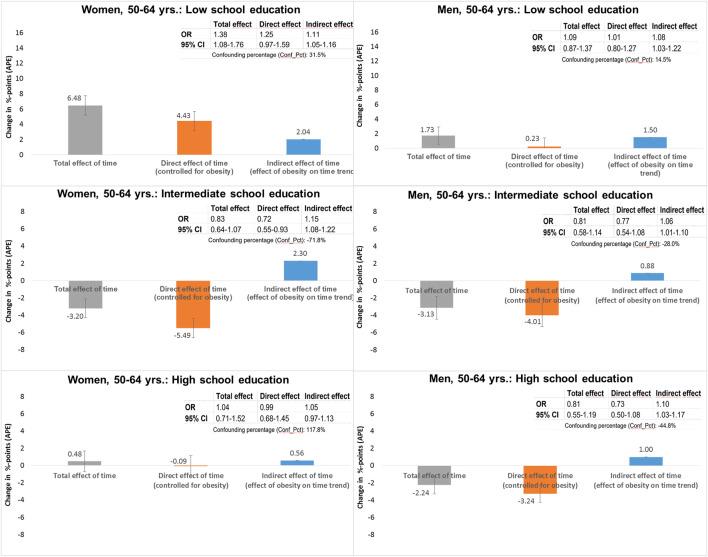
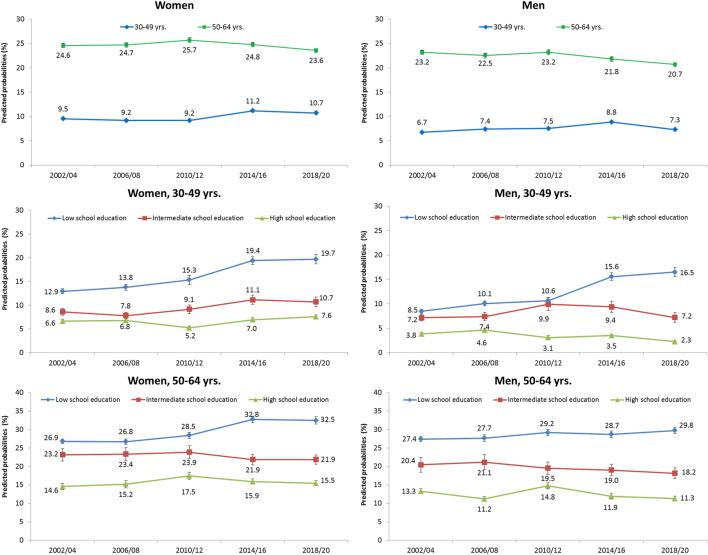
Over time, educational inequalities in obesity as well as impaired physical health widened in men and women, particularly among those aged 30-49 years. For individuals with a low level of education at this age, the probability of impaired physical health increased significantly by 7.7%-points in women and 9.4%-points in men. Of this increase, 25.9% for women and 14.8% for men could be attributed to the increase in obesity.
CONCLUSION
Our findings suggest that the steeper rise in obesity among individuals with a low level of education partly explains the observed widening in educational inequalities in physical health.
目的
本研究考察了肥胖对身体健康方面教育不平等现象发展的影响。
方法
我们使用了德国社会经济面板数据(2002-2020 年)。身体健康状况采用改良版 SF12 问卷进行测量。应用逻辑回归分析来估计时间趋势。通过相对不平等指数(RII)和不平等斜率指数(SII)来检验教育不平等现象。采用 Karlson-Holm-Breen(KHB)方法分析肥胖作为中介的作用。
结果
随着时间的推移,肥胖和身体健康受损方面的教育不平等在男性和女性中都有所扩大,特别是在 30-49 岁的人群中。对于这个年龄段受教育程度较低的个体,女性的身体健康受损概率显著增加了 7.7 个百分点,男性则增加了 9.4 个百分点。其中,女性肥胖率增加的 25.9%和男性肥胖率增加的 14.8%可归因于肥胖率的上升。
结论
我们的研究结果表明,受教育程度较低的个体中肥胖率的急剧上升,部分解释了身体健康方面教育不平等现象的扩大。


 Zotero 插件