
Arg1 缺乏 PI3 激酶活性,而是通过其 IP 激酶活性发挥毒性作用。
Arg1 from lacks PI3 kinase activity and conveys virulence roles via its IP kinase activity.
机构信息
Centre for Infectious Diseases and Microbiology, The Westmead Institute for Medical Research, Sydney, Australia.
Faculty of Medicine and Health, Sydney Institute for Infectious Diseases, University of Sydney, Sydney, Australia.
出版信息
mBio. 2024 Jun 12;15(6):e0060824. doi: 10.1128/mbio.00608-24. Epub 2024 May 14.
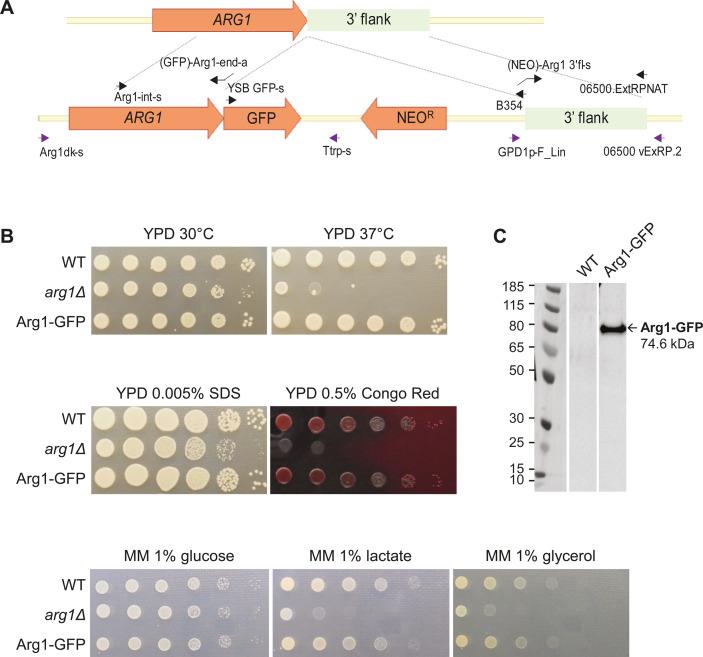
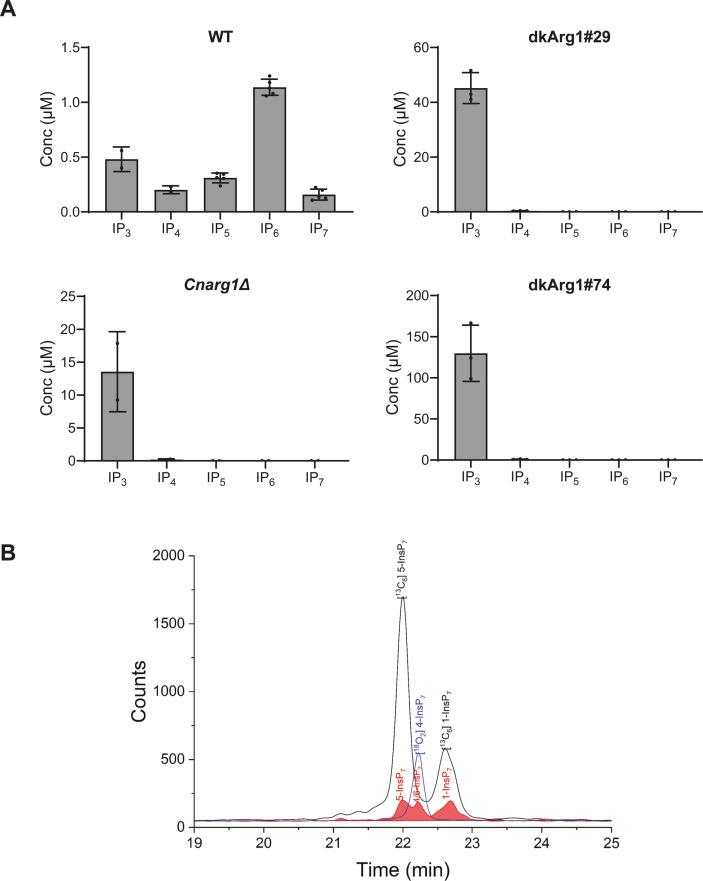
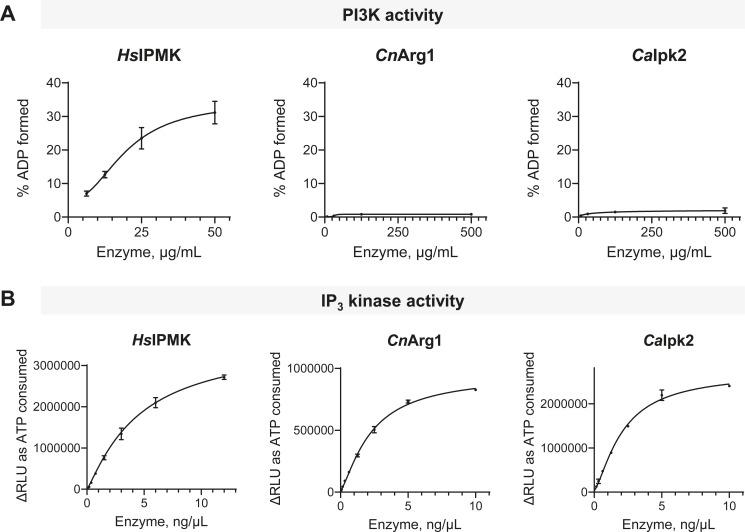
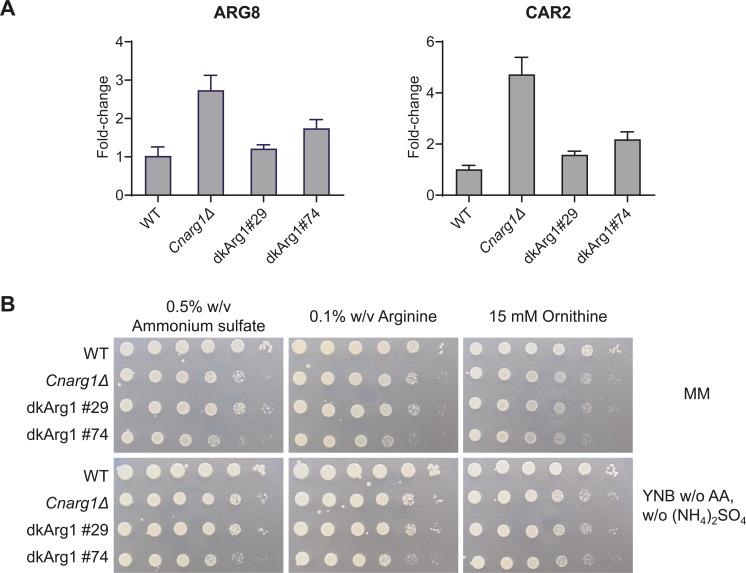
Inositol tris/tetrakis phosphate kinases (IPK) in the human fungal priority pathogens, (Arg1) and (Ipk2), convey numerous virulence functions, yet it is not known whether the IPK catalytic activity or a scaffolding role is responsible. We therefore generated a strain with a non-functional kinase, referred to as the dead-kinase (dk) Arg1 strain (dkArg1). We verified that, although dk cDNA cloned from this strain produced a protein with the expected molecular weight, dkArg1 was catalytically inactive with no IPK activity. Using recombinant Arg1 and Ipk2 we confirmed that, unlike the IPK homologs in humans and , Arg1 and Ipk2 do not phosphorylate the lipid-based substrate, phosphatidylinositol 4,5-bisphosphate, and therefore do not function as class I PI3Ks. Inositol polyphosphate profiling using capillary electrophoresis-electrospray ionization-mass spectrometry revealed that IP conversion is blocked in the dkArg1 and deletion (Δ) strains and that 1-IP and a recently discovered isomer (4/6-IP) are made by wild-type . Importantly, the dkArg1 and Δ strains had similar virulence defects, including suppressed growth at 37°C, melanization, capsule production, and phosphate starvation response, and were avirulent in an insect model, confirming that virulence is dependent on IPK catalytic activity. Our data also implicate the dkArg1 scaffold in transcriptional regulation of arginine metabolism but via a different mechanism to since Arg1 is dispensable for growth on different nitrogen sources. IPK catalytic activity therefore plays a dominant role in fungal virulence, and IPK pathway function has diverged in fungal pathogens.IMPORTANCEThe World Health Organization has emphasized the urgent need for global action in tackling the high morbidity and mortality rates stemming from invasive fungal infections, which are exacerbated by the limited variety and compromised effectiveness of available drug classes. Fungal IPK is a promising target for new therapy, as it is critical for promoting virulence of the human fungal priority pathogens, and , and impacts numerous functions, including cell wall integrity. This contrasts to current therapies, which only target a single function. IPK enzymes exert their effect through their inositol polyphosphate products or via the protein scaffold. Here, we confirm that the IPK catalytic activity of Arg1 promotes all virulence traits in that are attenuated by deletion reinforcing our ongoing efforts to find inositol polyphosphate effector proteins and to create inhibitors targeting the IPK catalytic site, as a new antifungal drug class.
肌醇三/四磷酸激酶(IPK)在人类真菌优先病原体中,(Arg1)和(Ipk2),赋予了许多毒力功能,但尚不清楚是 IPK 催化活性还是支架作用负责。因此,我们生成了一个激酶失活的突变菌株,称为无激酶(dk)Arg1 菌株(dkArg1)。我们验证了,尽管从该菌株克隆的 dk cDNA 产生了具有预期分子量的蛋白质,但 dkArg1 没有催化活性,没有 IPK 活性。使用重组 Arg1 和 Ipk2,我们证实与人类和酵母的 IPK 同源物不同,Arg1 和 Ipk2 不磷酸化基于脂质的底物磷脂酰肌醇 4,5-双磷酸,因此不作为 I 类 PI3K 发挥作用。使用毛细管电泳-电喷雾电离-质谱法进行肌醇多磷酸谱分析表明,IP 转化在 dkArg1 和缺失(Δ)菌株中受阻,野生型产生 1-IP 和最近发现的异构体(4/6-IP)。重要的是,dkArg1 和Δ菌株具有相似的毒力缺陷,包括在 37°C 下生长受到抑制、黑色素化、荚膜产生和磷酸盐饥饿反应,并且在昆虫模型中无毒力,这证实了毒力依赖于 IPK 催化活性。我们的数据还表明,dkArg1 支架参与了精氨酸代谢的转录调控,但与不同,因为 Arg1 对于不同氮源的生长是可有可无的。因此,IPK 催化活性在真菌毒力中起主导作用,并且真菌病原体中的 IPK 途径功能已经分化。
重要性:世界卫生组织强调了全球行动的迫切需要,以应对由侵袭性真菌感染引起的高发病率和死亡率,而现有药物类别的多样性有限和效力受损使情况更加恶化。真菌 IPK 是新疗法的一个有前途的靶点,因为它对促进人类真菌优先病原体的毒力至关重要,并且影响许多功能,包括细胞壁完整性。这与目前的治疗方法形成对比,目前的治疗方法仅针对单一功能。IPK 酶通过其肌醇多磷酸产物或通过蛋白质支架发挥作用。在这里,我们确认 Arg1 的 IPK 催化活性促进了 中所有的毒力特征,这些特征都被缺失所减弱,这加强了我们正在进行的努力,以寻找肌醇多磷酸效应蛋白,并创建靶向 IPK 催化位点的抑制剂,作为一种新的抗真菌药物类别。




 Zotero 插件