
探讨青蒿琥酯在抗 NMDAR 脑炎小鼠模型中的神经保护作用:来自分子机制和透射电子显微镜的见解。
Exploring the neuroprotective role of artesunate in mouse models of anti-NMDAR encephalitis: insights from molecular mechanisms and transmission electron microscopy.
机构信息
Department of Neurology, Nanfang Hospital, Southern Medical University, Guangzhou, 510515, China.
Department of Neurology, Guangzhou First People's Hospital, School of Medicine, South China University of Technology, Guangzhou, 510641, China.
出版信息
Cell Commun Signal. 2024 May 14;22(1):269. doi: 10.1186/s12964-024-01652-4.
BACKGROUND
The pathway involving PTEN-induced putative kinase 1 (PINK1) and PARKIN plays a crucial role in mitophagy, a process activated by artesunate (ART). We propose that patients with anti-N-methyl-D-aspartate receptor (NMDAR) encephalitis exhibit insufficient mitophagy, and ART enhances mitophagy via the PINK1/PARKIN pathway, thereby providing neuroprotection.
METHODS
Adult female mice aged 8-10 weeks were selected to create a passive transfer model of anti-NMDAR encephalitis. We conducted behavioral tests on these mice within a set timeframe. Techniques such as immunohistochemistry, immunofluorescence, and western blotting were employed to assess markers including PINK1, PARKIN, LC3B, p62, caspase3, and cleaved caspase3. The TUNEL assay was utilized to detect neuronal apoptosis, while transmission electron microscopy (TEM) was used to examine mitochondrial autophagosomes. Primary hippocampal neurons were cultured, treated, and then analyzed through immunofluorescence for mtDNA, mtROS, TMRM.
RESULTS
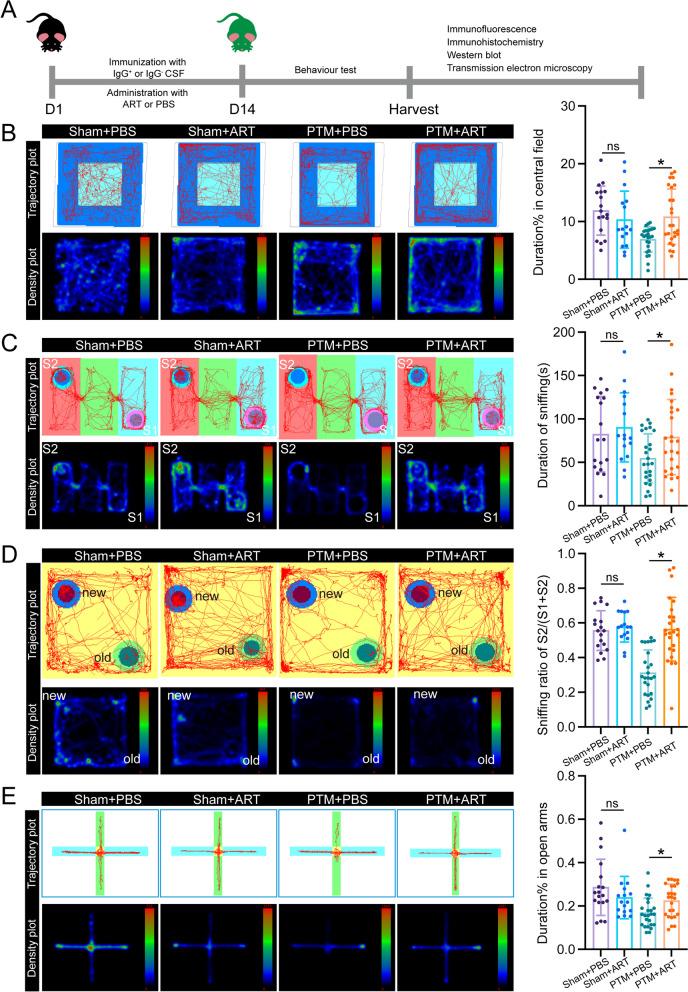
In comparison to the control group, mitophagy levels in the experimental group were not significantly altered, yet there was a notable increase in apoptotic neurons. Furthermore, markers indicative of mitochondrial leakage and damage were found to be elevated in the experimental group compared to the control group, but these markers showed improvement following ART treatment. ART was effective in activating the PINK1/PARKIN pathway, enhancing mitophagy, and diminishing neuronal apoptosis. Behavioral assessments revealed that ART ameliorated symptoms in mice with anti-NMDAR encephalitis in the passive transfer model (PTM). The knockdown of PINK1 led to a reduction in mitophagy levels, and subsequent ART intervention did not alleviate symptoms in the anti-NMDAR encephalitis PTM mice, indicating that ART's therapeutic efficacy is mediated through the activation of the PINK1/PARKIN pathway.
CONCLUSIONS
At the onset of anti-NMDAR encephalitis, mitochondrial damage is observed; however, this damage is mitigated by the activation of mitophagy via the PINK1/PARKIN pathway. This regulatory feedback mechanism facilitates the removal of damaged mitochondria, prevents neuronal apoptosis, and consequently safeguards neural tissue. ART activates the PINK1/PARKIN pathway to enhance mitophagy, thereby exerting neuroprotective effects and may achieve therapeutic goals in treating anti-NMDAR encephalitis.
背景
PTEN 诱导激酶 1(PINK1)和 PARKIN 途径在自噬中起关键作用,自噬是青蒿琥酯(ART)激活的过程。我们提出,抗 N-甲基-D-天冬氨酸受体(NMDAR)脑炎患者表现出自噬不足,ART 通过 PINK1/PARKIN 途径增强自噬,从而提供神经保护。
方法
选择 8-10 周龄成年雌性小鼠建立抗 NMDAR 脑炎被动转移模型。在设定的时间框架内对这些小鼠进行行为测试。使用免疫组织化学、免疫荧光和 Western blot 等技术评估 PINK1、PARKIN、LC3B、p62、caspase3 和 cleaved caspase3 等标志物。TUNEL 检测法检测神经元凋亡,透射电镜(TEM)检测线粒体自噬体。原代海马神经元培养、处理后通过免疫荧光法检测 mtDNA、mtROS、TMRM。
结果
与对照组相比,实验组的自噬水平没有明显变化,但凋亡神经元明显增加。此外,与对照组相比,实验组的线粒体渗漏和损伤标志物升高,但 ART 治疗后这些标志物有所改善。ART 能有效激活 PINK1/PARKIN 途径,增强自噬,减少神经元凋亡。行为评估显示,ART 改善了抗 NMDAR 脑炎被动转移模型(PTM)中小鼠的症状。PINK1 敲低导致自噬水平降低,随后 ART 干预不能缓解抗 NMDAR 脑炎 PTM 小鼠的症状,表明 ART 的治疗效果是通过激活 PINK1/PARKIN 途径介导的。
结论
在抗 NMDAR 脑炎发病初期,观察到线粒体损伤;然而,通过 PINK1/PARKIN 途径激活自噬减轻了这种损伤。这种调节反馈机制有助于清除受损线粒体,防止神经元凋亡,从而保护神经组织。ART 通过激活 PINK1/PARKIN 途径增强自噬,从而发挥神经保护作用,并可能达到治疗抗 NMDAR 脑炎的治疗目标。


 Zotero 插件