
系统评价的十年:细胞绘画的演变与影响
A Decade in a Systematic Review: The Evolution and Impact of Cell Painting.
作者信息
Seal Srijit, Trapotsi Maria-Anna, Spjuth Ola, Singh Shantanu, Carreras-Puigvert Jordi, Greene Nigel, Bender Andreas, Carpenter Anne E
机构信息
Broad Institute of MIT and Harvard, Cambridge, Massachusetts, United States.
Yusuf Hamied Department of Chemistry, University of Cambridge, Lensfield Road, CB2 1EW, Cambridge, United Kingdom.
出版信息
ArXiv. 2024 May 4:arXiv:2405.02767v1.
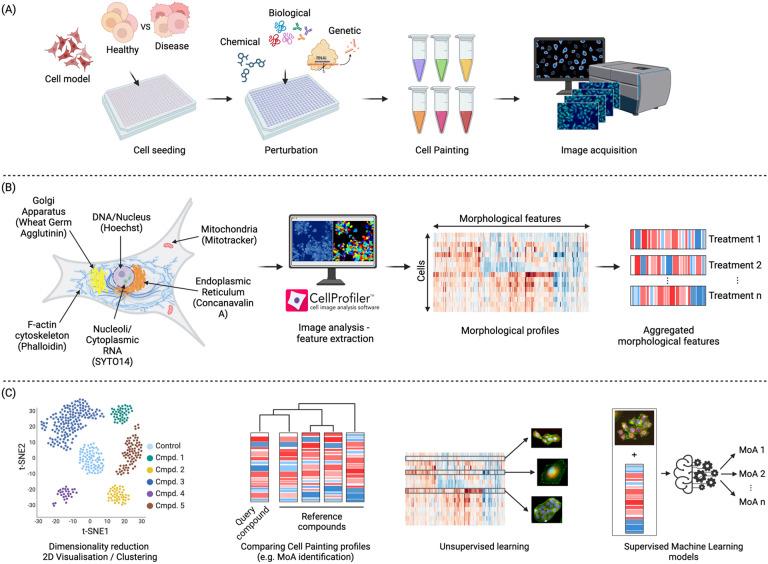
High-content image-based assays have fueled significant discoveries in the life sciences in the past decade (2013-2023), including novel insights into disease etiology, mechanism of action, new therapeutics, and toxicology predictions. Here, we systematically review the substantial methodological advancements and applications of Cell Painting. Advancements include improvements in the Cell Painting protocol, assay adaptations for different types of perturbations and applications, and improved methodologies for feature extraction, quality control, and batch effect correction. Moreover, machine learning methods recently surpassed classical approaches in their ability to extract biologically useful information from Cell Painting images. Cell Painting data have been used alone or in combination with other -omics data to decipher the mechanism of action of a compound, its toxicity profile, and many other biological effects. Overall, key methodological advances have expanded Cell Painting's ability to capture cellular responses to various perturbations. Future advances will likely lie in advancing computational and experimental techniques, developing new publicly available datasets, and integrating them with other high-content data types.
在过去十年(2013 - 2023年)中,基于高内涵成像的分析方法推动了生命科学领域的重大发现,包括对疾病病因、作用机制、新疗法以及毒理学预测的全新见解。在此,我们系统地回顾了细胞绘画技术在方法学上的重大进展及其应用。进展包括细胞绘画方案的改进、针对不同类型扰动和应用的分析方法调整,以及特征提取、质量控制和批次效应校正方法的改进。此外,机器学习方法最近在从细胞绘画图像中提取生物学有用信息的能力上超越了传统方法。细胞绘画数据已被单独使用或与其他组学数据结合,以解读化合物的作用机制、毒性特征以及许多其他生物学效应。总体而言,关键的方法学进展扩展了细胞绘画技术捕捉细胞对各种扰动反应的能力。未来的进展可能在于推进计算和实验技术、开发新的公开可用数据集,并将它们与其他高内涵数据类型整合。


 Zotero 插件