
LRG1对脉管系统和血管周围微环境的破坏作用。
The disruptive role of LRG1 on the vasculature and perivascular microenvironment.
作者信息
Dritsoula Athina, Camilli Carlotta, Moss Stephen E, Greenwood John
机构信息
UCL Institute of Ophthalmology, University College London, London, United Kingdom.
出版信息
Front Cardiovasc Med. 2024 Apr 30;11:1386177. doi: 10.3389/fcvm.2024.1386177. eCollection 2024.
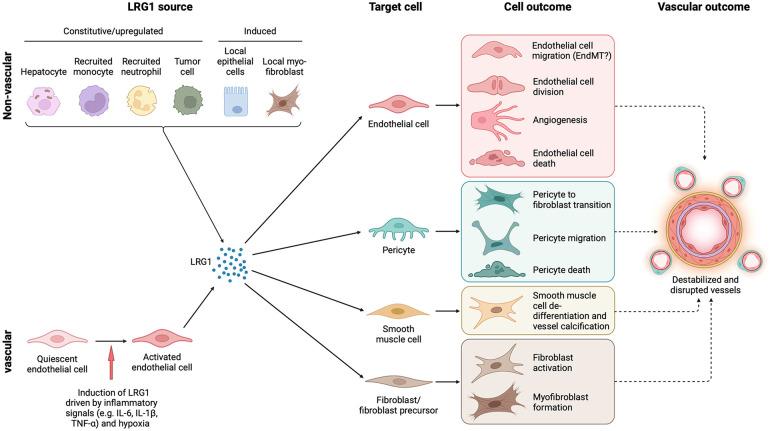
The establishment of new blood vessels, and their subsequent stabilization, is a critical process that facilitates tissue growth and organ development. Once established, vessels need to diversify to meet the specific needs of the local tissue and to maintain homeostasis. These processes are tightly regulated and fundamental to normal vessel and tissue function. The mechanisms that orchestrate angiogenesis and vessel maturation have been widely studied, with signaling crosstalk between endothelium and perivascular cells being identified as an essential component. In disease, however, new vessels develop abnormally, and existing vessels lose their specialization and function, which invariably contributes to disease progression. Despite considerable research into the vasculopathic mechanisms in disease, our knowledge remains incomplete. Accordingly, the identification of angiocrine and angiopathic molecules secreted by cells within the vascular microenvironment, and their effect on vessel behaviour, remains a major research objective. Over the last decade the secreted glycoprotein leucine-rich α-2 glycoprotein 1 (LRG1), has emerged as a significant vasculopathic molecule, stimulating defective angiogenesis, and destabilizing the existing vasculature mainly, but not uniquely, by altering both canonical and non-canonical TGF-β signaling in a highly cell and context dependent manner. Whilst LRG1 does not possess any overt homeostatic role in vessel development and maintenance, growing evidence provides a compelling case for LRG1 playing a pleiotropic role in disrupting the vasculature in many disease settings. Thus, LRG1 has now been reported to damage vessels in various disorders including cancer, diabetes, chronic kidney disease, ocular disease, and lung disease and the signaling processes that drive this dysfunction are being defined. Moreover, therapeutic targeting of LRG1 has been widely proposed to re-establish a quiescent endothelium and normalized vasculature. In this review, we consider the current status of our understanding of the role of LRG1 in vascular pathology, and its potential as a therapeutic target.
新血管的形成及其随后的稳定是促进组织生长和器官发育的关键过程。血管一旦形成,就需要多样化以满足局部组织的特定需求并维持体内平衡。这些过程受到严格调控,对正常血管和组织功能至关重要。协调血管生成和血管成熟的机制已得到广泛研究,内皮细胞与血管周围细胞之间的信号串扰被认为是一个重要组成部分。然而,在疾病中,新血管发育异常,现有血管失去其特化和功能,这 invariably 会导致疾病进展。尽管对疾病中的血管病变机制进行了大量研究,但我们的了解仍然不完整。因此,识别血管微环境中细胞分泌的血管分泌和血管病变分子及其对血管行为的影响,仍然是一个主要的研究目标。在过去十年中,分泌型富含亮氨酸的α-2糖蛋白1(LRG1)已成为一种重要的血管病变分子,刺激有缺陷的血管生成,并主要但并非唯一地通过以高度细胞和背景依赖的方式改变经典和非经典TGF-β信号来破坏现有血管系统。虽然LRG1在血管发育和维持中不具有任何明显的稳态作用,但越来越多的证据表明LRG1在许多疾病环境中破坏血管系统中发挥多效性作用。因此,现在已有报道称LRG1在包括癌症、糖尿病、慢性肾病、眼部疾病和肺部疾病在内的各种疾病中损害血管,并且正在确定驱动这种功能障碍的信号传导过程。此外,广泛提出对LRG1进行治疗靶向以重建静止的内皮细胞和正常化的血管系统。在这篇综述中,我们考虑了目前我们对LRG1在血管病理学中的作用及其作为治疗靶点的潜力的理解现状。



 Zotero 插件