
特定突变作为乳腺癌同源重组缺陷的潜在生物标志物:一项临床二代测序研究
-specific mutations serve as a potential biomarker for homologous recombination deficiency in breast cancer: a clinical next-generation sequencing study.
作者信息
Huang Yongsheng, Ren Shuwei, Ding Linxiaoxiao, Jiang Yuanling, Luo Jiahuan, Huang Jinghua, Yin Xinke, Zhao Jianli, Fu Sha, Liao Jianwei
机构信息
Cellular & Molecular Diagnostics Center, Sun Yat-sen Memorial Hospital, Sun Yat-sen University, Guangzhou 510120, China.
Guangdong Provincial Key Laboratory of Malignant Tumor Epigenetics and Gene Regulation, Sun Yat-sen Memorial Hospital, Sun Yat-sen University, Guangzhou 510120, China.
出版信息
Precis Clin Med. 2024 Apr 9;7(2):pbae009. doi: 10.1093/pcmedi/pbae009. eCollection 2024 Jun.
BACKGROUND
mutations and homologous recombination deficiency (HRD) occur frequently in breast cancer. However, the characteristics of pathogenic mutations in breast cancer patients with/without HRD are not clear.
METHODS
Clinical next-generation sequencing (NGS) of both tumor and paired blood DNA from 119 breast cancer patients (BRCA-119 cohort) was performed with a 520-gene panel. Mutations, tumor mutation burden (TMB), and genomic HRD scores were assessed from NGS data. NGS data from 47 breast cancer patients in the HRD test cohort were analyzed for further verification.
RESULTS
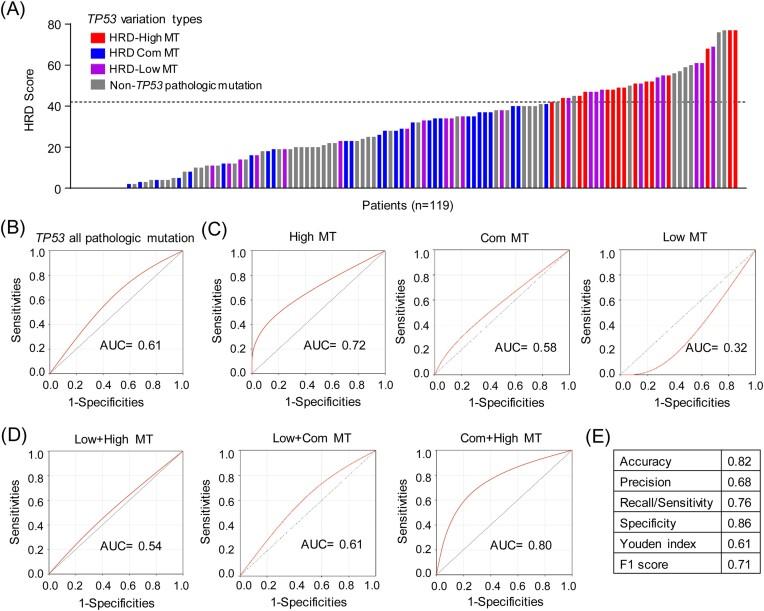
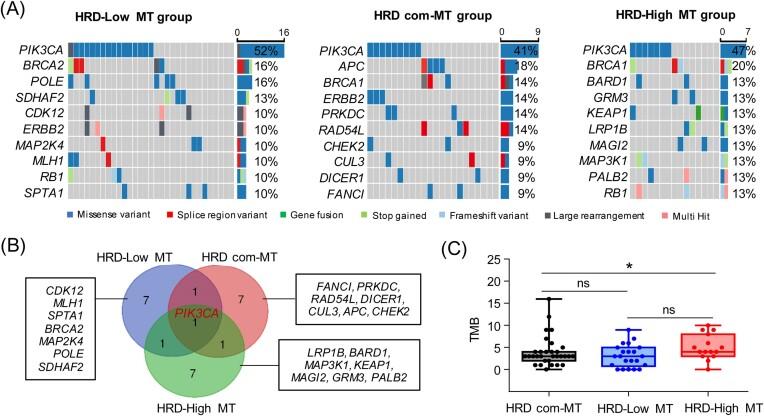
All pathogenic mutations in patients had somatic origin, which was associated with the protein expression of estrogen receptor and progestogen receptor. Compared to patients without pathologic mutations, patients with pathologic mutations had higher levels of HRD scores and different genomic alterations. The frequency of pathologic mutation was higher in the HRD-high group (HRD score ≥ 42) relative to that in the HRD-low group (HRD score < 42). has different mutational characteristics between the HRD-low and HRD-high groups. -specific mutation subgroups had diverse genomic features and TMB. Notably, pathogenic mutations predicted the HRD status of breast cancer patients with an area under the curve (AUC) of 0.61. TP53-specific mutations, namely HRD-low mutation, HRD-high mutation, and HRD common mutation, predicted the HRD status of breast cancer patients with AUC values of 0.32, 0.72, and 0.58, respectively. Interestingly, HRD-high mutation and HRD common mutation combinations showed the highest AUC values (0.80) in predicting HRD status.
CONCLUSIONS
-specific mutation combinations predict the HRD status of patients, indicating that pathogenic mutations could serve as a potential biomarker for poly-ADP-ribose polymerase (PARP) inhibitors in breast cancer patients .
背景
突变和同源重组缺陷(HRD)在乳腺癌中频繁发生。然而,伴有/不伴有HRD的乳腺癌患者的致病突变特征尚不清楚。
方法
对119例乳腺癌患者(BRCA - 119队列)的肿瘤及配对血液DNA进行临床二代测序(NGS),检测基因数为520个。从NGS数据中评估突变、肿瘤突变负荷(TMB)和基因组HRD评分。对HRD检测队列中的47例乳腺癌患者的NGS数据进行分析以进一步验证。
结果
患者的所有致病突变均为体细胞起源,这与雌激素受体和孕激素受体的蛋白表达相关。与无病理突变的患者相比,有病理突变的患者HRD评分更高且基因组改变不同。HRD高分组(HRD评分≥42)的病理突变频率高于HRD低分组(HRD评分<42)。HRD低分组和高分组之间具有不同的突变特征。特定突变亚组具有多样的基因组特征和TMB。值得注意的是,致病突变预测乳腺癌患者HRD状态的曲线下面积(AUC)为0.61。TP53特异性突变,即HRD低突变、HRD高突变和HRD常见突变,预测乳腺癌患者HRD状态的AUC值分别为0.32、0.72和0.58。有趣的是,HRD高突变和HRD常见突变组合在预测HRD状态时显示出最高的AUC值(0.80)。
结论
特定突变组合可预测患者的HRD状态,表明致病突变可作为乳腺癌患者聚ADP - 核糖聚合酶(PARP)抑制剂的潜在生物标志物。


 Zotero 插件