
泌尿生殖系统癌症的新前沿:从分子基础到临床前模型,为卵巢癌和前列腺癌患者制定个性化治疗方案。
Novel frontiers in urogenital cancers: from molecular bases to preclinical models to tailor personalized treatments in ovarian and prostate cancer patients.
机构信息
Candiolo Cancer Institute, FPO - IRCCS, Laboratory of Translational Cancer Genetics, Strada Provinciale 142, Km 3.95, Candiolo, TO, ZIP 10060, Italy.
Department of Oncology, University of Torino, Strada Provinciale 142, Km 3.95, Candiolo, TO, ZIP 10060, Italy.
出版信息
J Exp Clin Cancer Res. 2024 May 15;43(1):146. doi: 10.1186/s13046-024-03065-0.
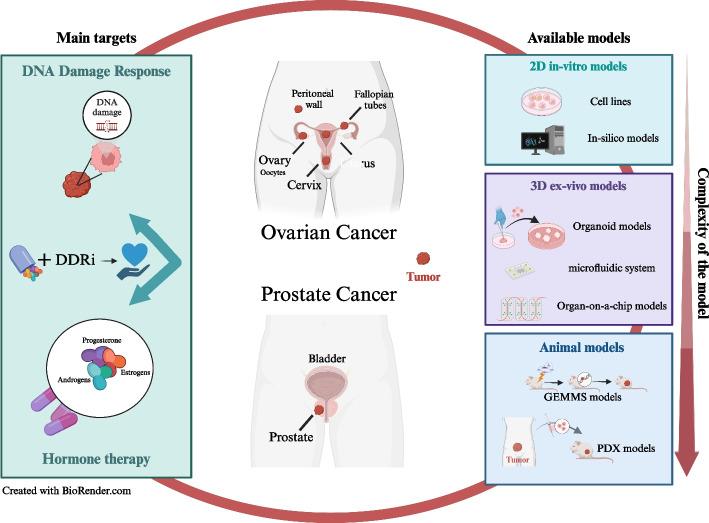
Over the last few decades, the incidence of urogenital cancers has exhibited diverse trends influenced by screening programs and geographical variations. Among women, there has been a consistent or even increased occurrence of endometrial and ovarian cancers; conversely, prostate cancer remains one of the most diagnosed malignancies, with a rise in reported cases, partly due to enhanced and improved screening efforts.Simultaneously, the landscape of cancer therapeutics has undergone a remarkable evolution, encompassing the introduction of targeted therapies and significant advancements in traditional chemotherapy. Modern targeted treatments aim to selectively address the molecular aberrations driving cancer, minimizing adverse effects on normal cells. However, traditional chemotherapy retains its crucial role, offering a broad-spectrum approach that, despite its wider range of side effects, remains indispensable in the treatment of various cancers, often working synergistically with targeted therapies to enhance overall efficacy.For urogenital cancers, especially ovarian and prostate cancers, DNA damage response inhibitors, such as PARP inhibitors, have emerged as promising therapeutic avenues. In BRCA-mutated ovarian cancer, PARP inhibitors like olaparib and niraparib have demonstrated efficacy, leading to their approval for specific indications. Similarly, patients with DNA damage response mutations have shown sensitivity to these agents in prostate cancer, heralding a new frontier in disease management. Furthermore, the progression of ovarian and prostate cancer is intricately linked to hormonal regulation. Ovarian cancer development has also been associated with prolonged exposure to estrogen, while testosterone and its metabolite dihydrotestosterone, can fuel the growth of prostate cancer cells. Thus, understanding the interplay between hormones, DNA damage and repair mechanisms can hold promise for exploring novel targeted therapies for ovarian and prostate tumors.In addition, it is of primary importance the use of preclinical models that mirror as close as possible the biological and genetic features of patients' tumors in order to effectively translate novel therapeutic findings "from the bench to the bedside".In summary, the complex landscape of urogenital cancers underscores the need for innovative approaches. Targeted therapy tailored to DNA repair mechanisms and hormone regulation might offer promising avenues for improving the management and outcomes for patients affected by ovarian and prostate cancers.
在过去的几十年中,由于筛查计划和地理差异的影响,泌尿生殖系统癌症的发病率呈现出不同的趋势。在女性中,子宫内膜癌和卵巢癌的发病率持续或甚至有所增加;相反,前列腺癌仍然是最常见的诊断恶性肿瘤之一,报告病例有所增加,部分原因是筛查工作的加强和改进。同时,癌症治疗领域也发生了显著的演变,包括引入了靶向治疗和传统化疗的重大进展。现代靶向治疗旨在针对驱动癌症的分子异常进行有针对性的治疗,最大限度地减少对正常细胞的不良影响。然而,传统化疗仍然发挥着关键作用,提供了一种广谱治疗方法,尽管其副作用范围更广,但在治疗各种癌症方面仍然不可或缺,通常与靶向治疗协同作用,以提高整体疗效。对于泌尿生殖系统癌症,特别是卵巢癌和前列腺癌,DNA 损伤反应抑制剂,如 PARP 抑制剂,已成为有前途的治疗途径。在 BRCA 突变的卵巢癌中,PARP 抑制剂如奥拉帕利和尼拉帕利已显示出疗效,因此被批准用于特定适应症。同样,具有 DNA 损伤反应突变的患者对前列腺癌中的这些药物敏感,这为疾病管理开辟了一个新的领域。此外,卵巢癌和前列腺癌的进展与激素调节密切相关。卵巢癌的发展也与长期暴露于雌激素有关,而睾丸激素及其代谢物二氢睾丸酮可促进前列腺癌细胞的生长。因此,了解激素、DNA 损伤和修复机制之间的相互作用可能为探索卵巢和前列腺肿瘤的新型靶向治疗方法提供希望。此外,使用尽可能接近患者肿瘤的生物学和遗传特征的临床前模型来验证新的治疗发现,将其从“实验室到临床”进行转化,这一点至关重要。综上所述,泌尿生殖系统癌症的复杂情况凸显了需要创新方法。针对 DNA 修复机制和激素调节的靶向治疗可能为改善受卵巢癌和前列腺癌影响的患者的管理和预后提供有前途的途径。

 Zotero 插件