
使用新型荧光免疫探针选择性检测活性细胞外颗粒酶A及其在炎症性疾病中的应用
Selective Detection of Active Extracellular Granzyme A by Using a Novel Fluorescent Immunoprobe with Application to Inflammatory Diseases.
作者信息
Senan-Salinas Ana, Comas Laura, Esteban Patricia, Garzón-Tituaña Marcela, Cheng Zhiming, Santiago Llipsy, Domingo Maria Pilar, Ramírez-Labrada Ariel, Paño-Pardo José Ramón, Vendrell Marc, Pardo Julián, Arias Maykel A, Galvez Eva M
机构信息
Instituto de Carboquímica ICB-CSIC, 50018 Zaragoza, Spain.
Fundación Instituto de Investigación Sanitaria Aragón (IIS Aragón), Biomedical Research Centre of Aragón (CIBA), 50009 Zaragoza, Spain.
出版信息
ACS Pharmacol Transl Sci. 2024 Apr 22;7(5):1474-1484. doi: 10.1021/acsptsci.4c00065. eCollection 2024 May 10.
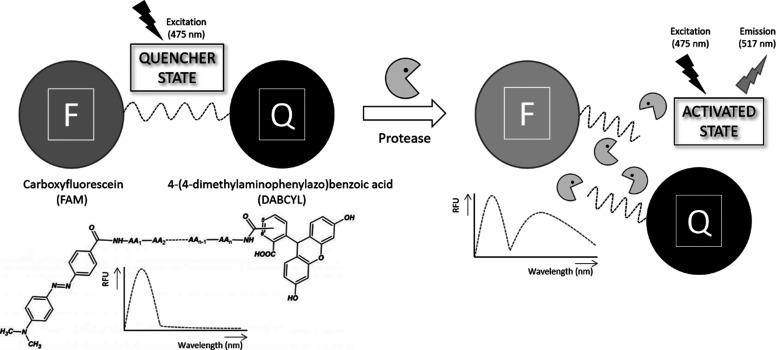
Granzymes (Gzms), a family of serine proteases, expressed by immune and nonimmune cells, present perforin-dependent and independent intracellular and extracellular functions. When released in the extracellular space, GzmA, with trypsin-like activity, is involved in the pathophysiology of different inflammatory diseases. However, there are no validated specific systems to detect active forms of extracellular GzmA, making it difficult to assess its biological relevance and potential use as a biomarker. Here, we have developed fluorescence-energy resonance-transfer (FRET)-based peptide probes (FAM-peptide-DABCYL) to specifically detect GzmA activity in tissue samples and biological fluids in both mouse and human samples during inflammatory diseases. An initial probe was developed and incubated with GzmA and different proteases like GzmB and others with similar cleavage specificity as GzmA like GzmK, thrombin, trypsin, kallikrein, or plasmin. After measuring fluorescence, the probe showed very good specificity and sensitivity for human and mouse GzmA when compared to GzmB, its closest homologue GzmK, and with thrombin. The specificity of this probe was further refined by incubating the samples in a coated plate with a GzmA-specific antibody before adding the probe. The results show a high specific detection of soluble GzmA even when compared with other soluble proteases with very similar cleavage specificity like thrombin, GzmK, trypsin, kallikrein, or plasmin, which shows nearly no fluorescence signal. The high specific detection of GzmA was validated, showing that using pure proteins and serum and tissue samples from GzmA-deficient mice presented a significant reduction in the signal compared with WT mice. The utility of this system in humans was confirmed, showing that GzmA activity was significantly higher in serum samples from septic patients in comparison with healthy donors. Our results present a new immunoprobe with utility to detect extracellular GzmA activity in different biological fluids, confirming the presence of active forms of the soluble protease in vivo during inflammatory and infectious diseases.
颗粒酶(Gzms)是一类丝氨酸蛋白酶,由免疫细胞和非免疫细胞表达,具有穿孔素依赖性和非依赖性的细胞内及细胞外功能。当释放到细胞外空间时,具有胰蛋白酶样活性的颗粒酶A(GzmA)参与不同炎症性疾病的病理生理过程。然而,目前尚无经过验证的特异性系统来检测细胞外GzmA的活性形式,这使得难以评估其生物学相关性以及作为生物标志物的潜在用途。在此,我们开发了基于荧光能量共振转移(FRET)的肽探针(FAM-肽-DABCYL),以特异性检测炎症性疾病期间小鼠和人类样本的组织样品及生物体液中的GzmA活性。我们首先开发了一种探针,并将其与GzmA以及不同的蛋白酶(如颗粒酶B(GzmB)和其他与GzmA具有相似切割特异性的蛋白酶,如颗粒酶K(GzmK)、凝血酶、胰蛋白酶、激肽释放酶或纤溶酶)一起孵育。在测量荧光后,与GzmB、其最接近的同源物GzmK以及凝血酶相比,该探针显示出对人和小鼠GzmA具有非常好的特异性和敏感性。通过在添加探针之前将样品在包被有GzmA特异性抗体的板中孵育,进一步提高了该探针的特异性。结果表明,即使与具有非常相似切割特异性的其他可溶性蛋白酶(如凝血酶、GzmK、胰蛋白酶、激肽释放酶或纤溶酶,它们几乎没有荧光信号)相比,该探针也能高度特异性地检测可溶性GzmA。GzmA的高特异性检测得到了验证,结果显示,与野生型小鼠相比,使用来自GzmA缺陷小鼠的纯蛋白、血清和组织样品时,信号显著降低。该系统在人类中的实用性也得到了证实,结果表明,与健康供体相比,脓毒症患者血清样品中的GzmA活性显著更高。我们的研究结果展示了一种新型免疫探针,可用于检测不同生物体液中的细胞外GzmA活性,证实了可溶性蛋白酶的活性形式在炎症和感染性疾病期间存在于体内。



 Zotero 插件