
宏基因组下一代测序在假体周围关节感染病原体鉴定中的临床应用:一项回顾性研究。
Clinical applications of metagenomic next-generation sequencing in the identification of pathogens in periprosthetic joint infections: a retrospective study.
机构信息
Department of Clinical Laboratory, Fuzhou Second General Hospital, Fuzhou, Fujian, China.
Department of Clinical Laboratory, Fujian Maternity and Child Health Hospital, Fuzhou, Fujian, China.
出版信息
J Orthop Surg Res. 2024 May 17;19(1):301. doi: 10.1186/s13018-024-04745-5.
BACKGROUND
This study aimed to evaluate the application of metagenomic next-generation sequencing (mNGS) technology to identify pathogens in periprosthetic joint infection (PJI).
METHODS
A retrospective analysis was conducted on 65 patients suspected of having PJI between April 2020 and July 2023. The patients were categorized into PJI (46 patients) and non-PJI (19 patients) groups based on the 2018 International Consensus Meeting criteria. Clinical data were collected, and both conventional bacterial culture and mNGS were performed. The diagnostic performance of the two methods was compared and analyzed.
RESULTS
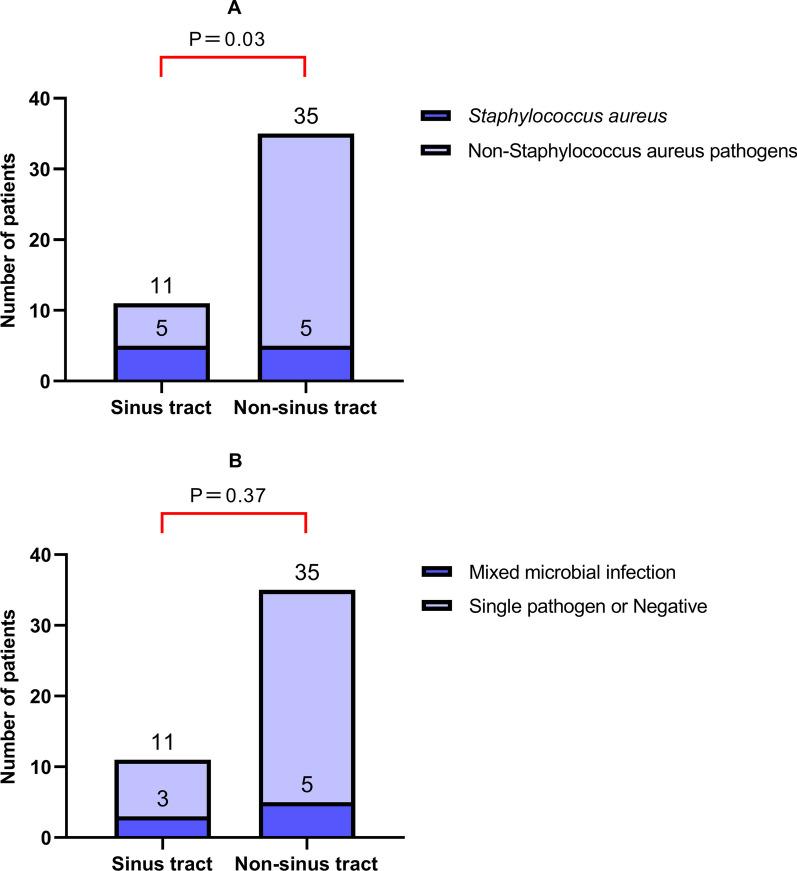
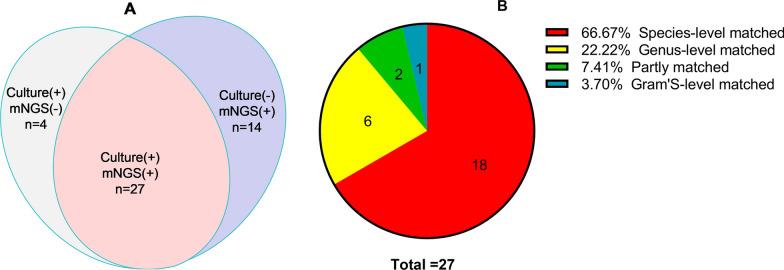
mNGS exhibited a sensitivity of 89.13%, a specificity of 94.74%, a positive predictive value of 97.62%, a negative predictive value of 78.26%, and an overall diagnostic accuracy of 90.77%. Compared to microbial culture, mNGS demonstrated superior diagnostic sensitivity while maintaining similar specificity. A total of 48 pathogens were successfully identified using mNGS, with Coagulase-negative staphylococci, Streptococci, Staphylococcus aureus, and Cutibacterium acnes being the most common infectious agents. Notably, mNGS was used to identify 17 potential pathogens in 14 culture-negative PJI samples, highlighting its ability to detect rare infectious agents, including Cutibacterium acnes (n = 5), Granulicatella adiacens (n = 1), Mycobacterium tuberculosis complex (n = 1), and Coxiella burnetii (n = 1), among others, which are not detectable by routine culture methods. However, mNGS failed to detect the pathogen in 4 culture-positive PJI patients, indicating its limitations. Among the 46 PJI patients, 27 had positive culture and mNGS results. The results of mNGS were concordant with those of culture at the genus level in 6 patients with PJI and at the species level in 18 patients. Furthermore, the present study revealed a significantly greater proportion of Staphylococcus aureus in the sinus tract group (45.45%) than in the non-sinus tract group (14.29%), indicating the association of this pathogen with sinus formation in PJI (P = 0.03). Additionally, there was no significant difference in the occurrence of polymicrobial infections between the sinus tract group (27.27%) and the non-sinus tract group (33.33%) (P = 0.37).
CONCLUSIONS
Metagenomic next-generation sequencing can serve as a valuable screening tool in addition to traditional culture methods to improve diagnostic accuracy through optimized culture strategies.
背景
本研究旨在评估宏基因组下一代测序(mNGS)技术在识别假体周围关节感染(PJI)病原体中的应用。
方法
对 2020 年 4 月至 2023 年 7 月间疑似患有 PJI 的 65 例患者进行回顾性分析。根据 2018 年国际共识会议标准,将患者分为 PJI(46 例)和非 PJI(19 例)组。收集临床数据,并进行常规细菌培养和 mNGS。比较两种方法的诊断性能并进行分析。
结果
mNGS 的灵敏度为 89.13%,特异性为 94.74%,阳性预测值为 97.62%,阴性预测值为 78.26%,总诊断准确性为 90.77%。与微生物培养相比,mNGS 具有更高的诊断敏感性,同时保持相似的特异性。mNGS 共成功鉴定出 48 种病原体,其中凝固酶阴性葡萄球菌、链球菌、金黄色葡萄球菌和痤疮丙酸杆菌是最常见的感染因子。值得注意的是,mNGS 在 14 例培养阴性的 PJI 样本中鉴定出 17 种潜在病原体,突显其检测罕见感染因子的能力,包括痤疮丙酸杆菌(n=5)、颗粒短杆菌(n=1)、结核分枝杆菌复合体(n=1)和伯氏考克斯体(n=1)等,这些病原体无法通过常规培养方法检测到。然而,mNGS 在 4 例培养阳性的 PJI 患者中未能检测到病原体,表明其存在局限性。在 46 例 PJI 患者中,27 例有阳性培养和 mNGS 结果。mNGS 的结果与 6 例 PJI 患者的属水平和 18 例患者的种水平的培养结果一致。此外,本研究还发现,窦道组金黄色葡萄球菌的比例(45.45%)显著高于非窦道组(14.29%),表明该病原体与 PJI 窦道形成有关(P=0.03)。此外,窦道组(27.27%)和非窦道组(33.33%)多微生物感染的发生率无显著差异(P=0.37)。
结论
宏基因组下一代测序可以作为传统培养方法的有益补充,通过优化培养策略提高诊断准确性。

 Zotero 插件