
中华猕猴桃根诱导肾癌细胞自噬和凋亡。
Radix Actinidiae chinensis induces the autophagy and apoptosis in renal cell carcinoma cells.
机构信息
College of Pharmaceutical Science, Zhejiang University of Technology, No. 18 Chaowang Rd, Gongshu District, Hangzhou, 310014, Zhejiang, China.
National Clinical Research Center for Geriatric Disorders, Xiangya Hospital, Central South University, Changsha, China.
出版信息
Eur J Med Res. 2024 May 19;29(1):291. doi: 10.1186/s40001-024-01881-w.
BACKGROUND
Renal cell carcinoma (RCC) is a malignant tumor. Radix Actinidiae chinensis (RAC) is the root of Actinidia arguta (Sieb. et Zucc) Planch. ex Miq. In clinical research, RAC was confirmed to have a certain anti-tumor effect, including liver cancer and cholangiocarcinoma. This study investigated the anticancer effect and mechanism of RAC in RCC cells.
METHODS
The 786-O and A498 cells were intervened with varying concentrations of RAC (0-100 mg/mL) to detect the half maximal inhibitory concentration (IC) of RAC. The cells were then co-cultured with 0-50 mg/mL RAC for 0-72 h to assess the effect of RAC on cell viability using the cell counting kit-8. The effects on cell proliferation, cell cycle or apoptosis, migration or invasion, and autophagy were detected using cloning, flow cytometry, Transwell, AOPI assay and Western blot. The number of autophagolysosomes was quantified using a transmission electron microscope. PI3K/AKT/mTOR pathway-related proteins were detected by Western blot. Additionally, an autophagy inhibitor 3-MA was used to explore the underlying mechanism of RAC.
RESULTS
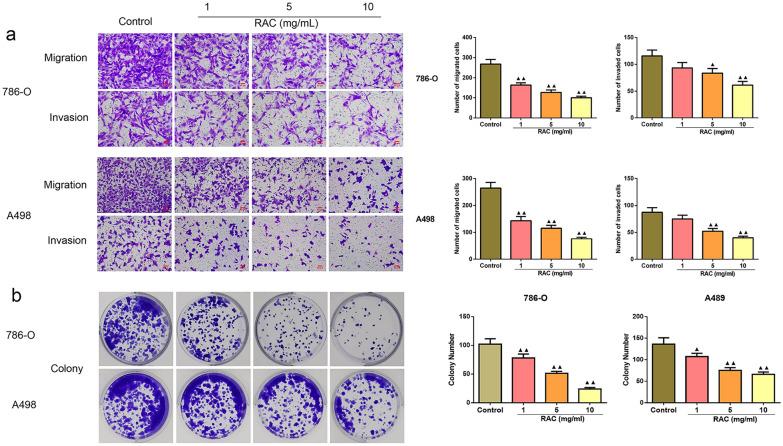
IC values of RAC in 786-O and A498 were 14.76 mg/mL and 13.09 mg/mL, respectively. RAC demonstrated the ability to reduce the cell malignant phenotype of RCC cells, blocked the S phase of cells, promoted apoptosis and autophagy in cells. Furthermore, RAC was observed to increase autophagy-related proteins LC3II/I and Beclin-1, while decreasing the level of P62. The expression of apoptosis-related proteins was increased, while the ratios of p-PI3K/PI3K, p-AKT/AKT, p-mTOR/mTOR, p-P38/P38 and p-ERK/ERK were reduced by RAC. However, the addition of 3-MA reduced the apoptosis and autophagy- promotion effects of RAC on RCC cells.
CONCLUSION
RAC induced the apoptosis and autophagy, to inhibit the progression of RCC cells. This study may provide a theoretical and experimental basis for clinical anti-cancer application of RAC for RCC.
背景
肾细胞癌(RCC)是一种恶性肿瘤。软枣猕猴桃(RAC)是软枣猕猴桃的根。在临床研究中,RAC 被证实具有一定的抗肿瘤作用,包括肝癌和胆管癌。本研究探讨了 RAC 在肾癌细胞中的抗癌作用及其机制。
方法
用不同浓度的 RAC(0-100mg/mL)干预 786-O 和 A498 细胞,检测 RAC 的半数抑制浓度(IC)。然后将细胞与 0-50mg/mL 的 RAC 共培养 0-72h,用细胞计数试剂盒-8 检测 RAC 对细胞活力的影响。用克隆、流式细胞术、Transwell、AOPI 测定和 Western blot 检测细胞增殖、细胞周期或凋亡、迁移或侵袭和自噬的影响。用透射电子显微镜定量自噬溶酶体的数量。用 Western blot 检测 PI3K/AKT/mTOR 通路相关蛋白。此外,还用自噬抑制剂 3-MA 探讨 RAC 的潜在机制。
结果
RAC 在 786-O 和 A498 中的 IC 值分别为 14.76mg/mL 和 13.09mg/mL。RAC 能够降低肾癌细胞的恶性表型,阻滞细胞 S 期,促进细胞凋亡和自噬。此外,RAC 观察到自噬相关蛋白 LC3II/I 和 Beclin-1 增加,而 P62 水平降低。凋亡相关蛋白表达增加,而 RAC 降低了 p-PI3K/PI3K、p-AKT/AKT、p-mTOR/mTOR、p-P38/P38 和 p-ERK/ERK 的比值。然而,加入 3-MA 降低了 RAC 对肾癌细胞的促凋亡和自噬作用。
结论
RAC 诱导细胞凋亡和自噬,抑制 RCC 细胞的进展。本研究可能为 RAC 临床应用于 RCC 提供理论和实验依据。




 Zotero 插件