
表面吸附与光致降解:用于从水中去除一种模型有机污染物的尖晶石铁氧体纳米材料的研究
Surface Adsorption and Photoinduced Degradation: A Study of Spinel Ferrite Nanomaterials for Removal of a Model Organic Pollutant from Water.
作者信息
Sanchez-Lievanos Karla R, Sun Tong, Gendrich Elise A, Knowles Kathryn E
机构信息
Department of Chemistry, University of Rochester, Rochester, New York 14627, United States.
出版信息
Chem Mater. 2024 Apr 24;36(9):3981-3998. doi: 10.1021/acs.chemmater.3c01986. eCollection 2024 May 14.
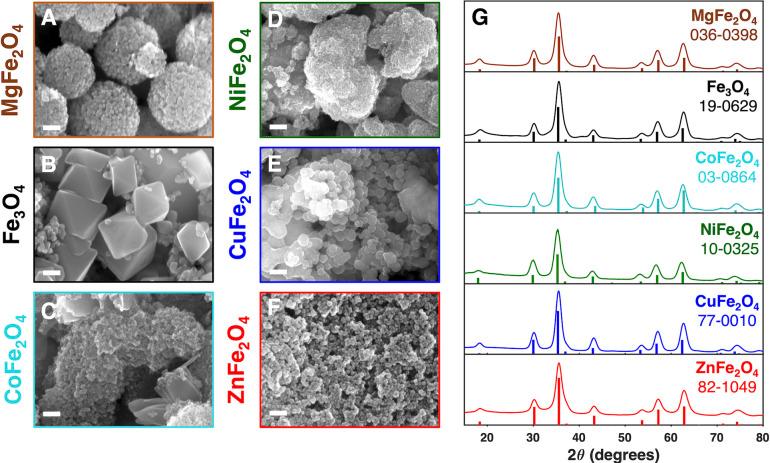
Spinel oxide nanocrystals are attractive materials for photoinduced advanced oxidation processes that degrade organic pollutants in water due to their chemical stability and tunability, visible light absorption, and magnetic recoverability. However, a systematic understanding of the structural and chemical factors that control the reactivity of specific spinel oxide nanocrystal materials toward photoinduced degradation processes is lacking. This Perspective illustrates these knowledge gaps through an investigation into the impacts of surface chemistry and composition of spinel ferrite nanocrystals of formula MFeO (M = Mg, Fe, Co, Ni, Cu, Zn) on their ability to remove a model organic pollutant (methyl orange (MO)) from water. We identify two mechanisms by which the nanocrystals remove MO from water: () surface adsorption and () photoinduced degradation under visible light irradiation in the presence of hydrogen peroxide via the photo-Fenton reaction. Nanocrystals that do not contain any surface ligands are more effective at removing MO from water than nanocrystals that contain surface ligands, despite our observation that the ligand-less nanocrystals do not form stable colloidal dispersions in water, while ligand-coated nanocrystals are colloidally stable. For many of the spinel ferrite compositions studied here, the fraction of methyl orange removal via adsorption to the nanocrystal surface in the absence of photoexcitation is larger than the fraction removed under irradiation. Our data indicate that the composition-dependent surface charge of the nanocrystals controls the degree of surface adsorption of the charged MO molecule. Overall, these results demonstrate that careful consideration of the impacts of surface chemistry on the behavior of spinel ferrite nanocrystals is required to accurately assess and subsequently understand their activity toward the photoinduced degradation of organic molecules.
尖晶石氧化物纳米晶体因其化学稳定性、可调节性、可见光吸收能力和磁回收性,成为用于光诱导高级氧化过程以降解水中有机污染物的有吸引力的材料。然而,目前缺乏对控制特定尖晶石氧化物纳米晶体材料对光诱导降解过程反应活性的结构和化学因素的系统理解。本观点通过研究化学式为MFeO(M = Mg、Fe、Co、Ni、Cu、Zn)的尖晶石铁氧体纳米晶体的表面化学和组成对其从水中去除模型有机污染物(甲基橙(MO))能力的影响,阐述了这些知识空白。我们确定了纳米晶体从水中去除MO的两种机制:(i)表面吸附和(ii)在过氧化氢存在下通过光芬顿反应在可见光照射下的光诱导降解。不含任何表面配体的纳米晶体比含有表面配体的纳米晶体在从水中去除MO方面更有效,尽管我们观察到无配体纳米晶体在水中不会形成稳定的胶体分散体,而配体包覆的纳米晶体是胶体稳定的。对于此处研究的许多尖晶石铁氧体组成,在无光激发情况下通过吸附到纳米晶体表面去除的甲基橙比例大于照射下去除的比例。我们的数据表明,纳米晶体的组成依赖性表面电荷控制着带电荷的MO分子的表面吸附程度。总体而言,这些结果表明,要准确评估并随后理解尖晶石铁氧体纳米晶体对有机分子光诱导降解的活性,需要仔细考虑表面化学对其行为的影响。




 Zotero 插件