
合并或未合并心力衰竭的慢性肾脏病患者的高钾血症:一项意大利经济模型研究
Hyperkalemia in chronic kidney disease patients with and without heart failure: an Italian economic modelling study.
作者信息
Stawowczyk Ewa, Ward Thomas, Paoletti Ernesto, Senni Michele, de Arellano Antonio Ramirez
机构信息
Health Economics and Outcomes Research Ltd, Cardiff, UK.
Health Economics Group, College of Medicine and Health, University of Exeter, Exeter, UK.
出版信息
Cost Eff Resour Alloc. 2024 May 21;22(1):42. doi: 10.1186/s12962-024-00547-y.
BACKGROUND
Hyperkalemia (HK) is frequently present in chronic kidney disease (CKD). Risk factors for HK among CKD patients include comorbidities and renin-angiotensin-aldosterone system inhibitor (RAASi) treatment. Current standard of care (SoC) often necessitates RAASi down-titration or discontinuation, resulting in poorer cardiorenal outcomes, hospitalization and mortality. This study evaluates the cost-effectiveness of patiromer for HK in CKD patients with and without heart failure (HF) in an Italian setting.
METHODS
A lifetime Markov cohort model was developed based on OPAL-HK to assess the health economic impact of patiromer therapy in comparison to SoC after accounting for the effects of HK and RAASi use on clinical events. Outcomes included accumulated clinical events, number needed to treat (NNT) and the incremental cost-effectiveness ratio (ICER). Subgroup analysis was conducted in CKD patients with and without HF.
RESULTS
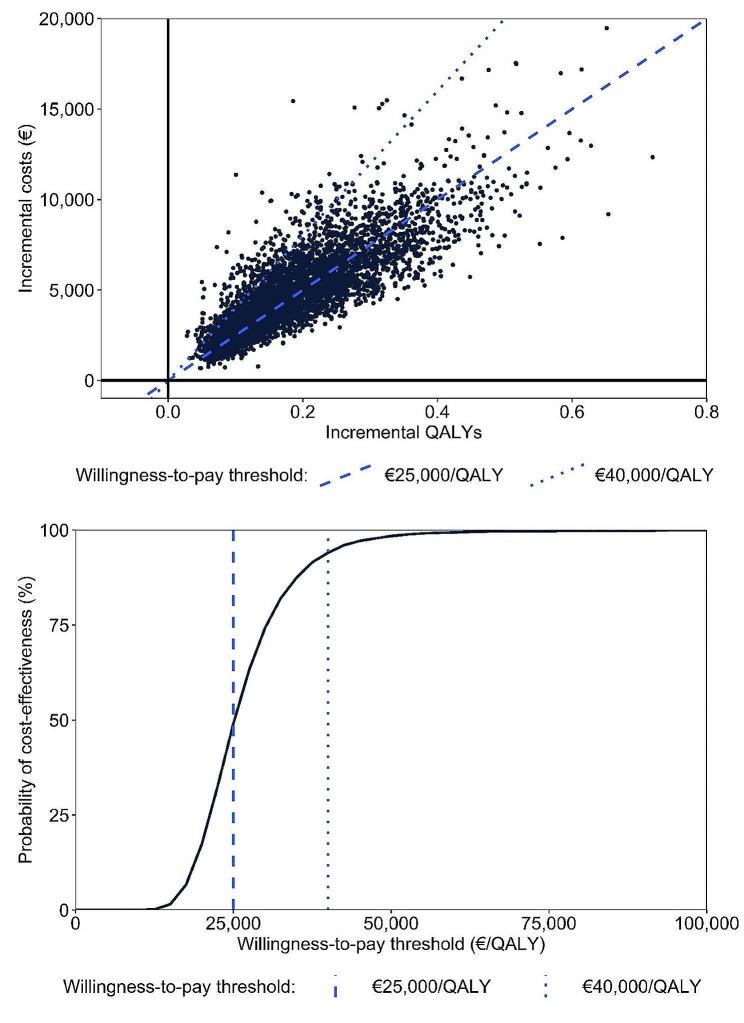
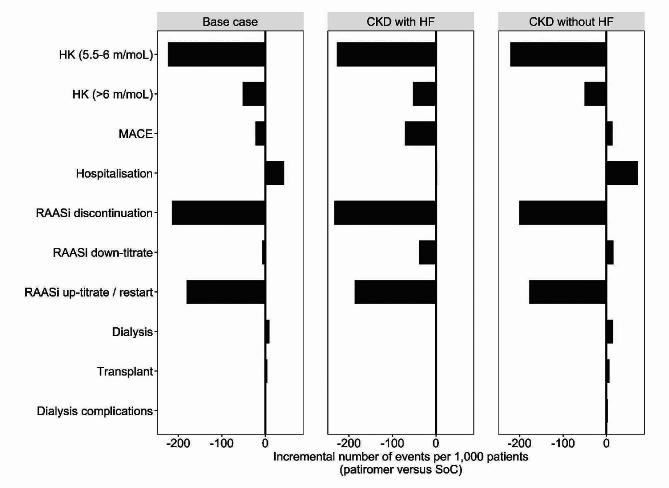
Patiromer was associated with an incremental discounted cost of €4,660 and 0.194 quality adjusted life years (QALYs), yielding an ICER of €24,004. Per 1000 patients, patiromer treatment prevented 275 moderate/severe HK events, 54 major adverse cardiovascular event, 246 RAASi discontinuation and 213 RAASi up-titration/restart. Subgroup analysis showed patiromer was more effective in preventing clinical events in CKD patients with HF compared to those without; QALY gains were greater in CKD patients without HF versus those with HF (0.267 versus 0.092, respectively). Scenario analysis and sensitivity analysis results support base-case conclusions.
CONCLUSION
Patiromer is associated with QALY gains in CKD patients with and without HF compared to SoC in Italy. Patiromer prevented HK events, enabled RAASi therapy maintenance and reduced cardiovascular event risk.
背景
高钾血症(HK)在慢性肾脏病(CKD)患者中很常见。CKD患者发生HK的危险因素包括合并症和肾素-血管紧张素-醛固酮系统抑制剂(RAASi)治疗。当前的护理标准(SoC)通常需要降低RAASi剂量或停药,这会导致更差的心脏肾脏结局、住院率和死亡率。本研究评估了在意大利背景下,帕替罗姆治疗CKD合并或不合并心力衰竭(HF)患者HK的成本效益。
方法
基于OPAL-HK建立了一个终身马尔可夫队列模型,以评估帕替罗姆治疗与SoC相比,在考虑HK和RAASi使用对临床事件的影响后,对健康经济的影响。结局包括累积临床事件、治疗所需人数(NNT)和增量成本效益比(ICER)。对合并和不合并HF的CKD患者进行亚组分析。
结果
帕替罗姆的增量贴现成本为4660欧元,质量调整生命年(QALY)为0.194,ICER为24004欧元。每1000例患者中,帕替罗姆治疗可预防275例中度/重度HK事件、54例主要不良心血管事件、246例RAASi停药和213例RAASi剂量增加/重新开始。亚组分析显示,与无HF的CKD患者相比,帕替罗姆在预防合并HF的CKD患者临床事件方面更有效;无HF的CKD患者的QALY增益大于合并HF的患者(分别为0.267和0.092)。情景分析和敏感性分析结果支持基础病例结论。
结论
在意大利,与SoC相比,帕替罗姆在合并和不合并HF的CKD患者中均可带来QALY增益。帕替罗姆可预防HK事件,维持RAASi治疗并降低心血管事件风险。
 Zotero 插件