
使卫生系统每年为 2500 多万例分娩服务:印度孕产妇和新生儿死亡率显著下降的驱动因素。
Making the health system work for over 25 million births annually: drivers of the notable decline in maternal and newborn mortality in India.
机构信息
National Health Systems Resource Centre, New Delhi, India.
International Institute for Population Sciences, Mumbai, Maharashtra, India.
出版信息
BMJ Glob Health. 2024 May 6;9(Suppl 2):e011411. doi: 10.1136/bmjgh-2022-011411.
INTRODUCTION
India's progress in reducing maternal and neonatal mortality since the 1990s was faster than the regional average. We systematically analysed how national health policies, services for maternal and newborn health, and socioeconomic contextual changes, drove these mortality reductions.
METHODS
The study's mixed-methods design integrated quantitative trend analyses of mortality, intervention coverage and equity since the 1990s, using the sample registration system and national surveys, with interpretive understandings from policy documents and 13 key informant interviews.
RESULTS
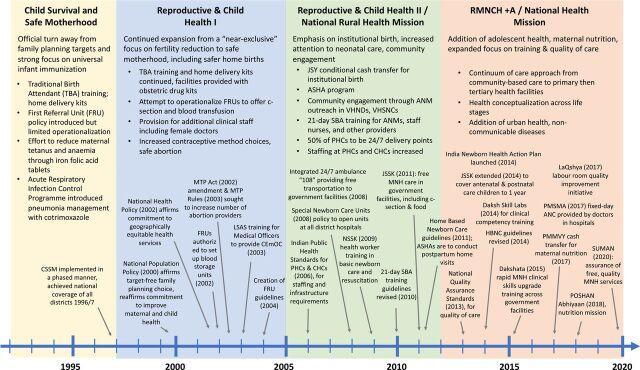
India's maternal mortality ratio (MMR) declined from 412 to 103 maternal deaths per 100 000 live births between 1997-1998 and 2017-2019. The neonatal mortality rate (NMR) declined from 46 to 22 per 1000 live births between 1997 and 2019. The average annual rate of mortality reduction increased over time. During this period, coverage of any antenatal care (57%-94%), quality antenatal care (37%-85%) and institutional delivery (34%-90%) increased, as did caesarean section rates among the poorest tertile (2%-9%); these coverage gains occurred primarily in the government (public) sector. The fastest rates for increasing coverage occurred during 2005-2012.The 2005-2012 National Rural Health Mission (which became the National Health Mission in 2012) catalysed bureaucratic innovations, additional resources, pro-poor commitments and accountability. These efforts occurred alongside smaller family sizes and improvements in macroeconomic growth, mobile and road networks, women's empowerment, and nutrition. These together reduced high-risk births and improved healthcare access, particularly among the poor.
CONCLUSION
Rapid reduction in NMR and MMR in India was accompanied by increased coverage of maternal and newborn health interventions. Government programmes strengthened public sector services, thereby expanding the reach of these interventions. Simultaneously, socioeconomic and demographic shifts led to fewer high-risk births. The study's integrated methodology is relevant for generating comprehensive knowledge to advance universal health coverage.
引言
自 20 世纪 90 年代以来,印度在降低母婴死亡率方面的进展速度快于该地区的平均水平。本研究系统分析了国家卫生政策、母婴健康服务以及社会经济背景变化如何推动这些死亡率的降低。
方法
该研究采用混合方法设计,综合分析了自 20 世纪 90 年代以来的死亡率、干预措施覆盖范围和公平性趋势,使用了样本登记系统和全国性调查,同时结合了政策文件和 13 次关键知情人访谈的解释性理解。
结果
印度的产妇死亡率从 1997-1998 年至 2017-2019 年期间的每 10 万活产儿 412 例降至 103 例;新生儿死亡率从 1997 年的每 1000 例活产儿 46 例降至 2019 年的 22 例。死亡率的年均下降速度随着时间的推移而增加。在此期间,任何产前护理(57%-94%)、优质产前护理(37%-85%)和机构分娩(34%-90%)的覆盖率增加,最贫困三分之一人群中剖宫产率(2%-9%)也有所增加;这些覆盖范围的增加主要发生在政府(公立)部门。2005-2012 年期间,覆盖率增长最快。2005-2012 年国家农村卫生使命(2012 年更名为国家卫生使命)催化了官僚机构的创新、额外资源、扶贫承诺和问责制。这些努力与较小的家庭规模以及宏观经济增长、移动和道路网络、妇女赋权和营养状况的改善同时发生,从而减少了高危分娩,并改善了医疗保健的可及性,特别是在贫困人口中。
结论
印度新生儿死亡率和产妇死亡率的快速下降伴随着母婴健康干预措施覆盖范围的扩大。政府计划加强了公共部门服务,从而扩大了这些干预措施的覆盖范围。与此同时,社会经济和人口结构的变化导致高危分娩减少。该研究综合的方法学对于产生全面的知识以推进全民健康覆盖具有重要意义。


 Zotero 插件