
口腔微生物群与结直肠癌的关系:一项系统综述。
Relationship between oral microbiota and colorectal cancer: A systematic review.
作者信息
Camañes-Gonzalvo Sara, Montiel-Company José María, Lobo-de-Mena Miriam, Safont-Aguilera María José, Fernández-Diaz Amaya, López-Roldán Andrés, Paredes-Gallardo Vanessa, Bellot-Arcís Carlos
机构信息
Department of Stomatology, Faculty of Medicine and Dentistry, University of Valencia, Valencia, Spain.
Medical Oncology Department, Consortium of the General University Hospital of Valencia, University of Valencia, Valencia, Spain.
出版信息
J Periodontal Res. 2024 Dec;59(6):1071-1082. doi: 10.1111/jre.13289. Epub 2024 May 22.
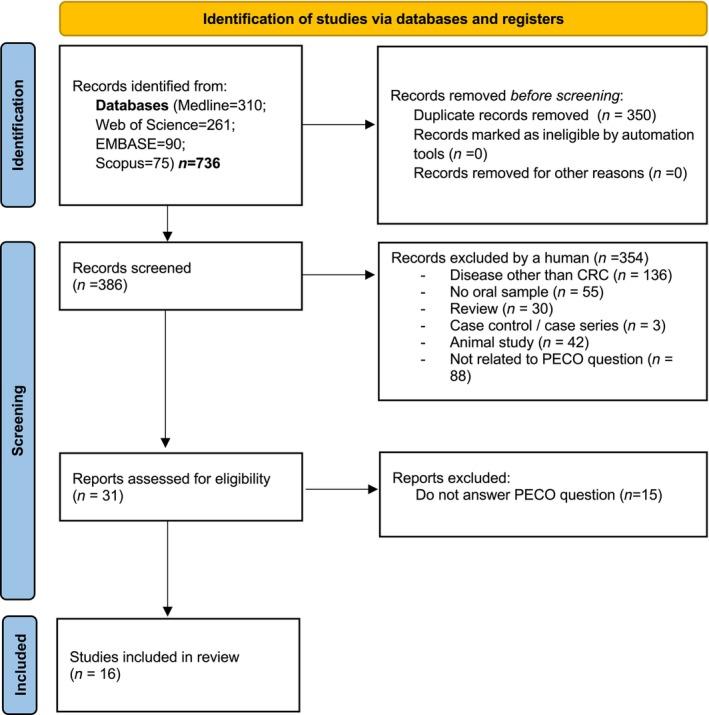
This systematic review aims to investigate the microbial basis underlying the association between oral microbiota and colorectal cancer. A comprehensive search was conducted across four databases, encompassing potentially relevant studies published up to April 2024 related to the PECO question: "Is there a differentiation in oral microbial composition between adult patients diagnosed with colorectal cancer compared to healthy patients?". The Newcastle-Ottawa Scale was used to evaluate the quality of the studies included. The level of evidence was assessed through the GRADE (Grading of Recommendations, Assessment, Development and Evaluation) tool. Sixteen studies fulfilled the eligibility criteria. Based on low to moderate evidence profile, high levels of certain subspecies within Firmicutes (such as Streptococcus anginosus, Peptostreptococcus stomatis, S. koreensis, and S. gallolyticus), Prevotella intermedia, Fusobacterium nucleatum, and Neisseria oralis were found to be associated with colorectal cancer. Conversely, certain bacteria (e.g., Lachnospiraceae, F. periodonticum, and P. melaninogenica) could exert a symbiotic protective effect against colorectal cancer. Based on existing evidence, it appears that variations in oral microbiota composition exist among individuals with and without colorectal cancer. However, further research is necessary to determine the mechanisms of oral dysbiosis in colorectal carcinogenesis.
本系统评价旨在探究口腔微生物群与结直肠癌之间关联的微生物学基础。我们在四个数据库中进行了全面检索,纳入了截至2024年4月发表的与PECO问题相关的潜在相关研究:“与健康患者相比,被诊断为结直肠癌的成年患者口腔微生物组成是否存在差异?”。使用纽卡斯尔-渥太华量表评估纳入研究的质量。通过GRADE(推荐分级、评估、制定和评价)工具评估证据水平。十六项研究符合纳入标准。基于低到中等的证据概况,发现厚壁菌门内某些亚种(如咽峡炎链球菌、口腔消化链球菌、韩国链球菌和解脲链球菌)、中间普雷沃菌、具核梭杆菌和口腔奈瑟菌的高水平与结直肠癌相关。相反,某些细菌(如毛螺菌科、牙周费氏菌和产黑色素普雷沃菌)可能对结直肠癌发挥共生保护作用。基于现有证据,结直肠癌患者和非结直肠癌患者的口腔微生物群组成似乎存在差异。然而,需要进一步研究以确定口腔生态失调在结直肠癌发生中的机制。
 Zotero 插件