
在行走过程中,活跃的胫骨截肢者和健康男性下肢关节间协调变异性。
Lower-extremity inter-joint coordination variability in active individuals with transtibial amputation and healthy males during gait.
机构信息
Department of Biomechanics and Sports Injuries, Faculty of Physical Education and Sports Sciences, Kharazmi University, Tehran, Iran.
Department of Sport Sciences, Faculty of Education and Psychology, Shiraz University, Shiraz, Iran.
出版信息
Sci Rep. 2024 May 22;14(1):11668. doi: 10.1038/s41598-024-62655-2.
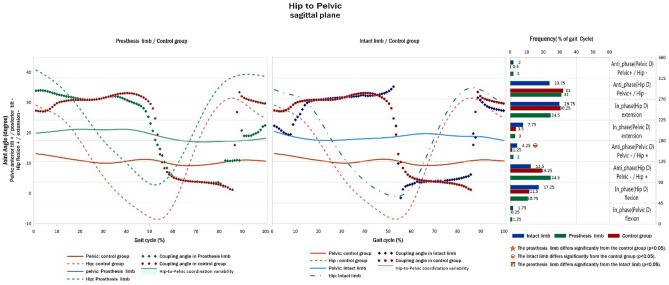
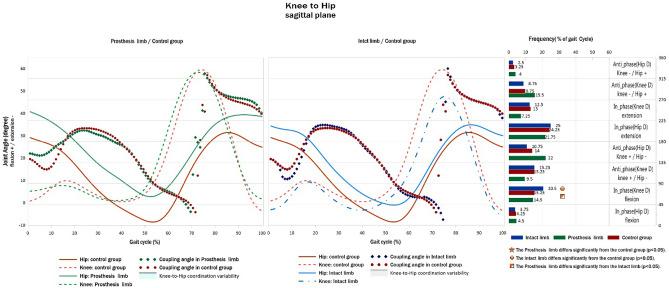
This study was aimed to compare the variability of inter-joint coordination in the lower-extremities during gait between active individuals with transtibial amputation (TTAs) and healthy individuals (HIs). Fifteen active male TTAs (age: 40.6 ± 16.24 years, height: 1.74 ± 0.09 m, and mass: 71.2 ± 8.87 kg) and HIs (age: 37.25 ± 13.11 years, height: 1.75 ± 0.06 m, and mass: 74 ± 8.75 kg) without gait disabilities voluntarily participated in the study. Participants walked along a level walkway covered with Vicon motion capture system, and their lower-extremity kinematics data were recorded during gait. The spatiotemporal gait parameters, lower-extremity joint range of motion (ROM), and their coordination and variability were calculated and averaged to report a single value for each parameter based on biomechanical symmetry assumption in the lower limbs of HIs. Additionally, these parameters were separately calculated and reported for the intact limb (IL) and the prosthesis limb (PL) in TTAs individuals. Finally, a comparison was made between the averaged values in HIs and those in the IL and PL of TTAs subjects. The results showed that the IL had a significantly lower stride length than that of the PL and averaged value in HIs, and the IL had a significantly lower knee ROM and greater stance-phase duration than that of HIs. Moreover, TTAs showed different coordination patterns in pelvis-to-hip, hip-to-knee, and hip-to-ankle couplings in some parts of the gait cycle. It concludes that the active TTAs with PLs walked with more flexion of the knee and hip, which may indicate a progressive walking strategy and the differences in coordination patterns suggest active TTA individuals used different neuromuscular control strategies to adapt to their amputation. Researchers can extend this work by investigating variations in these parameters across diverse patient populations, including different amputation etiologies and prosthetic designs. Moreover, Clinicians can use the findings to tailor rehabilitation programs for TTAs, emphasizing joint flexibility and coordination.
本研究旨在比较下肢在步态中关节间协调性的变异性,比较有活动能力的胫骨截肢者(TTAs)和健康个体(HIs)之间的差异。15 名活跃的男性 TTAs(年龄:40.6±16.24 岁,身高:1.74±0.09 米,体重:71.2±8.87 千克)和 HIs(年龄:37.25±13.11 岁,身高:1.75±0.06 米,体重:74±8.75 千克)没有步态障碍,自愿参加了这项研究。参与者沿着一个水平的走道行走,上面覆盖着 Vicon 运动捕捉系统,他们的下肢运动学数据在行走过程中被记录下来。步态的时空步态参数、下肢关节活动范围(ROM)以及它们的协调性和变异性被计算并平均化,根据 HIs 下肢的生物力学对称性假设,为每个参数报告一个单一的值。此外,在 TTAs 个体中,这些参数分别为完整肢体(IL)和假肢肢体(PL)进行了计算和报告。最后,将 HIs 的平均值与 TTAs 个体的 IL 和 PL 的平均值进行了比较。结果表明,IL 的步长明显低于 PL 和 HIs 的平均值,IL 的膝关节 ROM 明显低于 HIs,站立阶段持续时间明显更长。此外,TTAs 在步态周期的某些部分显示出骨盆到臀部、臀部到膝盖和臀部到脚踝耦合的不同协调模式。这表明,使用 PL 的活跃 TTAs 以更大的膝盖和臀部弯曲行走,这可能表明一种渐进的行走策略,协调模式的差异表明活跃的 TTA 个体使用不同的神经肌肉控制策略来适应他们的截肢。研究人员可以通过研究这些参数在不同患者群体中的变化来扩展这项工作,包括不同的截肢病因和假肢设计。此外,临床医生可以利用这些发现为 TTAs 定制康复计划,强调关节灵活性和协调性。



 Zotero 插件