
阿卡替尼联合维奈托克和利妥昔单抗治疗初治套细胞淋巴瘤:2 年安全性和疗效分析。
Acalabrutinib plus venetoclax and rituximab in treatment-naive mantle cell lymphoma: 2-year safety and efficacy analysis.
机构信息
Department of Lymphoma/Myeloma, Division of Cancer Medicine, MD Anderson Cancer Center, The University of Texas, Houston, TX.
Department of Hematology, Copernicus Memorial Hospital, Medical University of Lodz, Lodz, Poland.
出版信息
Blood Adv. 2024 Sep 10;8(17):4539-4548. doi: 10.1182/bloodadvances.2023012424.
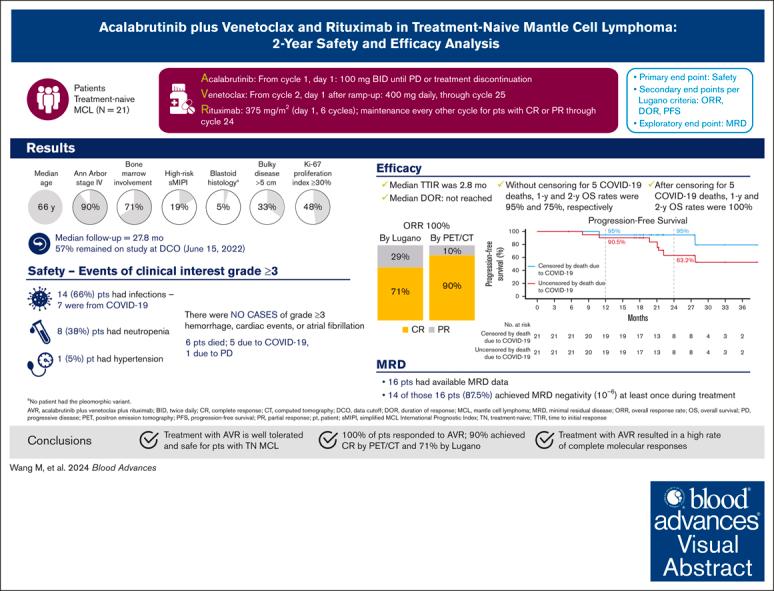
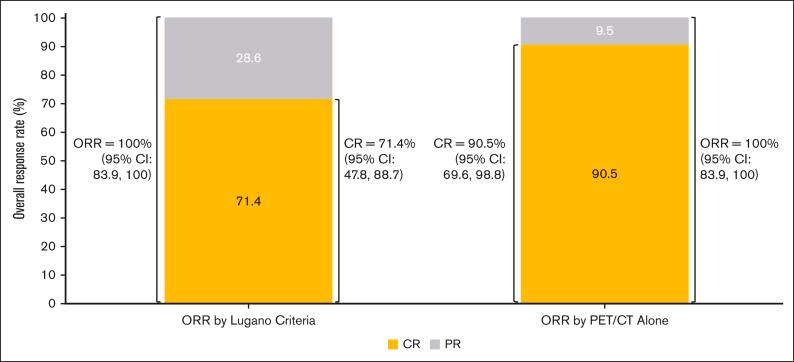
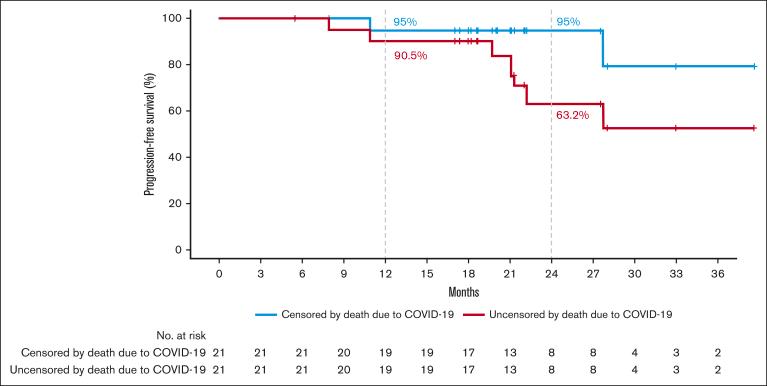
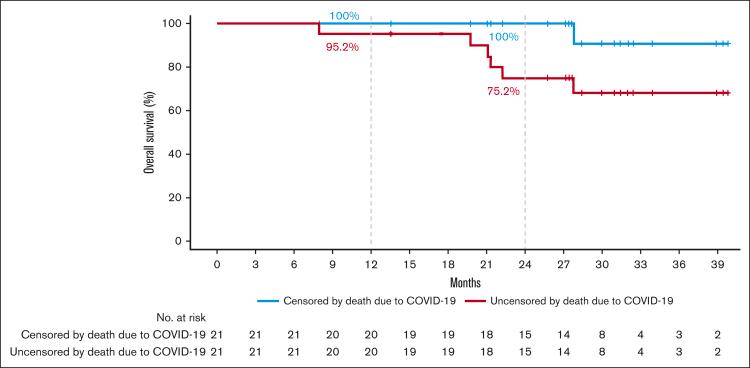
This phase 1b study evaluated safety and efficacy of acalabrutinib, venetoclax, and rituximab (AVR) in treatment-naive mantle cell lymphoma (TN MCL). Patients received acalabrutinib from cycle 1 until progressive disease (PD) or undue toxicity, rituximab for 6 cycles with maintenance every other cycle through cycle 24 or until PD, and venetoclax, beginning at cycle 2, for 24 cycles. Twenty-one patients were enrolled; 95.2% completed induction (6 AVR cycles) and 47.6% continued acalabrutinib maintenance. Thirteen (61.9%) patients had grade 3-4 adverse events (AEs), most commonly neutropenia (33.3%). Seven (33.3%) patients had COVID-19 infection (6 [28.6%] serious AEs and 5 [23.8%] deaths, all among unvaccinated patients). There was no grade ≥3 atrial fibrillation, ventricular tachyarrhythmias, major hemorrhages, or tumor lysis syndrome. Overall response rate (ORR) was 100% (95% CI, 83.9-100.0) with 71.4% complete response. With median follow-up of 27.8 months, median progression-free survival (PFS) and overall survival (OS) were not reached. PFS rates at 1 and 2 years were 90.5% (95% CI, 67.0-97.5) and 63.2% (95% CI, 34.7-82.0), respectively; both were 95% after censoring COVID-19 deaths. OS rates at 1 and 2 years were 95.2% (95% CI, 70.7-99.3) and 75.2% (95% CI, 50.3-88.9), respectively; both were 100% after censoring COVID-19 deaths. Overall, 87.5% of patients with available minimal residual disease (MRD) data achieved MRD negativity (10-6; next-generation sequencing) during treatment. AVR represents a chemotherapy-free regimen for TN MCL and resulted in high ORR and high rates of MRD negativity. The trial was registered at www.ClinicalTrials.gov as #NCT02717624.
这项 1b 期研究评估了阿卡替尼、维奈托克和利妥昔单抗(AVR)在初治套细胞淋巴瘤(TN MCL)患者中的安全性和疗效。患者在接受阿卡替尼治疗,直至疾病进展(PD)或毒性不可耐受,利妥昔单抗共 6 个周期,第 24 周期前每 2 个周期维持治疗,或直至 PD,维奈托克从第 2 周期开始,共 24 个周期。共入组 21 例患者,95.2%完成诱导治疗(6 个 AVR 周期),47.6%继续接受阿卡替尼维持治疗。13 例(61.9%)患者发生 3-4 级不良事件(AE),最常见的是中性粒细胞减少症(33.3%)。7 例(33.3%)患者发生 COVID-19 感染(6 例[28.6%]为严重 AE,5 例[23.8%]死亡,均发生在未接种疫苗的患者中)。无 3 级及以上心房颤动、室性心动过速/心搏过速、大出血或肿瘤溶解综合征。总缓解率(ORR)为 100%(95%CI,83.9-100.0),完全缓解率为 71.4%。中位随访 27.8 个月时,中位无进展生存期(PFS)和总生存期(OS)均未达到。1 年和 2 年时的 PFS 率分别为 90.5%(95%CI,67.0-97.5)和 63.2%(95%CI,34.7-82.0),均在剔除 COVID-19 死亡病例后为 95%;OS 率分别为 95.2%(95%CI,70.7-99.3)和 75.2%(95%CI,50.3-88.9),剔除 COVID-19 死亡病例后均为 100%。总体而言,87.5%有可评估最小残留病灶(MRD)数据的患者在治疗期间达到 MRD 阴性(10-6;下一代测序)。AVR 是一种初治套细胞淋巴瘤的无化疗方案,其 ORR 高,MRD 阴性率高。该研究在 ClinicalTrials.gov 上注册,编号为 #NCT02717624。



 Zotero 插件