
自动化工具和共识方法重建微生物群落代谢模型的比较分析。
Comparative analysis of metabolic models of microbial communities reconstructed from automated tools and consensus approaches.
机构信息
Bioinformatics Department, Institute of Biochemistry and Biology, University of Potsdam, Potsdam, Germany.
Systems Biology and Mathematical Modeling Group, Max Planck Institute of Molecular Plant Physiology, Potsdam, Germany.
出版信息
NPJ Syst Biol Appl. 2024 May 23;10(1):54. doi: 10.1038/s41540-024-00384-y.
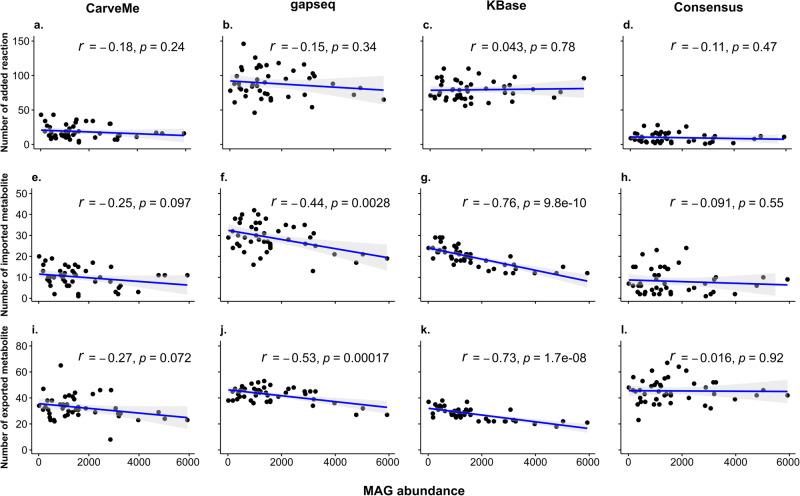
Genome-scale metabolic models (GEMs) of microbial communities offer valuable insights into the functional capabilities of their members and facilitate the exploration of microbial interactions. These models are generated using different automated reconstruction tools, each relying on different biochemical databases that may affect the conclusions drawn from the in silico analysis. One way to address this problem is to employ a consensus reconstruction method that combines the outcomes of different reconstruction tools. Here, we conducted a comparative analysis of community models reconstructed from three automated tools, i.e. CarveMe, gapseq, and KBase, alongside a consensus approach, utilizing metagenomics data from two marine bacterial communities. Our analysis revealed that these reconstruction approaches, while based on the same genomes, resulted in GEMs with varying numbers of genes and reactions as well as metabolic functionalities, attributed to the different databases employed. Further, our results indicated that the set of exchanged metabolites was more influenced by the reconstruction approach rather than the specific bacterial community investigated. This observation suggests a potential bias in predicting metabolite interactions using community GEMs. We also showed that consensus models encompassed a larger number of reactions and metabolites while concurrently reducing the presence of dead-end metabolites. Therefore, the usage of consensus models allows making full and unbiased use from aggregating genes from the different reconstructions in assessing the functional potential of microbial communities.
微生物群落的基因组规模代谢模型 (GEM) 为研究其成员的功能能力提供了有价值的见解,并促进了对微生物相互作用的探索。这些模型是使用不同的自动化重建工具生成的,每个工具都依赖于可能影响从计算机分析中得出的结论的不同生化数据库。解决此问题的一种方法是采用共识重建方法,该方法结合了不同重建工具的结果。在这里,我们利用来自两个海洋细菌群落的宏基因组数据,对三种自动化工具(即 CarveMe、gapseq 和 KBase)重建的群落模型以及共识方法进行了比较分析。我们的分析表明,这些重建方法虽然基于相同的基因组,但由于使用了不同的数据库,导致 GEM 具有不同数量的基因和反应以及代谢功能。此外,我们的结果表明,交换代谢物的集合更多地受到重建方法的影响,而不是特定的细菌群落的影响。这一观察结果表明,使用群落 GEM 预测代谢物相互作用可能存在潜在的偏差。我们还表明,共识模型包含更多的反应和代谢物,同时减少了死端代谢物的存在。因此,使用共识模型可以充分利用来自不同重建的基因,并在评估微生物群落的功能潜力时避免出现偏差。




 Zotero 插件