
南亚和北欧女性妊娠糖尿病后脂肪组织胰岛素抵抗情况
Adipose Tissue Insulin Resistance in South Asian and Nordic Women after Gestational Diabetes Mellitus.
作者信息
Kvist Ahalya Anita Suntharalingam, Sharma Archana, Sommer Christine, Qvigstad Elisabeth, Gulseth Hanne Løvdal, Sollid Stina Therese, Nermoen Ingrid, Sattar Naveed, Gill Jason, Tannæs Tone Møller, Birkeland Kåre Inge, Lee-Ødegård Sindre
机构信息
Institute of Clinical Medicine, University of Oslo, 0372 Oslo, Norway.
Department of Endocrinology, Morbid Obesity and Preventive Medicine, Oslo University Hospital, 0424 Oslo, Norway.
出版信息
Metabolites. 2024 May 18;14(5):288. doi: 10.3390/metabo14050288.
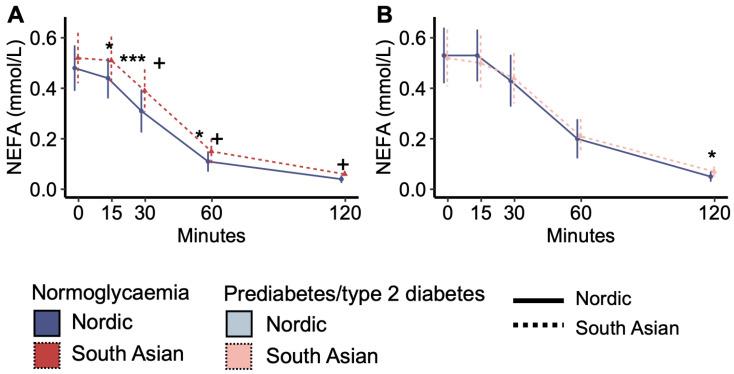
South Asians (SAs) have a higher risk of developing type 2 diabetes (T2D) than white Europeans, especially following gestational diabetes mellitus (GDM). Despite similar blood glucose levels post-GDM, SAs exhibit more insulin resistance (IR) than Nordics, though the underlying mechanisms are unclear. This study aimed to assess markers of adipose tissue (AT) IR and liver fat in SA and Nordic women post-GDM. A total of 179 SA and 108 Nordic women in Norway underwent oral glucose tolerance tests 1-3 years post-GDM. We measured metabolic markers and calculated the AT IR index and non-alcoholic fatty liver disease liver fat (NAFLD-LFS) scores. Results showed that normoglycaemic SAs had less non-esterified fatty acid (NEFA) suppression during the test, resembling prediabetes/T2D responses, and higher levels of plasma fetuin-A, CRP, and IL-6 but lower adiponectin, indicating AT inflammation. Furthermore, normoglycaemic SAs had higher NAFLD-LFS scores, lower insulin clearance, and higher peripheral insulin than Nordics, indicating increased AT IR, inflammation, and liver fat in SAs. Higher liver fat markers significantly contributed to the ethnic disparities in glucose metabolism, suggesting a key area for intervention to reduce T2D risk post-GDM in SAs.
南亚人(SAs)患2型糖尿病(T2D)的风险高于欧洲白人,尤其是在妊娠期糖尿病(GDM)之后。尽管GDM后血糖水平相似,但南亚人比北欧人表现出更多的胰岛素抵抗(IR),但其潜在机制尚不清楚。本研究旨在评估GDM后南亚和北欧女性的脂肪组织(AT)IR和肝脏脂肪标志物。挪威共有179名南亚女性和108名北欧女性在GDM后1至3年接受了口服葡萄糖耐量试验。我们测量了代谢标志物,并计算了AT IR指数和非酒精性脂肪性肝病肝脏脂肪(NAFLD-LFS)评分。结果显示,血糖正常的南亚人在测试期间非酯化脂肪酸(NEFA)抑制较少,类似于糖尿病前期/T2D反应,血浆胎球蛋白-A、CRP和IL-6水平较高,但脂联素水平较低,表明存在AT炎症。此外,血糖正常的南亚人比北欧人具有更高的NAFLD-LFS评分、更低的胰岛素清除率和更高的外周胰岛素水平,表明南亚人的AT IR、炎症和肝脏脂肪增加。较高的肝脏脂肪标志物显著导致了葡萄糖代谢的种族差异,这表明这是降低南亚人GDM后T2D风险的一个关键干预领域。



 Zotero 插件