
断开 NALCN 的侧向窗孔会暴露出孔区的一个隐藏药物结合位点。
Unplugging lateral fenestrations of NALCN reveals a hidden drug binding site within the pore region.
机构信息
Department of Drug Design and Pharmacology, University of Copenhagen, Copenhagen 2100, Denmark.
Department of Biology, Temple University, Philadelphia, PA 19122.
出版信息
Proc Natl Acad Sci U S A. 2024 May 28;121(22):e2401591121. doi: 10.1073/pnas.2401591121. Epub 2024 May 24.
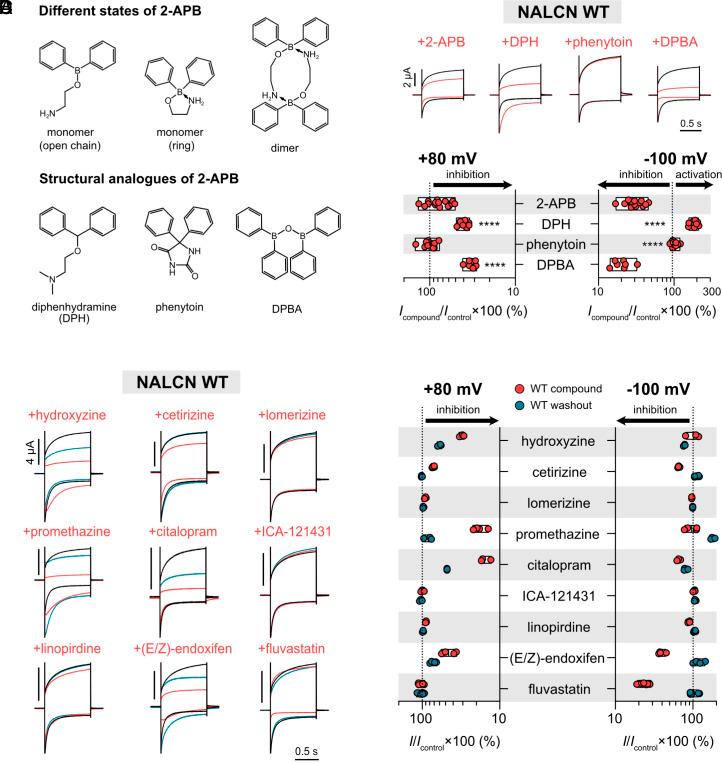
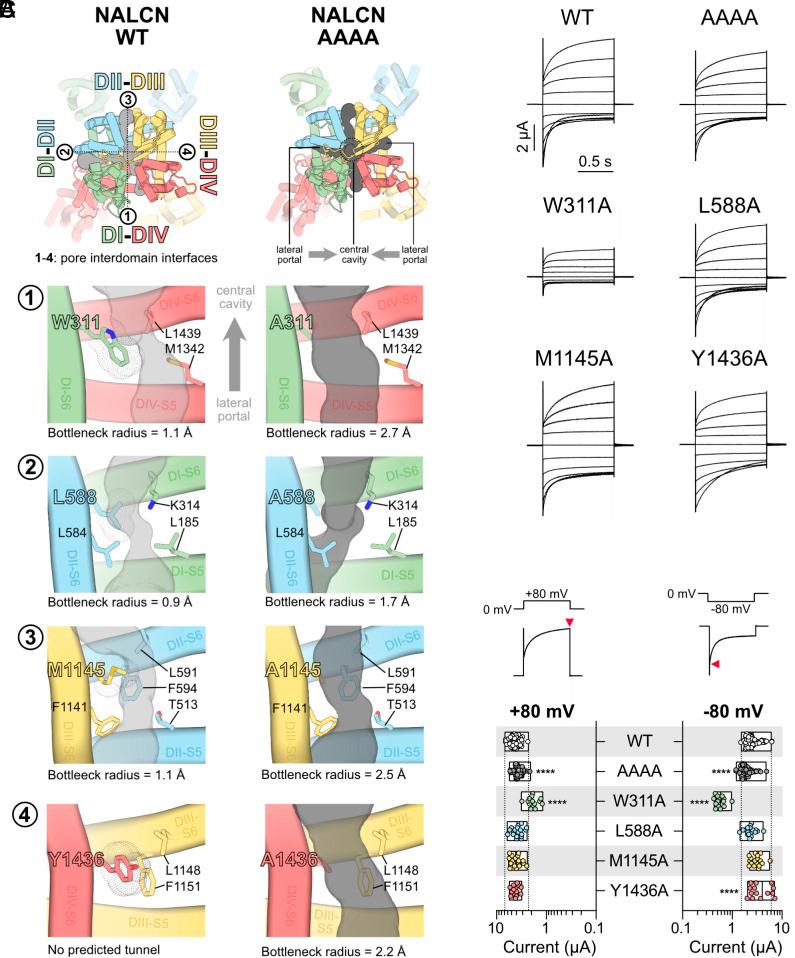
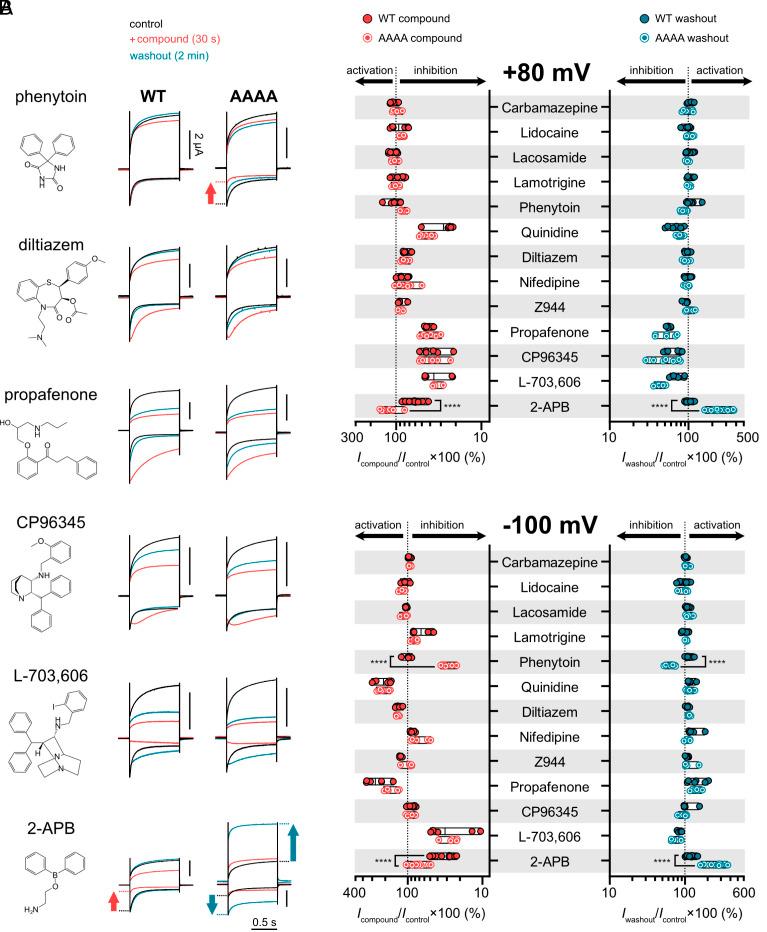
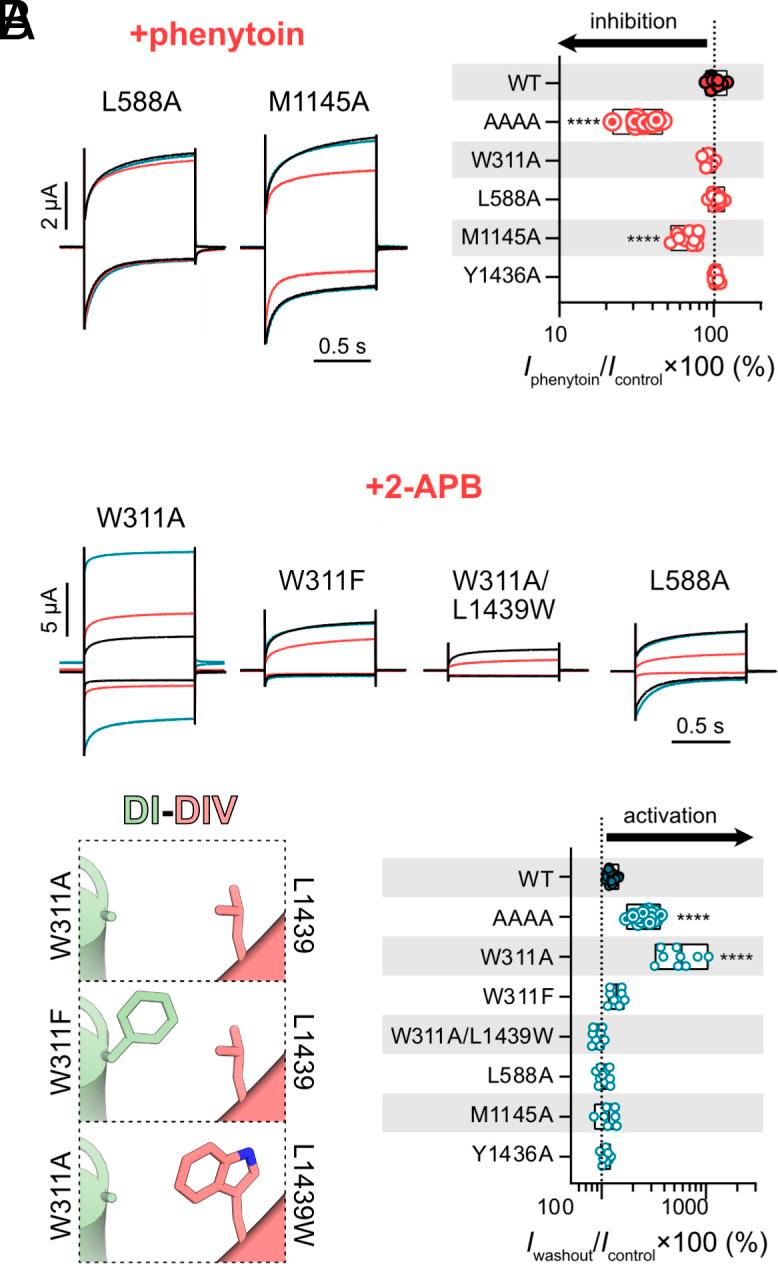
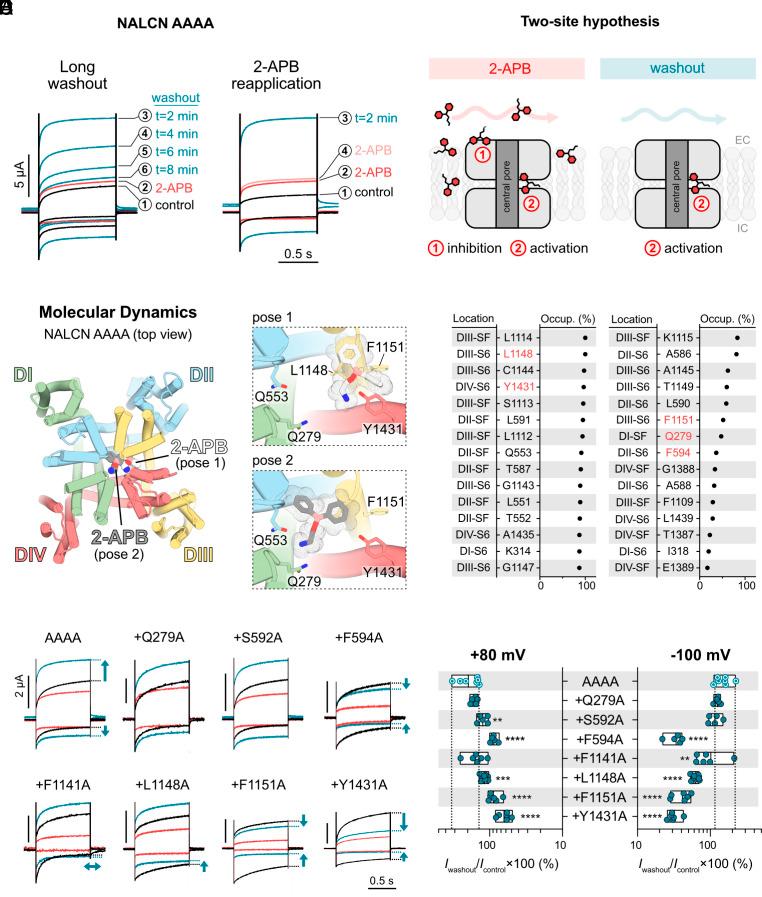
The sodium (Na) leak channel (NALCN) is a member of the four-domain voltage-gated cation channel family that includes the prototypical voltage-gated sodium and calcium channels (Nas and Cas, respectively). Unlike Nas and Cas, which have four lateral fenestrations that serve as routes for lipophilic compounds to enter the central cavity to modulate channel function, NALCN has bulky residues (W311, L588, M1145, and Y1436) that block these openings. Structural data suggest that occluded fenestrations underlie the pharmacological resistance of NALCN, but functional evidence is lacking. To test this hypothesis, we unplugged the fenestrations of NALCN by substituting the four aforementioned residues with alanine (AAAA) and compared the effects of Na, Ca, and NALCN blockers on both wild-type (WT) and AAAA channels. Most compounds behaved in a similar manner on both channels, but phenytoin and 2-aminoethoxydiphenyl borate (2-APB) elicited additional, distinct responses on AAAA channels. Further experiments using single alanine mutants revealed that phenytoin and 2-APB enter the inner cavity through distinct fenestrations, implying structural specificity to their modes of access. Using a combination of computational and functional approaches, we identified amino acid residues critical for 2-APB activity, supporting the existence of drug binding site(s) within the pore region. Intrigued by the activity of 2-APB and its analogues, we tested compounds containing the diphenylmethane/amine moiety on WT channels. We identified clinically used drugs that exhibited diverse activity, thus expanding the pharmacological toolbox for NALCN. While the low potencies of active compounds reiterate the pharmacological resistance of NALCN, our findings lay the foundation for rational drug design to develop NALCN modulators with refined properties.
钠(Na)泄漏通道(NALCN)是四域电压门控阳离子通道家族的成员,该家族包括原型电压门控钠和钙通道(Nas 和 Cas,分别)。与具有四个侧向窗孔的 Nas 和 Cas 不同,这些窗孔作为亲脂性化合物进入中央腔以调节通道功能的途径,NALCN 具有大的残基(W311、L588、M1145 和 Y1436),这些残基会阻止这些开口。结构数据表明,闭塞的窗孔是 NALCN 药理学抗性的基础,但缺乏功能证据。为了验证这一假说,我们通过用丙氨酸(AAAA)取代上述四个残基来阻塞 NALCN 的窗孔,并比较了 Na、Ca 和 NALCN 阻滞剂对 WT 和 AAAA 通道的影响。大多数化合物在两种通道上的行为相似,但苯妥英和 2-氨基乙氧基二苯硼酸盐(2-APB)在 AAAA 通道上引起了额外的、不同的反应。使用单个丙氨酸突变体的进一步实验表明,苯妥英和 2-APB 通过不同的窗孔进入内腔,这意味着它们进入的方式具有结构特异性。使用计算和功能方法的组合,我们确定了对 2-APB 活性至关重要的氨基酸残基,支持在孔区域存在药物结合位点。我们对 2-APB 及其类似物的活性感到好奇,因此在 WT 通道上测试了含有二苯甲烷/胺部分的化合物。我们鉴定了具有不同活性的临床使用药物,从而扩展了 NALCN 的药理学工具包。虽然活性化合物的低效力重申了 NALCN 的药理学抗性,但我们的发现为合理的药物设计奠定了基础,以开发具有精细特性的 NALCN 调节剂。
 Zotero 插件