
系统评价欧洲前列腺癌筛查的成本效益。
Systematic Review on the Cost Effectiveness of Prostate Cancer Screening in Europe.
机构信息
Department of Public Health and Primary Care, Ghent University, Ghent, Belgium.
Department of Public Health and Primary Care, Ghent University, Ghent, Belgium.
出版信息
Eur Urol. 2024 Nov;86(5):400-408. doi: 10.1016/j.eururo.2024.04.036. Epub 2024 May 23.
BACKGROUND AND OBJECTIVE
In Europe, prostate cancer (PCa) is the most common cancer in men. Screening may therefore be crucial to lower health care costs, morbidity, and mortality. This systematic review aimed to provide a contemporary overview of the costs and benefits of PCa screening programmes.
METHODS
A peer-reviewed literature search was conducted, using the PICO method. A detailed search strategy was developed in four databases based on the following key search terms: "PCa", "screening", and "cost effectiveness". Any type of economic evaluation was included. The search strategy was restricted to European countries, but no restrictions were set on the year of publication.
KEY FINDINGS AND LIMITATIONS
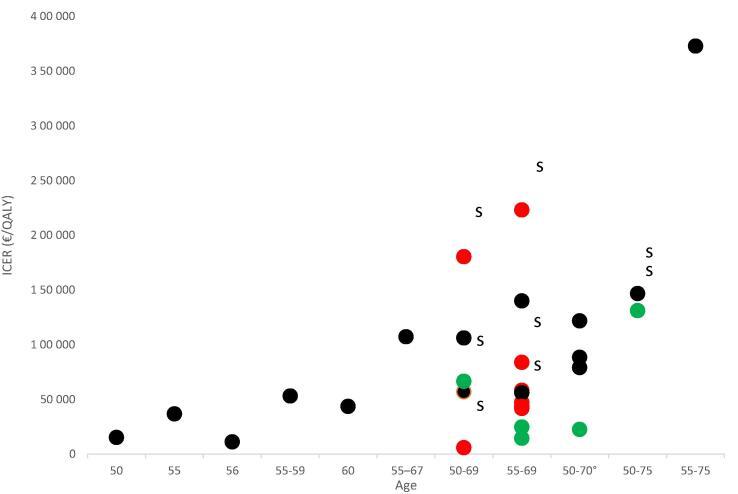
A total of 7484 studies were identified initially. Of these, 19 studies described the cost effectiveness of PCa screening in Europe. Among the studies using an initially healthy study population, most focussed on risk- and/or age- and/or magnetic resonance imaging (MRI)-based screening in addition to prostate-specific antigen (PSA) testing and compared this with no screening. Incremental cost ratios (ICERs) varied from €5872 per quality-adjusted life year (QALY) to €372 948/QALY, with a median of €56 487/QALY. Risk-based screening followed by MRI testing seemed to be a more cost-effective strategy than no screening.
CONCLUSIONS AND CLINICAL IMPLICATIONS
This systematic review indicates that screening programmes incorporating a risk-based approach and MRI have the potential to be cost effective.
PATIENT SUMMARY
In this review, we looked at the cost effectiveness of prostate cancer screening in Europe. We found that a risk-based approach and incorporation of magnetic resonance imaging has the potential to be cost effective. However, there remains a knowledge gap regarding cost effectiveness of prostate cancer screening. Therefore, determinants of cost effectiveness require further investigation.
背景与目的
在欧洲,前列腺癌(PCa)是男性最常见的癌症。因此,筛查可能对降低医疗保健成本、发病率和死亡率至关重要。本系统评价旨在提供 PCa 筛查计划的成本效益的最新概述。
方法
使用 PICO 方法进行了同行评审的文献检索。根据以下关键搜索词,在四个数据库中制定了详细的搜索策略:“PCa”、“筛查”和“成本效益”。包括任何类型的经济评估。搜索策略仅限于欧洲国家,但对出版物的年份没有限制。
主要发现和局限性
最初确定了 7484 项研究。其中,19 项研究描述了欧洲 PCa 筛查的成本效益。在使用最初健康的研究人群的研究中,大多数研究侧重于风险和/或年龄和/或磁共振成像(MRI)为基础的筛查,加上前列腺特异性抗原(PSA)检测,并将其与不筛查进行比较。增量成本比(ICER)从每质量调整生命年(QALY)5872 欧元到 372948 欧元/QALY 不等,中位数为 56487 欧元/QALY。风险筛查后进行 MRI 检测似乎比不筛查更具成本效益。
结论和临床意义
本系统评价表明,纳入风险评估方法和 MRI 的筛查计划具有成本效益。
患者总结
在这项研究中,我们研究了欧洲前列腺癌筛查的成本效益。我们发现,基于风险的方法和结合磁共振成像具有成本效益的潜力。然而,关于前列腺癌筛查的成本效益仍存在知识空白。因此,成本效益的决定因素需要进一步研究。

 Zotero 插件