
中国新疆部分地区对畜禽构成主要威胁的[病原体名称]的流行病学、毒力及抗生素耐药性分析 。(注:原文中“,”处应补充具体病原体名称)
Epidemiological, Virulence, and Antibiotic Resistance Analysis of , a Major Source of Threat to Livestock and Poultry in Some Regions of Xinjiang, China.
作者信息
Hou Gongmingzhu, Ahmad Sajjad, Li Yanfang, Yan Duo, Yang Shuhan, Chen Siqi, Qiu Zhengqing, Yu Xingyu, Li Nana, Li Yang, Liang Yan, Leng Qingwen, Qu Yonggang
机构信息
College of Animal Science and Technology, Shihezi University, Shihezi 832003, China.
出版信息
Animals (Basel). 2024 May 10;14(10):1433. doi: 10.3390/ani14101433.
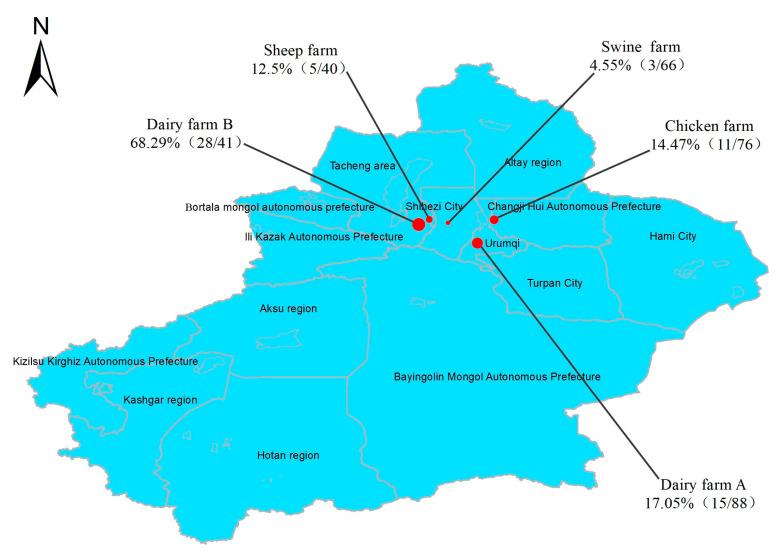
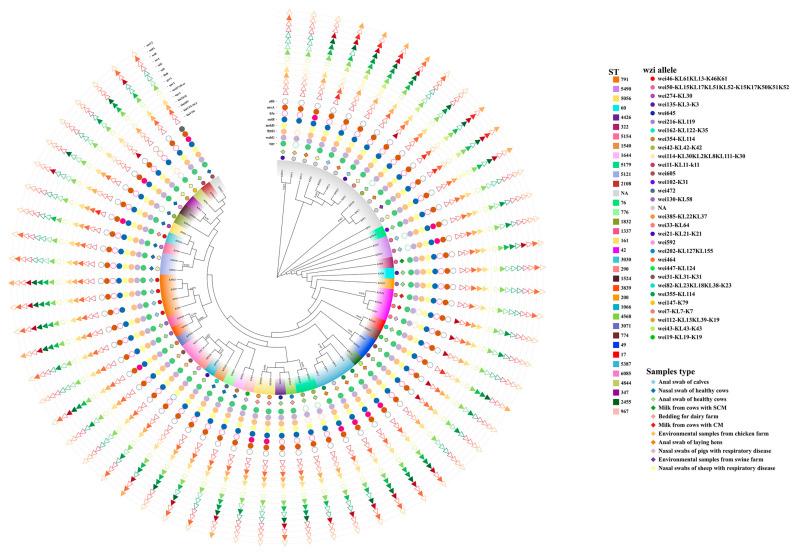
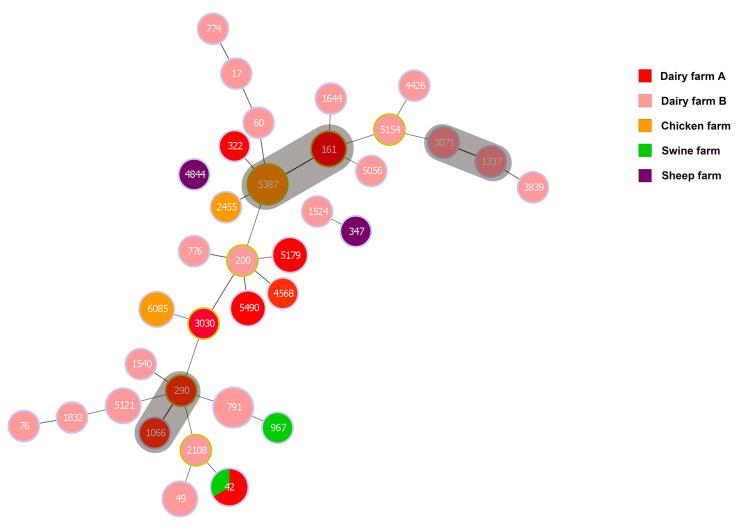
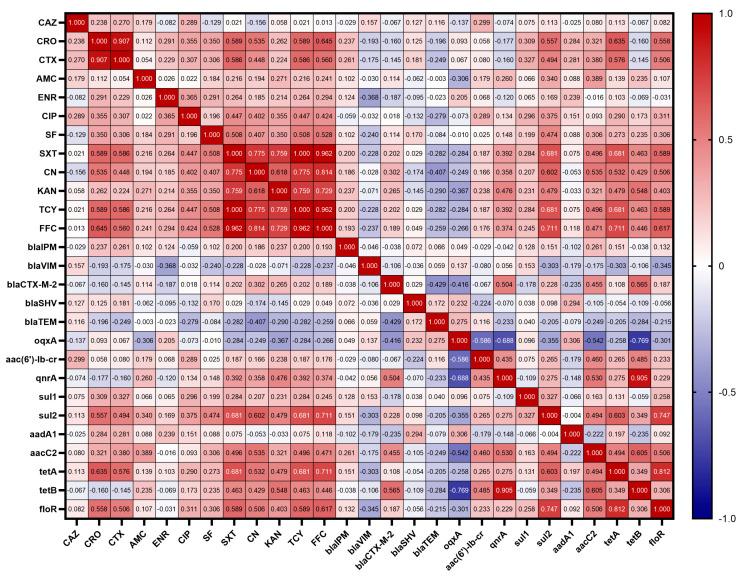
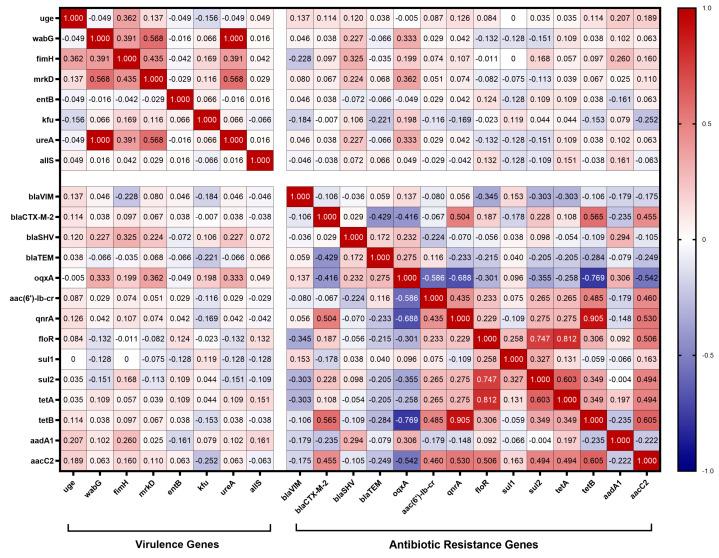
() is recognized as a zoonotic pathogen with an increasing threat to livestock and poultry. However, research on of animal origin remains limited. To address the gap, a comprehensive investigation was carried out by collecting a total of 311 samples from the farms of four animal species (dairy cow, chicken, sheep, and pig) in selected areas of Xinjiang, China. Isolates were identified by gene amplification and 16S rRNA gene sequencing. Genotyping of isolates was performed using typing and multilocus sequence typing (MLST). PCR was employed to identify virulence and resistance genes. An antibiotic susceptibility test was conducted using the Kirby-Bauer method. The findings revealed an isolation of 62 strains, with an average isolation rate of 19.94%, with the highest proportion originating from cattle sources (33.33%). Over 85.00% of these isolates harbored six virulence genes ( and ); while more than 75.00% of isolates possessed four resistance genes (, and ). All isolates exhibited complete resistance to ampicillin and demonstrated substantial resistance to sulfisoxazole, amoxicillin/clavulanic acid, and enrofloxacin, with an antibiotic resistance rate of more than 50%. Furthermore, 48.39% (30/62) of isolates were classified as multidrug-resistant (MDR) strains, with a significantly higher isolation rate observed in the swine farms (66.67%) compared to other farms. Genetic characterization revealed the classification of the 62 isolates into 30 distinct allele types or 35 different sequence types (STs). Notably, we identified strains of dairy and swine origin belonging to the same ST42 and wzi33-KL64 types, as well as strains of dairy and chicken origin belonging to the same wzi31-KL31-K31 type. These findings emphasize the widespread occurrence of drug-resistant across diverse animal sources in Xinjiang, underscoring the high prevalence of multidrug resistance. Additionally, our results suggest the potential for animal-to-animal transmission of and there was a correlation between virulence genes and antibiotic resistance genes. Moreover, the current study provides valuable data on the prevalence, antibiotic resistance, and genetic diversity of originating from diverse animal sources in Xinjiang, China.
(某病原体)被认为是一种人畜共患病原体,对畜禽的威胁日益增加。然而,关于动物源性该病原体的研究仍然有限。为填补这一空白,在中国新疆选定地区,从四种动物(奶牛、鸡、羊和猪)养殖场共采集了311份样本,进行了全面调查。通过该病原体基因扩增和16S rRNA基因测序鉴定分离株。使用该病原体分型和多位点序列分型(MLST)对分离株进行基因分型。采用聚合酶链反应(PCR)鉴定毒力和耐药基因。使用 Kirby-Bauer 法进行抗生素敏感性试验。研究结果显示分离出62株该病原体菌株,平均分离率为19.94%,其中比例最高的来自牛源(33.33%)。超过85.00%的这些分离株携带六个毒力基因(和);而超过75.00%的分离株拥有四个耐药基因(、和)。所有分离株对氨苄西林均表现出完全耐药,对磺胺异恶唑、阿莫西林/克拉维酸和恩诺沙星表现出高度耐药,抗生素耐药率超过50%。此外,48.39%(30/62)的分离株被归类为多重耐药(MDR)菌株,与其他养殖场相比,猪场的分离率显著更高(66.67%)。基因特征分析显示,62株分离株被分为30种不同的该病原体等位基因类型或35种不同的序列类型(STs)。值得注意的是,我们鉴定出奶牛和猪源的菌株属于相同的ST42和wzi33-KL64类型,以及奶牛和鸡源的菌株属于相同的wzi31-KL31-K31类型。这些发现强调了新疆不同动物源中耐药该病原体的广泛存在,凸显了多重耐药的高流行率。此外,我们的结果表明该病原体存在动物间传播的可能性,并且毒力基因和抗生素耐药基因之间存在相关性。此外,本研究为中国新疆不同动物源该病原体的流行率、抗生素耐药性和遗传多样性提供了有价值的数据。


 Zotero 插件