
体力活动、呼气峰值流量与衰老认知功能的关系:一项横断面分析。
Association between physical activity, peak expiratory flow, and cognitive function in aging: a cross-sectional analysis.
机构信息
Department of Geriatrics, Jilin Geriatrics Clinical Research Center, The First Hospital of Jilin University, Changchun, 130021, China.
School of Education, Changchun Normal University, Changchun, China.
出版信息
BMC Geriatr. 2024 May 26;24(1):460. doi: 10.1186/s12877-024-05080-4.
BACKGROUND
The aging global population is experiencing escalating challenges related to cognitive deficits and dementia. This study explored the interplay between pulmonary function, physical activity, and cognitive function in older U.S. adults to identify modifiable risk factors for cognitive decline.
METHODS
Utilizing NHANES 2011-2012 data, we conducted a cross-sectional analysis of 729 participants aged ≥ 60 years. Cognitive function, peak expiratory flow (PEF), and physical activity were assessed. Weighted logistic regression and mediation analyses were employed to examine associations.
RESULTS
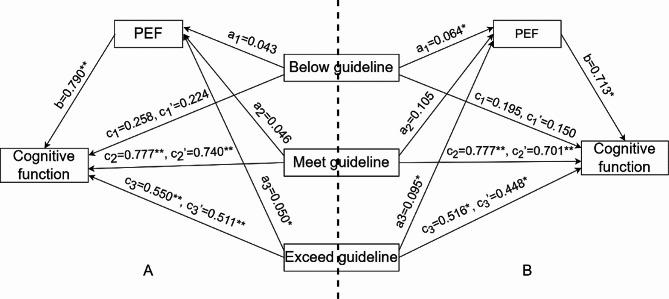
The sample size was 729 (weighted mean [SD] age, 67.1 [5.3] years; 53.6% female participants). Preliminary correlation analysis indicated a positive correlation between the global cognitive score and physical activity (β = 0.16; p < 0.001), recreational activity (β = 0.22; p < 0.001), and PEF in percent predicted (PEF%) (β = 0.18; p < 0.001). Compared to those with a PEF% >100%, the PEF% (80-100%) group (OR, 2.66; 95% CI, 1.34-5.29; p = 0.005) and PEF% <80% group (OR, 3.36; 95% CI, 1.67-6.76; p = 0.001) were significantly associated with higher cognitive deficits risk. Recreational activity meeting guidelines was linked to a lower risk of cognitive deficits (OR, 0.24; 95% CI, 0.10-0.57; p = 0.001). Mediation analysis demonstrated that PEF mediates the relationship between physical activity and cognitive function.
CONCLUSION
This study revealed significant associations between lower PEF, diminished physical activity, and increased cognitive deficits in elderly individuals. The results supported the hypothesis that pulmonary function may mediate the connection between activity and cognitive health, emphasizing the importance of respiratory health in cognitive aging. Recognizing these associations is crucial for clinical care and public health policy aiming to mitigate cognitive decline in aging populations. While these findings are intriguing, validation through longitudinal design studies is deemed necessary.
背景
全球人口老龄化带来了认知能力下降和痴呆症等问题的挑战。本研究旨在探讨美国老年人群中肺功能、身体活动与认知功能之间的相互关系,以确定认知能力下降的可改变风险因素。
方法
利用 2011-2012 年 NHANES 数据,我们对 729 名年龄≥60 岁的参与者进行了横断面分析。评估了认知功能、呼气峰流速(PEF)和身体活动。采用加权逻辑回归和中介分析来检验关联。
结果
样本量为 729 名(加权平均[SD]年龄 67.1[5.3]岁;53.6%为女性参与者)。初步相关性分析表明,全球认知评分与身体活动(β=0.16;p<0.001)、娱乐活动(β=0.22;p<0.001)和 PEF 占预计百分比(PEF%)(β=0.18;p<0.001)呈正相关。与 PEF%>100%的参与者相比,PEF%(80-100%)组(OR,2.66;95%CI,1.34-5.29;p=0.005)和 PEF%<80%组(OR,3.36;95%CI,1.67-6.76;p=0.001)患认知功能障碍的风险显著增加。达到娱乐活动指南的参与者患认知功能障碍的风险较低(OR,0.24;95%CI,0.10-0.57;p=0.001)。中介分析表明,PEF 介导了身体活动与认知功能之间的关系。
结论
本研究揭示了老年人中较低的 PEF、较少的身体活动与认知功能障碍之间的显著关联。结果支持了肺功能可能介导活动与认知健康之间关系的假设,强调了呼吸健康在认知老化中的重要性。认识到这些关联对于旨在减轻老年人群认知能力下降的临床护理和公共卫生政策至关重要。虽然这些发现很有吸引力,但需要通过纵向设计研究进行验证。
 Zotero 插件