
评估退伍军人健康管理局初级保健用户中患者体验的种族和民族差异的区域变化。
Evaluation of regional variation in racial and ethnic differences in patient experience among Veterans Health Administration primary care users.
机构信息
VA HSR Center for the Study of Healthcare Innovation, Implementation & Policy, VA Greater Los Angeles Healthcare System, Los Angeles, California, USA.
Division of General Internal Medicine and Health Services Research, UCLA David Geffen School of Medicine, Los Angeles, California, USA.
出版信息
Health Serv Res. 2024 Dec;59 Suppl 2(Suppl 2):e14328. doi: 10.1111/1475-6773.14328. Epub 2024 May 29.
OBJECTIVE
To evaluate racial and ethnic differences in patient experience among VA primary care users at the Veterans Integrated Service Network (VISN) level.
DATA SOURCE AND STUDY SETTING
We performed a secondary analysis of the VA Survey of Healthcare Experiences of Patients-Patient Centered Medical Home for fiscal years 2016-2019.
STUDY DESIGN
We compared 28 patient experience measures (six each in the domains of access and care coordination, 16 in the domain of person-centered care) between minoritized racial and ethnic groups (American Indian or Alaska Native [AIAN], Asian, Black, Hispanic, Multi-Race, Native Hawaiian or Other Pacific Islander [NHOPI]) and White Veterans. We used weighted logistic regression to test differences between minoritized and White Veterans, controlling for age and gender.
DATA COLLECTION/EXTRACTION METHODS: We defined meaningful difference as both statistically significant at two-tailed p < 0.05 with a relative difference ≥10% or ≤-10%. Within VISNs, we included tests of group differences with adequate power to detect meaningful relative differences from a minimum of five comparisons (domain agnostic) per VISN, and separately for a minimum of two for access and care coordination and four for person-centered care domains. We report differences as disparities/large disparities (relative difference ≥10%/≥ 25%), advantages (experience worse or better, respectively, than White patients), or equivalence.
PRINCIPAL FINDINGS
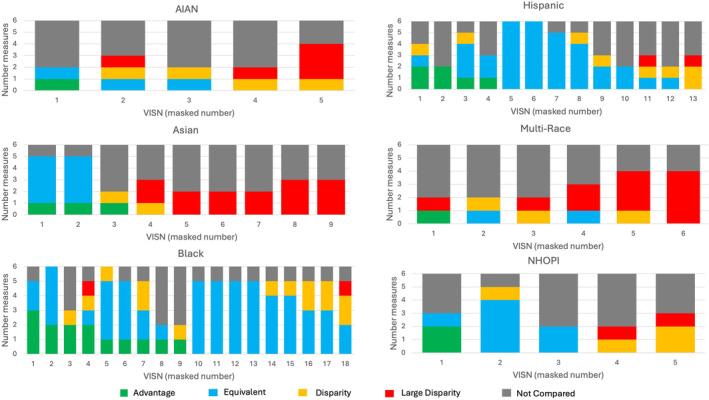
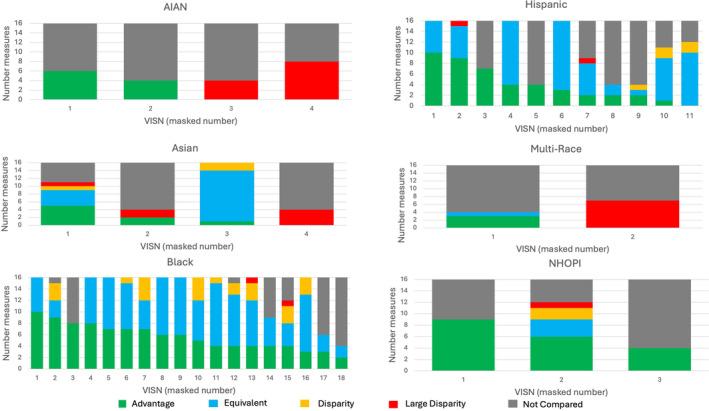
Our analytic sample included 1,038,212 Veterans (0.6% AIAN, 1.4% Asian, 16.9% Black, 7.4% Hispanic, 0.8% Multi-Race, 0.8% NHOPI, 67.7% White). Across VISNs, the greatest proportion of comparisons indicated disparities for three of seven eligible VISNs for AIAN, 6/10 for Asian, 3/4 for Multi-Race, and 2/6 for NHOPI Veterans. The plurality of comparisons indicated advantages or equivalence for 17/18 eligible VISNs for Black and 12/14 for Hispanic Veterans. AIAN, Asian, Multi-Race, and NHOPI groups had more comparisons indicating disparities by VISN in the access domain than person-centered care and care coordination.
CONCLUSIONS
We found meaningful differences in patient experience measures across VISNs for minoritized compared to White groups, especially for groups with lower population representation.
目标
评估退伍军人事务部(VA)初级保健用户在退伍军人综合服务网络(VISN)级别上的患者体验中的种族和民族差异。
数据来源和研究范围
我们对 2016 年至 2019 年财政年度的 VA 医疗体验调查-以患者为中心的医疗之家进行了二次分析。
研究设计
我们比较了少数民族(美洲印第安人或阿拉斯加原住民[AIAN]、亚裔、黑种人、西班牙裔、多种族、夏威夷原住民或其他太平洋岛民[NHOPI])和白种人退伍军人的 28 项患者体验指标(每个领域各有 6 项,包括获得和医疗协调、16 项以患者为中心的护理)。我们使用加权逻辑回归来测试少数民族和白种人退伍军人之间的差异,同时控制年龄和性别。
数据收集/提取方法:我们将统计学意义上的差异定义为双侧 p<0.05,且相对差异≥10%或≤-10%。在 VISN 内,我们对组间差异进行了检验,每个 VISN 至少有五个比较(不考虑领域)具有足够的能力来检测有意义的相对差异,而在获得和医疗协调领域至少有两个比较,在以人为中心的护理领域至少有四个比较。我们报告差异为差异/大差异(相对差异≥10%/≥25%)、优势(体验分别比白人患者差或好)或等效。
主要发现
我们的分析样本包括 1038212 名退伍军人(0.6%的 AIAN、1.4%的亚裔、16.9%的黑种人、7.4%的西班牙裔、0.8%的多种族、0.8%的 NHOPI、67.7%的白种人)。在 VISN 中,在七个符合条件的 VISN 中有三个表明 AIAN 退伍军人的大多数比较存在差异,在十个符合条件的 VISN 中有六个表明亚裔退伍军人的比较存在差异,在四个符合条件的 VISN 中有三个表明多种族退伍军人的比较存在差异,在六个符合条件的 VISN 中有两个表明 NHOPI 退伍军人的比较存在差异。在黑人退伍军人的 18 个符合条件的 VISN 中,大多数比较表明优势或等效,而在西班牙裔退伍军人的 14 个符合条件的 VISN 中,大多数比较表明优势或等效。在获得方面,与以人为中心的护理和医疗协调相比,AIAN、亚裔、多种族和 NHOPI 群体在 VISN 之间有更多表明差异的比较。
结论
我们发现少数民族群体与白人相比,在 VISN 上的患者体验指标存在有意义的差异,尤其是在人口代表性较低的群体中。

 Zotero 插件