
绿色生物合成金属纳米颗粒:生物学应用、优化及未来展望。
Green biologically synthesized metal nanoparticles: biological applications, optimizations and future prospects.
作者信息
Morgan Radwa N, Aboshanab Khaled M
机构信息
National Centre for Radiation Research & Technology (NCRRT), Drug Radiation Research Department, Egyptian Atomic Energy Authority (EAEA), Cairo, 11787, Egypt.
Microbiology & Immunology Department, Faculty of Pharmacy, Ain Shams University, Cairo, 11566, Egypt.
出版信息
Future Sci OA. 2024 May 15;10(1):FSO935. doi: 10.2144/fsoa-2023-0196. eCollection 2024.
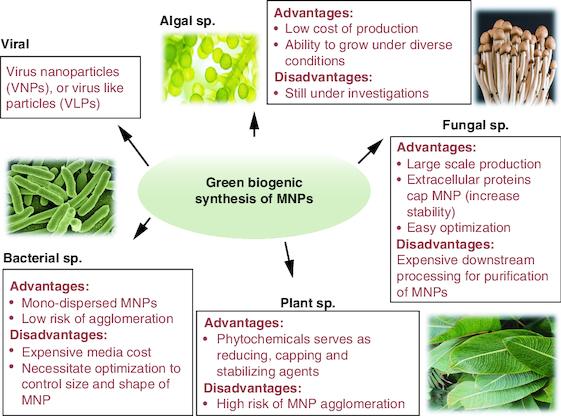
In green biological synthesis, metal nanoparticles are produced by plants or microorganisms. Since it is ecologically friendly, economically viable and sustainable, this method is preferable to other traditional ones. For their continuous groundbreaking advancements and myriad physiochemical and biological benefits, nanotechnologies have influenced various aspects of scientific fields. Metal nanoparticles (MNPs) are the field anchor for their outstanding optical, electrical and chemical capabilities that outperform their regular-sized counterparts. This review discusses the most current biosynthesized metal nanoparticles synthesized by various organisms and their biological applications along with the key elements involved in MNP green synthesis. The review is displayed in a manner that will impart assertiveness, help the researchers to open questions, and highlight many points for conducting future research.
在绿色生物合成中,金属纳米颗粒是由植物或微生物产生的。由于这种方法生态友好、经济可行且可持续,因此比其他传统方法更可取。纳米技术因其持续的开创性进展以及众多物理化学和生物学益处,已影响到科学领域的各个方面。金属纳米颗粒(MNPs)凭借其卓越的光学、电学和化学性能成为该领域的核心,这些性能优于其常规尺寸的对应物。本文综述了各种生物合成的最新金属纳米颗粒及其生物学应用,以及MNP绿色合成中涉及的关键要素。综述以一种能增强说服力的方式呈现,帮助研究人员提出问题,并突出许多未来研究的要点。


 Zotero 插件