
标准 care 嵌合抗原受体 T 细胞疗法治疗复发/难治性多发性骨髓瘤患者的骨外髓外疾病对结局的影响。
Impact of Extraosseous Extramedullary Disease on Outcomes of Patients with Relapsed-Refractory Multiple Myeloma receiving Standard-of-Care Chimeric Antigen Receptor T-Cell Therapy.
机构信息
Department of Hematology/Oncology, Cleveland Clinic, Taussig Cancer Institute, Cleveland, OH, USA.
US Myeloma Innovations Research Collaborative (USMIRC), Westwood, KS, USA.
出版信息
Blood Cancer J. 2024 May 31;14(1):90. doi: 10.1038/s41408-024-01068-w.
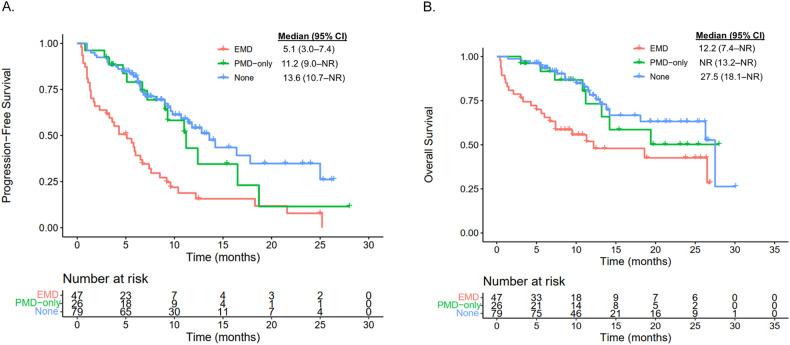
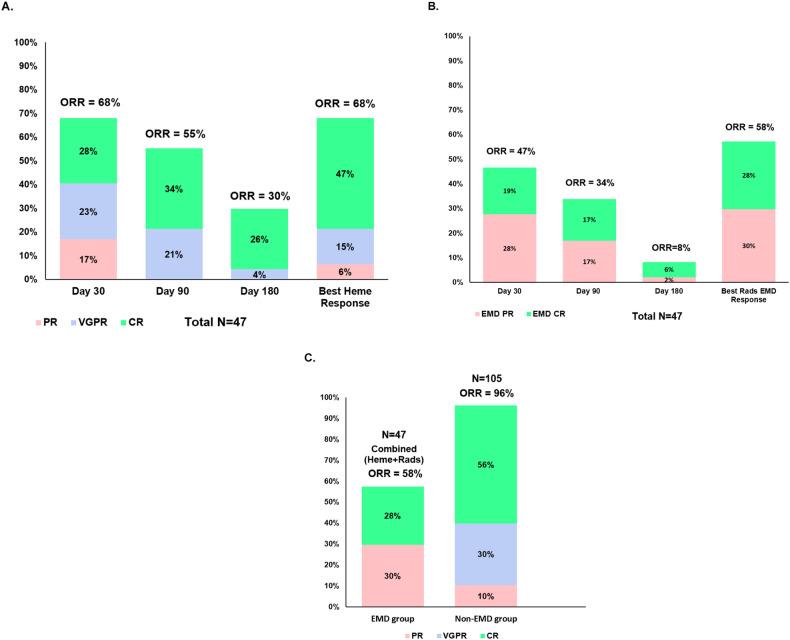
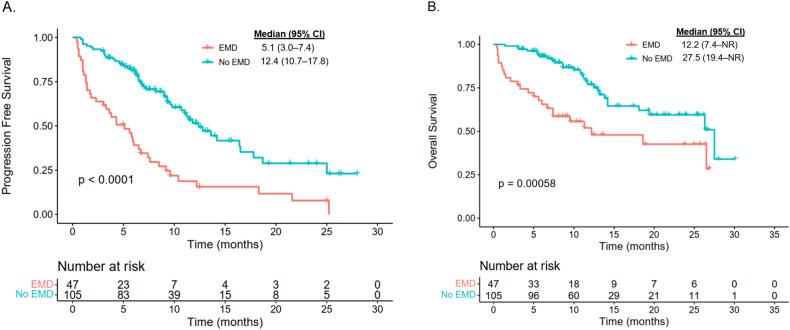
The presence of extramedullary disease (EMD) has been associated with poor outcomes in patients with relapsed-refractory multiple myeloma (RRMM). Herein, we report the outcomes of RRMM patients who were treated with standard-of-care (SOC) chimeric antigen receptor (CAR) T-cell therapy and had active extraosseous EMD before the infusion. Data were retrospectively collected from patients at three US institutions with the intent to receive SOC CAR T. Responses were assessed per the International Myeloma Working Group criteria. A total of 152 patients proceeded with infusion, of whom 47 (31%) had EMD (EMD group) and 105 (69%) did not (non-EMD group). Baseline patient characteristics were comparable between the two groups. The EMD group had a higher incidence of high-grade CRS, steroid and anakinra use, and thrombocytopenia on day +30 compared to the non-EMD group. In addition, the EMD group had an inferior overall response rate (58% vs 96%, p < 0.00001), median progression-free survival (PFS) (5.1 vs 12.4 months; p < 0.0001), and overall survival (OS) (12.2 vs 27.5 months; p = 0.00058) compared to the non-EMD group. We further subdivided the non-EMD patients into those with paramedullary disease (PMD-only group, n = 26 [17%]) and those with neither EMD nor PMD (bone marrow-contained group or BM-only group, n = 79 [52%]). Patients with PMD-only had similar median PFS (11.2 vs 13.6 months, p = 0.3798) and OS (not reached [NR] vs 27.5 months, p = 0.6446) compared to patients with BM-only disease. However, patients with EMD exhibited inferior median PFS (5.1 vs 13.6 months, p < 0.0001) and OS (12.2 vs 27.5, p = 0.0008) compared to patients in the BM-only group. Treatment with SOC CAR T yielded meaningful clinical outcomes in real-world RRMM patients with extraosseous EMD, though responses and survival outcomes were suboptimal compared to patients without EMD. The presence of only EMD but not PMD was associated with significantly worse survival outcomes following the CAR T infusion.
骨髓外疾病(EMD)的存在与复发性/难治性多发性骨髓瘤(RRMM)患者的不良预后相关。在此,我们报告了接受标准治疗(SOC)嵌合抗原受体(CAR)T 细胞治疗且输注前存在活动性骨外 EMD 的 RRMM 患者的结局。数据是从美国三个机构的患者中回顾性收集的,目的是接受 SOC CAR T 治疗。反应根据国际骨髓瘤工作组标准进行评估。共有 152 名患者进行了输注,其中 47 名(31%)有 EMD(EMD 组),105 名(69%)没有(非 EMD 组)。两组患者的基线特征相当。与非 EMD 组相比,EMD 组患者在第 30 天发生高级别 CRS、类固醇和阿那白滞素使用以及血小板减少症的发生率更高。此外,EMD 组的总缓解率(58% vs 96%,p<0.00001)、中位无进展生存期(PFS)(5.1 个月 vs 12.4 个月;p<0.0001)和总生存期(OS)(12.2 个月 vs 27.5 个月;p=0.00058)均低于非 EMD 组。我们进一步将非 EMD 患者分为骨髓旁疾病(仅 PMD 组,n=26[17%])和既无 EMD 也无 PMD(骨髓包含组或仅 BM 组,n=79[52%])。仅 PMD 患者的中位 PFS(11.2 个月 vs 13.6 个月,p=0.3798)和 OS(未达到[NR] vs 27.5 个月,p=0.6446)与仅 BM 疾病患者相似。然而,与仅 BM 疾病患者相比,EMD 患者的中位 PFS(5.1 个月 vs 13.6 个月,p<0.0001)和 OS(12.2 个月 vs 27.5 个月,p=0.0008)均较低。SOC CAR T 治疗在有骨外 EMD 的真实世界 RRMM 患者中产生了有意义的临床结果,但与无 EMD 患者相比,反应和生存结果并不理想。仅存在 EMD 而不存在 PMD 与 CAR T 输注后生存结局显著恶化相关。
 Zotero 插件